
I don’t spend much time on Instagram, but I like what the algorithm there sends me. My “dream world” is one where aesthetics and history merge, and that is definitely what I see on my Instagram feed.
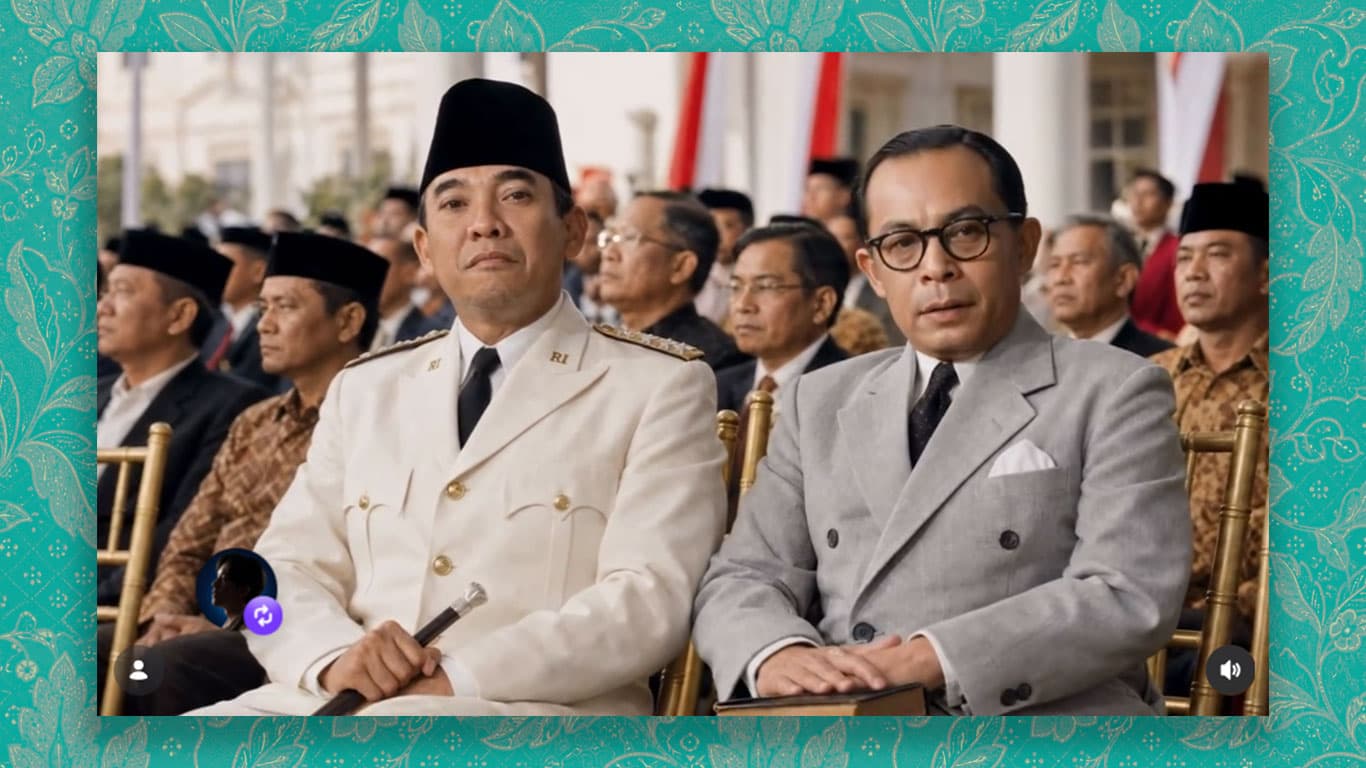
While most of what I see is more focused on retro vibes, I recently saw an AI video on Instagram that had a historical focus that I found extremely interesting. It is called “An Entrustment from Heroes” (Titipan Pahlawan).
The video is by an Indonesian creator named Brillian Fairiandi. What he did was to create a video of an imagined event where key figures from the founding of the modern nation of Indonesia were present. We see these famous people “looking at the camera” while the song “Tanah Airku” (My Homeland) plays.
“Tanah Airku” is a patriotic song written by Ibu Sud in 1927, but the version in the video is a recent recording by a young singer named Shanna Shannon, whose version has become a popular post-match song among Indonesian national-team supporters.
The people who appear in the video are the following:
Sukarno — Indonesia’s first president, who read the independence proclamation aloud on 17 August 1945 and led the country until 1967.
Mohammad Hatta — Sukarno’s co-proclaimer that same day and Indonesia’s first vice president, an economist by training and, unlike Sukarno, famously austere and allergic to self-mythologizing.
Sutan Sjahrir — Indonesia’s first prime minister (1945–1947), a socialist intellectual who had refused to collaborate with the Japanese occupation and later led negotiations with the returning Dutch on the young republic’s behalf; he eventually broke with Sukarno and died in exile.
Jenderal Soedirman — the republic’s first commander-in-chief, who led a seven-month guerrilla campaign against the returning Dutch military from a stretcher, already dying of tuberculosis, having sworn to defend the republic “until his last drop of blood.”
Fatmawati — Sukarno’s wife, remembered above all for having sewn the original red-and-white flag raised at the 1945 proclamation.
Sayuti Melik — the man who actually typed the proclamation text, on a borrowed German typewriter in the early hours of 17 August.
Bung Tomo (Sutomo) — a fiery radio orator whose broadcasts helped mobilize and sustain the Indonesian resistance in the Battle of Surabaya in November 1945, commemorated ever since as Indonesia’s Heroes’ Day.
Ki Hadjar Dewantara — founder of the Taman Siswa school movement and Indonesia’s first minister of education, still honored as the “Father of National Education,” his birthday now marked as National Education Day.
Teuku Umar — the chronological outlier of the group: an Acehnese guerrilla commander who spent the 1880s and 1890s twice feigning surrender to the Dutch in order to be armed and trusted by them, then turning those weapons back against them, before he was finally killed in 1899 — nearly half a century before anyone else in this video was proclaiming anything.
The caption of the video reads:
“If they were really here with us today, what do you think they’d feel? But whatever the circumstances, believe this: they will always live on with us. Forever. Indonesia.”
And the video closes with the message:
“Today, some of us have lost half of their life. But we have not lost Indonesia. Because as long as there are still those who care, that legacy will keep on living. Forever.”
For some reason, I cannot link directly to the video, so to view it, you need to go to the page below and then scroll down to the video (posted on
The Comments
I’ve gone through some of the comments on this video (perhaps 600+ out of 6,900), translating them and looking for patterns.
Some of the comments are exactly what you’d expect from a video like this — people saying they cried, that they got chills, that seeing these faces “alive” again moved them in a way old photographs never could.
I agree. I’m not Indonesian, but I started tearing up when I saw Fatmawati emotionally touching the flag that she sewed. . .
That reaction, on its own, is interesting. Black-and-white portraits have been sitting in books for eighty years without producing this kind of response. Animate them, and suddenly someone on Instagram is typing “I’m bawling” in the replies.
Meanwhile, roughly another set of comments turn into a genuine historiographical argument. Here the biggest issue is that the video did not include Marxist revolutionary Tan Malaka, and many people commented on that.
In those comments is a real debate about historical legitimacy, namely over whether Sukarno was the indispensable founder, or if Tan Malaka was the true architect of the nation?
That said, by far the largest number of comments is not about 1945 at all. It is a running, bitter argument about the current Indonesian government, kicked off by a single comment: “They struggled so hard to build this nation, only for it to be destroyed in an instant by the ‘gemoy’ dance” (Susah payah mereka membangun negeri ini, hancur sekejap oleh joget gemoy 😢).
“Gemoy” is Indonesian slang for “cute” or “adorable.” During the 2024 campaign, candidate (and now President) Prabowo Subianto adopted a signature lighthearted, cute dance style. It became a massive viral sensation on social media, especially among younger voters (Gen Z and Millennials).
That comment alone garnered over 400 replies.
Then there is a smaller discussion that addresses something I did not expect: a sincere, largely respectful debate about whether AI itself is a sign of the Dajjal, the Islamic “Deceitful Messiah” who will appear before Judgement Day, precisely because it can now “resurrect” the dead and make them move and speak.
Finally, there is a sub-thread of jokes about Sayuti Melik needing a typewriter to type the proclamation (“today’s version is the guy who brings his laptop everywhere”).
Two days after this video was posted, a Part 2, “Heirloom of the Nation” (Pusaka Bangsa), was posted. That one adds Tan Malaka and many other members of the nationalist pantheon going back to the nineteenth century.
This video did not gain as much attention (151K likes), and the comments express a mixture of admiration for Indonesia’s heroes and criticism of the current government.
I find this second video to be much more formulaic. In the first video, we see the various people reveal different facial expressions. This is interesting because it conveys the idea that the various people who came together to carry out the Indonesian Revolution had different interests, and as a result, would perhaps view the present in different ways. By portraying different facial expressions, the video opens up a space for the viewer to think/imagine about what each person might be thinking.
By contrast, in the second video, most of the people are seen shedding tears, but then they each turn to the camera and smile. What does that mean? I don’t know, but it feels more forced and generic than the first video.
AI Video is the Future of History
I’ve written before on this blog about how little the analog-age archive-to-article/monograph model of historical scholarship still connects with anyone outside the profession, and that even within the profession, I think historians read less and less of each other’s work.
The first video, with its 1.2 million likes and 6,900+ comments, generated far more direct, felt, argued-over engagement with Indonesian national memory in one week than any academic book on Indonesian independence will generate in an eternity.
Yes, some of that engagement is superficial and meaningless. But a large amount of it is real: people nominating which other heroes deserve a “Part 2,” people correcting each other’s history, people crying, people genuinely asking what the founders would think of them now.
Academic history cannot produce this kind of reaction. The primary encounter with the past, the one that actually moves people to feel something and then go argue about it, is going to keep happening in videos like this one.


“Academic history cannot produce this kind of reaction. The primary encounter with the past, the one that actually moves people to feel something and then go argue about it, is going to keep happening in videos like this one.”
Yes, but I thought the point of Academia dry, linear prose is for accuracy or scientific consensus over emotional and political propaganda arguments. I’ve been seeing too many AI slops and emotional reactions everytime I was in Facebook, that I primarily used reddit because it is 90% pure texts.
Personally, I search for works by academics because they are generally more trustworthy than random people in the internet. That’s came to mind, do you ever think of going to Askhistorians subreddit. That’s seem to be the best place for non-academic such as myself to see more nuanced and updated historical findings without the usual regurgitated pop history.
Thanks for the comment!! From what I’ve seen, there is very little on Askhistorians about Southeast Asian history, or even Asian history more generally. What I find that site valuable for are seemingly obscure topics that reveal a lot of interesting information. Questions like “How did factory workers wake up before there were alarm clocks?” Yes, I know that there are larger, more mainstream topics that get discussed, but I’m always amazed to see how knowledgeable some people are about small daily-life topics.
Any desire to go contribute to it? Maybe with an AMA or something. (Generally imo, the best time to ask questions on topics because there isn’t a requirement for an essay answer.)
For what it worth, I think Sinology are currently the most “growing” field there, since several of the moderators and active contributers are specialists in Chinese history, there are a lot of documentations, and we all know how historians loved challenging commonly accepted knowledge.
I would not know much about the works of Tang dynasty Li family being Xianbei by Chen Sanping, the so-called Jiankang Empire framework, or the New Qing without encountering its mentions on the subreddit. Since there is the standard history and divergent between Western, Japanese and Chinese academic, always interesting the way they argued.
Your work on Sanfoqi and SriVijaya got mention there in a question once but no answer. I already know your answer, but I think most are not aware of the question.
Also, my social media just recently show a new book on “SriVijaya: Power, Trade and Faith in Indonesia’s First Maritime Empire” by Herald Van De Linde. How aware of you of it and what do you think of Linde’s works in general?
Thanks for explaining more about AskHistorians. I’ll try to “check in” more often.
As for the new Srivijaya book, Herald Van De Linde is an equity strategist. While there is nothing stopping an equity strategist from learning Old Malay, classical Chinese, etc. and really digging into the sources, I see no evidence that he has done so. Instead, all I see is the same old same old with a shiny new cover.
Oh, and a cover that features a picture of. . . Borobudur!!
I saw on FB someone point this out. Here is the question and his response:
Question: “Theres no stone inscription that say Srivijay build Borobudur. Borobudur is build by Shailendra kingdom”
Answer: “you are right. Indeed, we do [no]t know who it build. We don’t even know its real name. Sailendra seems to be involved and we don’t know where they came from. But given we have the largest Buddhist temple in Java and one of the oldest Buddhist universities in the world on Jambi, there was probably some connection. In a broader frame, the trade that was facilitated by Srivijaya also carried ideas around the region, of which Borobudur is an very creative expression.”
Everything he thinks here comes from the flawed readings of the Chinese sources that have been passed down for over a century: that Jambi was home to a “Buddhist university” and that Srivijaya facilitated trade in that region, etc.
Yes, I would love to know if there is a connection between whoever made the Srivijaya inscriptions and whoever built Borobudur, but we can’t find the answer by repeating the same flawed ideas. The Chinese sources do not record information about that part of the world until much later. So, people need to put forth arguments about that connection based on the inscriptions and the archaeological evidence, as that is the only information we have.
I don’t have that expertise, nor does Herald Van De Linde. I do, however, have the knowledge to identify what information comes from Chinese sources, and to realize that we can’t use that information to try to understand the historical relationship (if any) between whoever wrote the Srivijaya inscriptions and whoever built Borobudur.
Ok, so that’s just talking about the cover, without even opening the book to see what’s inside. I know first impressions can be deceiving, but I really doubt that is the case here.