

When I think back on life, I realize that one of the most formative experiences that I had growing up was the time I spent listening.
I grew up on a dairy farm at the end of a dirt road in rural Vermont. In addition to running a small dairy, my father was also a high school teacher. Meanwhile, in the closest town, there was a small liberal arts college. We, therefore, had neighbors who were farmers, and neighbors who were college professors, and as a farming/teaching family, we interacted with people from both of those worlds and everyone in between.
In our kitchen, we had a wooden table with two wooden benches and a wooden chair (The image above is AI-generated. Our kitchen did not look that nice.). At dinner time, I sat in the middle of one of the benches, between my mother and eldest brother, and my two sisters and other brother sat on the other bench. The chair is where my father sat. We ate dinner sitting in those positions at 6:00 pm sharp every single day.
The only time this seating arrangement ever changed, was when guests arrived. In those days (the 1970s and 1980s), people rarely called before visiting. They just showed up. In general, people would show up at a time that did not interfere with meals, such as in the afternoon, and they would stay for hours.
Whenever guests visited, my father would always let the guest, or one of the guests, sit in his chair. He and my mother would then sit on a bench, and I would sit on the other bench and. . . listen.
I remember that at some point in the 1980s, we would talk about how much we wished we had videos of all of the people who had sat in my father’s chair, as it was a long list of very interesting characters, from the self-made millionaire who had a summer mansion near our farm and who drove a Cadillac and chain-smoked cigars, to a talented musician with a mental illness who would visit each time he was released from the Vermont State Hospital.
Then there were of course many farmers of all types (dairy, goat, chicken, pig, etc.), high school teachers, and a stream of my father’s former students. Here again, the members of that group were incredibly diverse: a banjo player who had moved to Maine, a hippy who went to Florida, people who were entering or exiting the military or jail, every type of person you could imagine. And all of these people had stories to tell not only about themselves but about others as well.
In listening to those conversations and stories, I learned from my father the power of an extremely important word: “uh-huh.” To a listener, this word can sound like someone is saying “I agree with you.” However, to the speaker, it can just mean “I hear the words that are coming from your mouth.” In other words, it is a word that allows for all kinds of different views to get expressed without there being any need for an argument.
When we had a guest who would talk about how the CIA was controlled by aliens and that they had set up a surveillance device in his mailbox. My father would just say, “uh-huh.” And that’s all that needed to be said.
Again, in hindsight, I think the thousands of hours that I spent listening to all kinds of different people were invaluable. I didn’t believe everyone I listened to (I think this is how “critical thinking” is developed), but I got a sense of how different people think, and I also feel that giving everyone respect (they all got to sit in the “chair of honor”) instilled in me some kind of sense that people are equal and that you always learn something when you listen to people talk.
While I believe that this is common sense. In academia, it is not.
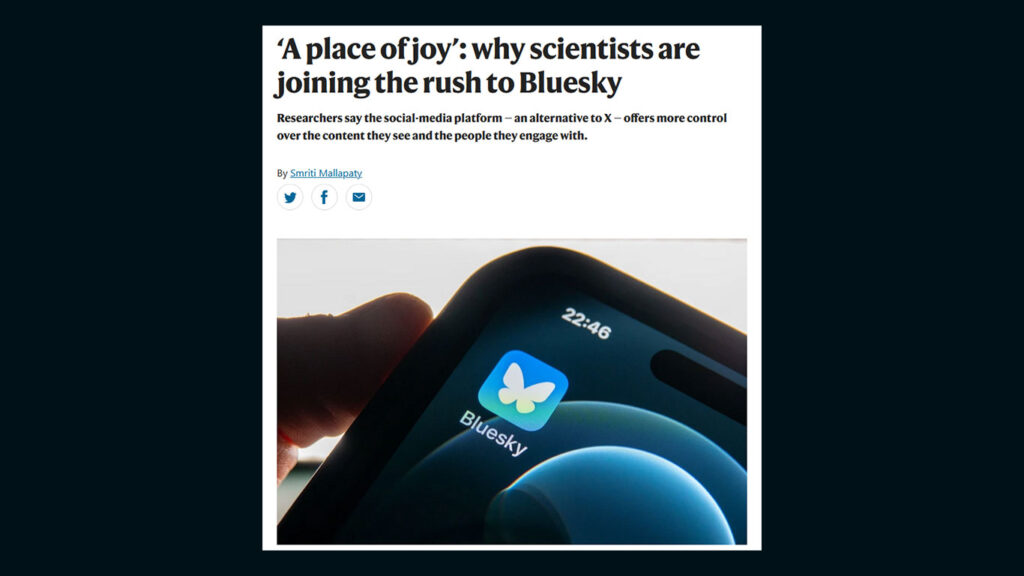
The journal Nature just published a brief piece entitled “‘A place of joy’: why scientists are joining the rush to Bluesky. Researchers say the social-media platform — an alternative to X — offers more control over the content they see and the people they engage with.”
When Elon Musk took over Twitter in 2022, there were many academics who left that platform out of the belief that it would become a cesspool of hate speech, racism, and discrimination, etc.
I had been on Twitter since 2012, but only started to use it regularly in early 2022 to follow the events in Ukraine. The only thing I noticed when Twitter transitioned to X was that for a couple of weeks, cute kitten videos started to appear in my feed. Prior to that point, no videos had ever appeared in my feed, but after Musk took control, my feed was “invaded” by cuddly cuteness. Then after a couple of weeks, these little furry friends disappeared, and my feed went back to the way it had been prior to the change from Twitter to X.
I can’t be alone. After all, there is the famous/notorious case of the interview that Musk gave with a BBC reporter where the reporter accused Musk of allowing hate speech and racism on the platform but then could not provide a single example to support his claim.
Following this last election, however, now apparently quite a few of the academics who remain on X are leaving for an alternative, Bluesky. According to the article in Nature, “Bluesky. . . offers users control over the content they see and the people they engage with, through moderation and protections such as blocking and muting features” and that “the platform also offers options to filter out content such as nudity and spam, or specific phrases, from appearing in their timelines.”
Hmmm, I’ve been on Twitter/X since 2012 and haven’t seen any nudity. So, I’m not sure what these academics are doing that they need a filter for that, but. . . seriously, the big issue here is that this is an article in an important scholarly journal that is promoting “NOT listening.”
Instead, it’s promoting retreating into a bubble of like-minded people. In other words, it would be the same as if when I was growing up, my parents had locked our doors and turned off the lights anytime a guest arrived at our house.
Imagine the “critical thinking” skills I would have developed in that setting!!
In the English-speaking world, the past few years have been fantastic for listening. In particular, there has been an explosion of podcasts that provide long-form interviews with people. To name just a few, there are the Coleman Hughes Podcast, Debra Soh Podcast, Winston Marshall Podcast, Triggernometry, UnHerd, Peter Boghossian Podcast, Lex Friedman Podcast, All In Podcast, Glenn Loury Show, etc.
For the past few years, these podcasts have produced thousands of hours of interviews which, for the most part, challenge the views of people on “the left,” which includes most of academia in places like North America. Further, the majority of the people behind these podcasts identify as being “liberal” or “left of center” in their views, and claim that “the left” has changed, not them.
Through these podcasts, I have been able to listen to people whom I had never listened to before. And when you listen to someone talk for two or three hours, there is a lot you can learn about that person. This is what I experienced as a kid when I listened to people talk for hours at our kitchen table.
I am not the only person who has recently listened to certain people for the first time. After the last election, I saw a lot of first-time Trump voters say on X that listening to Jared Kushner speak on the Lex Friedman podcast (or shortly after that on the All In Podcast) was an absolute game-changer/wake-up-call for them, as they found that this person whom the media had universally derided as an idiot was, in fact, intelligent and knowledgeable.
In the aftermath of the recent election in the US, I have seen plenty of academics feeling disillusioned, and leaving X for Bluesky, as Nature celebrates in this article. As for me, I found the outcome of the election 1,000% predictable, as I had been listening to people. I listened to people in these podcasts, and I listened to people on X, and I could see that there were many issues that concerned many people that the Democrats were not addressing. It was obvious that they were going to lose.
In other words, by listening, I was able to understand what is happening in the world.
Finally, I bring all of this up because I don’t think this matter can be separated from scholarship. In the past, I have heard people explain away poor teaching by saying that, “oh, it’s because that prof is a scholar, not a teacher.”
I don’t believe that any such distinction exists. You can’t be perceptive as a scholar and then be unable to perceive that your students are falling asleep because you are not teaching effectively.
The same goes for listening. You can’t be perceptive as a scholar if you close yourself off from the world and avoid trying to figure out what other people are thinking.
When you choose to live in a bubble, you can only produce ideas for that bubble. The way to get outside of that bubble is to. . . listen. That Nature is promoting the opposite. . . is not a good sign.


“PAULINE KAELISM”
In December 1972, after Richard Nixon had buried George McGovern in a landslide victory, the NEW YORKER’s film critic Pauline Kael made this famous but oft-distorted confession during a lecture:
“I live in a rather special world. I only know one person who voted for Nixon. Where they are I don’t know. They’re outside my ken. But sometimes when I’m in a theater I can feel them.”
Rightly or wrongly, it has since then turned her name into “a synonym for living in a bubble,” which tends to be referenced in the wake of unexpected triumphs by candidates who appeared to be utterly unqualified.
I am sure you are familiar with this very well-known anecdote, but it is too good to be left unmentioned in this particular context.
Thanks for the comment!! I was not actually aware of this anecdote.
The fact that this person wrote for The New Yorker also fits the context well, as that magazine came out with an early endorsement of Harris. Later, of course, other media outlets decided to pass on making any endorsements.
And just as an aside, David Remnick has been the editor of The New Yorker for years now. In the late 1980s/early 1990s he was sent to the Soviet Union as the Washington Post correspondent. Although he doesn’t know me, our paths crossed at the summer Russian language program at Middlebury College in 1989. I don’t think we ever talked, but I saw him there. He was just starting out (maybe 2nd-year level?). I then remember reading some of his writings a few years later and being very impressed. By that point there was a long history of foreign correspondents based in Moscow who would learn Russian well, who would talk and listen to Russians, and who would then write books about the place after they left their posts. I loved those books. Remnick is the last of this type, as far as I know. I’m sure there must have been bias in those works, but there were a ton of insights as well, ones which the media never conveyed, but which when you went there, were obvious and made sense. Those insights came from observing, but also from talking and listening.
“Nature is promoting the opposite” — not just in op-eds about social media platforms. Peer-reviewed academic journals publish articles that support conventional wisdom far more frequently than articles that don’t, even if the latter contain arguments with better evidence. Same for U.S. government research grants.