
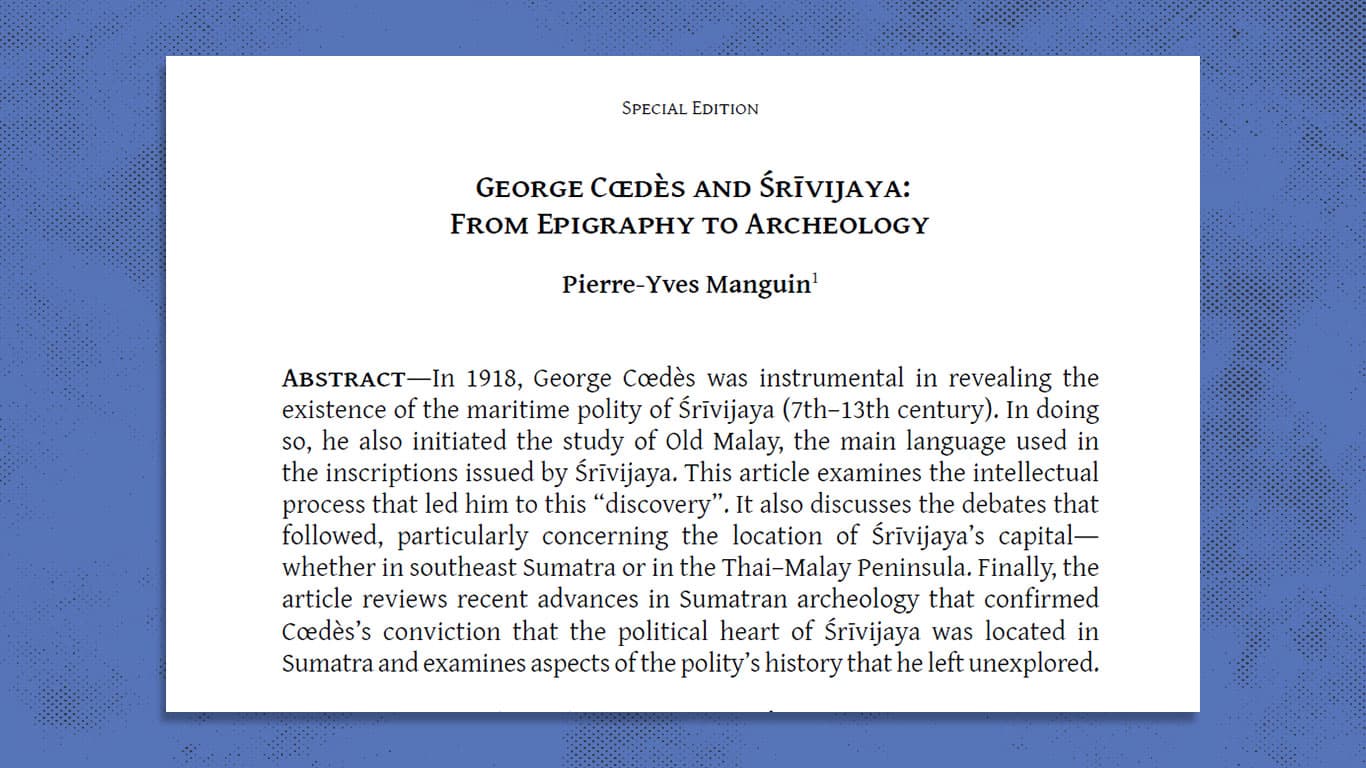
I was looking around for something on the Journal of the Siam Society website and saw a new article by Pierre-Yves Manguin on “George Coedès and Śrīvijaya: From Epigraphy to Archeology.”
For anyone who hasn’t read anything on this blog in the past six years and hasn’t read the works I’ve published on the Chinese sources on early Southeast Asia in the past four years, over a century ago, French scholar George Coedès made the argument that a couple of placenames that appear in Chinese sources, Shilifoshi and Sanfoqi, referred to a polity that he claimed was based at Palembang called “Srivijaya.”
Coedès could not read Chinese, nor can Manguin, and there is by now a large body of scholarship by such scholars which tries to get the information in Chinese sources (which they access through [often very old] translations) about Shilifoshi and Sanfoqi to tell the history of “Srivijaya.”
For anyone who can actually read Chinese, it is obvious that those two placenames do not refer to Palembang, nor can they possibly be transcriptions of the name “Srivijaya.”
I have tried to figure out what they actually refer to. Shilifoshi is straightforward. It was the name of a polity in what is now southern Thailand, and in fact, many people have argued that point over the years.
Sanfoqi requires more investigation to locate, but over the course of two articles (with a third on the way) and a lot of blogposts here, I have argued that it literally was the name “Kambuja/Kampuchea” and that it was a place in the Cambodian interior that was accessed from the southern coast, most likely from Ha Tien. Further, while it was likely under the authority of Angkor, I don’t think most Chinese were actually traveling that far inland.
Professor Manguin clearly doesn’t realize any of this, but in reading his comments, I see that there is a lot that he doesn’t realize. Let me quote some of what he wrote in a section entitled “Locating Srivijaya” and then I will add some comments.
Majumdar (1933) and Quaritch Wales (1935) were the first professional scholars to open the long-running controversy over the location of the “capital” of Śrīvijaya. The main arguments used in attempts to counter the theses of Coedès and his placement of the heart of the polity of Śrīvijaya in southeast Sumatra―originally in Palembang and then moving to Jambi―can be summarized as follows. The main point is a divergent interpretation of the significance of the change, between the 8th and 9th centuries, in the transcription of the name of the state of Śrīvijaya used in Chinese sources. While in the 7th and 8th centuries the Chinese used the term Shilifoshi 室利佛逝 (or Foshi 佛逝), they employed a new name, Sanfoqi 三佛齊, from 904 onwards. Nobody has yet provided a fully satisfying explanation for this name change. While (Shili) foshi poses no phonetic problem for transcribing (Śrī)vijaya, the san 三 character of the second-place name is problematic, unless we invoke a spelling error or consider its literal value, “three”, rather than its phonetic value; we would then translate the terms as “the three Vijayas”. Majumdar took advantage of this ambiguity to dissociate the countries cited by the Chinese: he placed the capital of the kingdom of the Śailendra (Sanfoqi) in Nakhon Si Thammarat, thus attributing this dynasty a purely Indian origin—a proposal not subsequently accepted.
The 10th-century switch in Chinese sources from Shilifoshi to Sanfoqi served more recently as a pretext for two articles asserting new “relocations” of the polity outside of Sumatra; both articles, based only on a radical rereading of Chinese textual sources, totally ignore progress in the field of archeology, epigraphy, and navigation (Haw 2017; Kelley 2022) and are therefore far from convincing. Two additional arguments were put forward in support of the hypothesis of a center located in Thailand: (1) the place name Chaiya (ไชยา) and that of a nearby hill called Khao Siwichai (เขาศรีวิชัย) to the south of the same city were presented as Thai renderings of the name Śrīvijaya itself; and (2) peninsular Thailand could be said to present a greater wealth of archeological remains that dated from the Śrīvijaya period.
All of these arguments were refuted by Coedès as early as 1936 in a short article that constituted a response to the arguments put forward by Quaritch Wales. Regarding Chinese transcriptions, Coedès admitted that the san of Sanfoqi “remain[ed] embarrassing”, but because, in Chinese historical texts, the placename Sanfoqi is closely associated with its predecessor Shilifoshi and that, geographically, later Chinese sources unambiguously place Sanfoqi in Palembang, seemed to him to remove any discussion. He also considered the argument of Thai toponyms phonetically deriving from Śrīvijaya as of little value, pointing out that place names formed on the Sanskrit term vijaya (victory) are exceedingly common throughout Indianized Southeast Asia, including elsewhere in Thailand, without links to the kingdom of Śrīvijaya. Furthermore, modern toponyms forged from Sanskrit are also widely found in Thailand, such as Nakhon Si Thammarat (นครศรีธรรมราช; nagara śrī dharmarāja), with HRH Prince Damrong Rajanubhab credited with introducing some of these new names in Peninsular Thailand.
1) Let’s first address the issue of how my work is supposedly “far from convincing” because I do not take into account “progress in the field of archeology, epigraphy, and navigation” etc. By “progress in the field of archeology, epigraphy, and navigation,” I am assuming that Professor Manguin means scholarship in these areas that relates to Palembang and that region of Southeast Asia, which is where his expertise lies.
I grew up on a farm in Vermont in the US. Every time we plowed our fields, we would unearth arrowheads that had been made by Native Americans. Through those findings, never once did we ever think, let alone argue, that our farm was the center of an Abenaki confederacy and that this was referred to in Samuel de Champlain’s early-seventh-century travel writings.
However, this is precisely what scholars and archaeologists, such as Manguin himself, have done. They have followed Coedès in believing that certain inscriptions and artifacts found in southern Sumatra are from a place that is referred to in Chinese sources as Shilifoshi and Sanfoqi.
What I have demonstrated is that the Chinese sources do not place Shilifoshi or Sanfoqi on the island of Sumatra. Therefore, the “progress in the field of archeology” in places like Palembang, where Professor Manguin has worked, is irrelevant to the argument I am making because I am making a textual argument which demonstrates that Sanfoqi was not on the island of Sumatra.
Further, by this point, I have provided a mass of evidence that supports this argument, none of which Professor Manguin shows any indication of having read or understood.
The way to challenge what I have written, is to address the textual issues that I have written about. This is what Professor Manguin fails to do, and as we will see below, is incapable of.
Instead, he dismisses the textual arguments I have made demonstrating that Sanfoqi was not on Sumatra by stating that I don’t take into account the archaeology and epigraphy of places like Palembang and its environs.
To take the example of my family farm again, the equivalent would be if my family argued against an historian who demonstrated that the information about the Abenaki in Samuel de Champlain’s writings are not about our farm by saying, “No, look at all the arrowheads we found! You’re wrong!!”
I’m showing that the textual evidence demonstrates that Sanfoqi was not on Sumatra, so archaeological findings at Palembang and its environs do not undermine my argument. Instead, they are largely irrelevant to the argument.
2) Manguin makes it clear that central to the discussions in the extant scholarship about “Srivijaya” and where it was located is a supposed “change. . . in the transcription of the name of the state of Srivijaya used in Chinese sources.”
More specifically, Manguin states that “While in the 7th and 8th centuries the Chinese used the term Shilifoshi 室利佛逝 (or Foshi 佛逝), they employed a new name, Sanfoqi 三佛齊, from 904 onwards.”
And still later, he claims that “in Chinese historical texts, the placename Sanfoqi is closely associated with its predecessor Shilifoshi and that, geographically, later Chinese sources unambiguously place Sanfoqi in Palembang. . .”
I would love to know what Chinese historical texts Professor Manguin is referring to, because I’ve been working with the sources for years, and have found ZERO association between those two placenames.
ZERO.
So, please, anyone, tell me which Chinese historical source draws a connection between Shilifoshi and Sanfoqi? This is critical for the scholarship on “Srivijaya.” So, other than in Coedès’s mind, where this idea first emerged, where is that evidence?
Professor Manguin seems pretty confident about this, and has probably spent his entire career believing it, but where’s the evidence? Which historical source makes an association/connection between Shilifoshi and Sanfoqi? Spoiler alert: there isn’t any, and this is only one of many such issues with the scholarship on “Srivijaya.”
Indeed, what we can see here is how critical the information about Shilifoshi and Sanfoqi has been for the development of scholarship about “Srivijaya.” Chinese sources have been employed by scholars to form a kind of framework for the history of “Srivijaya.”
And yet, Coedès, who first created this framework, and scholars who spend their careers writing about “Srivijaya,” like Professor Manguin, cannot read the Chinese sources.
This is where the big problem is, because when it is demonstrated that those sources are not talking about Sumatra, there is no longer a framework. . .
3) “Nobody has yet provided a fully satisfying explanation for this name change. While (Shili) foshi poses no phonetic problem for transcribing (Śrī)vijaya, the san 三 character of the second-place name is problematic, unless we invoke a spelling error or consider its literal value, “three”, rather than its phonetic value; we would then translate the terms as “the three Vijayas”.”
First, as the above comments indicate, there is no evidence of a “name change” because there is no evidence in Chinese sources of any connection between the placenames Shilifoshi and Sanfoqi, to say nothing of the fact that neither of these placenames can be associated with Palembang, nor can they be shown to be in the same place.
Second, contrary to Manguin’s claim, there are enormous phonetic problems transcribing (Shili)foshi as “Srivijaya.” To take one example, for instance, we have to consider that Tang-era monk Yijing referred to it at times as Foshiduo (佛逝多), and there is no way on earth that we can get “Vijaya” from that. Budhjeta, perhaps, but definitely not Vijaya.
Again, this is yet another example of Manguin’s lack of knowledge of what’s in the Chinese sources.
As for Sanfoqi, I have provided an explanation, and one in which the san 三 character is not problematic. In particular, in the “Kelley 2022” article which Manguin cites, I employ Edwin G. Pulleyblank’s Lexicon of Reconstructed Pronunciation: In Early Middle Chinese, Late Middle Chinese and Early Mandarin to demonstrate that a thousand years ago, this term might have been pronounced something like “Samfhutshiaj.” That, I argue, is close to the term “Kambuja/Kampuchea,” a term which we find in Yuan dynasty sources written as Ganbozhi, Ganpuzhe, and Ganpuxi and in the History of the Ming as “Jianpuzhai.”
This is a much more straight-forward argument than the one Professor Manguin mentions, O. W. Wolters’ contorted argument that Sanfoqi means “three Vijayas” which somehow was supposed to mean “Srivijaya”. . .
4) As for “later Chinese sources unambiguously place Sanfoqi in Palembang,” I would encourage Professor Maguin to read the second part of my “Rescuing History from Srivijaya” paper where I undermine this point.
I am totally open to having my ideas challenged. However, these comments by Professor Manguin are insulting.
Professor Manguin clearly has no idea what is (or is not) in the Chinese sources, and therefore, has absolutely no ability to evaluate what I have written, nor to evaluate the historical scholarship on “Srivijaya” that has employed Chinese sources, and which he has relied on throughout his career.
Indeed, statements like “in Chinese historical texts, the placename Sanfoqi is closely associated with its predecessor Shilifoshi” reveal an astonishing lack of even the most basic knowledge about the sources.
Instead, Professor Manguin merely attempts to dismiss what I have written by saying that I ignore information from other fields in another part of the Southeast Asian region.
I have never denied that there was a polity associated with the name “Srivijaya.” And whatever archaeologists find on Sumatra is great. However, none of that has anything to do with a textual argument that demonstrates that the placename “Sanfoqi” was not “Srivijaya,” but instead, was “Kambuja/Kamphuchea.”
That said, the textual argument that I have made has enormous implications for the story that scholars have built about “Srivijaya” using Chinese sources, implications that go far beyond “relocations.”
This is an issue which I can see Professor Manguin has also failed to understand, because again, one has to be able to understand the Chinese sources to be able to evaluate what has been written about “Srivijaya” using those sources, and what I am arguing about those sources.
Professor Manguin clearly lacks the requisite knowledge to do any of the above, and yet he somehow feels that he can assess my work. That is why I find his critique insulting.

At some point last year, a reader wrote in a comment, “And since it is getting more and more evidences that Sanfoqi is Cambodia, or at least not Sumatra, has that cause any shift on the study of medieval maritime southeast Asia?”
In response, I wrote a long comment. Here is part of it:
As for the issue of my research causing any shift. . . That will NEVER happen. Let me explain why through another example. In the field of premodern Vietnamese history, the leading scholar wrote a book back in the 80s which talked about the “Hung kings,” the supposed first rulers of “Vietnam.” Like “Srivijaya,” this is a topic which everyone knows is problematic, however people just more or less went along with it. The above book, meanwhile, mentions that they might be “mythic” but the author nonetheless goes on to try to link the stories to archaeology and argues that the stories and archaeology point to a Vietnamese identity that predated the period of Chinese rule and which endured through 1,000 years of Chinese control. . .
I published an article 15 years ago where I document ways in which we can clearly see that the story about these kings was created in the “medieval period” (14th-15th centuries). After that, the leading scholar published a survey of Vietnamese history, and how did he deal with the Hung kings? He completely avoided the topic. Poof! These figures that were so important for his first book suddenly disappeared from Vietnamese history. 🙂
“Srivijaya,” meanwhile, is like an industry. For example, from 2009-2019, there was a “Nalanda-Sriwijaya Centre” in Singapore that had all the money, all the resources, all the brain power, and yet. . . like people had done with the Hung kings, everyone just kept following the same extremely problematic story.
Are people in that world, some of whom have spent their entire careers writing about how “Srivijaya was a great maritime polity at Palembang,” suddenly going to say “Oh, oops!! We were wrong. Let’s change course!” No, that is never going to happen. Like the senior scholar, they are going to avoid the topic entirely. Most of the people out there are in their late 50s or older and there is no upcoming generation that I’m aware of. They will “ride it out” through the twilight of their careers.
As such, while I find Professor Manguin’s dismissal of my work insulting, it is also entirely predictable.
Addendum: A day after writing this, I came across a note by Johannes Kurz on Academia.edu, “From Shilifoshi to Sanfoqi or the Sensitive Spot in “Srivijaya” Studies,” which likewise criticizes Professor Manguin’s piece in the Journal of the Siam Society.


When doing dissertation or other research, I typically investigated where authors got their ideas. Too often it would end up looking like a snake eating its own tail — I could recognize that scholar B was presenting something that originated with scholar A, whether or not B cited A. Then scholar C would propagate the ideas of B that B had taken from A, and so forth. No one would bother checking whether A’s conclusions had merit, it was the accepted wisdom, and woe to anyone who dared challenge it. Not a good look for supposedly unbiased, quality academics.
I’m noticing this a lot when checking the “chain of transmission” of various claims repeated by many academics on the history of a precolonial African Islamic kingdom I study, too. Some of the more recent academics at least sort of try to interrogate scholar A but I notice that more with Europeans academics (French especially))
Thanks for the comment!!
The digitization of all kinds of materials certainly makes the task of interrogating much easier. And I can see that LLMs are reaching a point where they can help as well. 20 years ago, I had to run up and down library stairs searching out materials in the various corners of university libraries, and to request materials through interlibrary loan, while now I can find pretty much everything online in one way or another.
Good point. What I think we have here are early colonial-era scholars who made a first effort to figure things out. Then you had people like O. W. Wolters who created a convoluted mess. And then you have the people like Manguin who 1) can’t evaluate what the colonial-era scholars wrote, and 2) can’t follow what Wolters said (no one can, because it’s a chaotic mess) but finds something there that can help support what he wants to say, and takes that and regurgitates it for decade after decade.