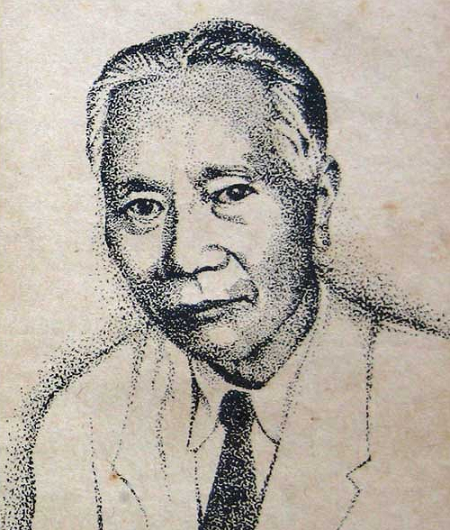
Trần Trọng Dương on De-Sinicization
In this video Trần Trọng Dương talks about the effort of some Vietnamese scholars to interpret the past in ways that they hope will distance Vietnamese culture from Chinese culture.
In 1831 the Nguyễn Dynasty official, Lý Văn Phức, escorted some stranded Chinese sailors back to Fujian province.
When he arrived there, the guesthouse where he was supposed to stay had a sign over it which indicated that it was for “Barbarians.”
https://www.youtube.com/watch?v=qXKkw8l87wE The above video is meant to introduce a new book - Erica Fox Brindley’s Ancient China and the Yue: Perceptions and Identities on the Southern Frontier, c. 400 BCE-50…
I’ve long wondered why the Yijing (the Classic/Book of Changes) is so important for ultra-nationalist ideas in Vietnam. Extreme nationalists in Vietnam today regard the Yijing and its ideas as…
In the post below, I wrote about some information in an inscription that was inscribed on a bell at a Daoist temple in the Red River Delta, the Thông Thánh…
The Annan zhiyuan, a fifteenth-century gazetteer of the greater Red River Delta region that Ming Dynasty officials created contains a section on “people” (人物), or what it is probably better…
Today I read about Trần Ích Tắc on Wikipedia. Trần Ích Tắc was a Trần Dynasty prince who submitted to the Mongols when they attacked the Red River Delta in the thirteenth century.
The Wikpedia entry refers to this transformation as Trần Ích Tắc’s “defection” (a Cold War term that was used to refer to people like Mikhail Baryshnikov who left the Soviet Union for the West, knowing that he would never be able to return again [until the Soviet Union fell]).
We learn that “Trần Ích Tắc was the most famous prince of Trần Thái Tông [the first emperor of the Trần Dynasty] for his intelligence and broad knowledge.” We also learn that “he was denounced in Vietnamese historical books as a traitor with the derogatory name ‘Ả Trần’ (Hán tự: 妸陳, ‘the woman named Trần’).”
When it comes to the period of the Ming occupation of the Red River delta in the fifteenth century, there is one source that is important which is very underused,…
I’ve long argued that the 15th century document, the “Bình Ngô đại cáo” (Great Proclamation on Pacifying the Ngô), does not represent a “declaration of independence” by “the Vietnamese” vis-à-vis…
I recently came across a poem in Chinese that was written by Yan Jieren 嚴杰人 in 1943 called “The Annam Maiden” (Annan Nulang 安南女郎). Yan Jieren was a writer and…