
By the time George Cœdès wrote and published his 1918 article, “Le Royaume de Çrivijaya,” there were various false assumptions that scholars had created about certain placenames mentioned in Chinese sources, particularly Shilifoshi, Sanfoqi, Moluoyu, and Shepo. As we saw in the previous two posts in this series, Cœdès worked from those false assumptions, and created one of his own, the idea that Shilifoshi is literally the name “Srivijaya.”
I have discussed those issues as more or less “background information” that one needs to realize when one reads his article. In this post, we will look at some of his actual argument.
Cœdès begins his article by talking about two inscriptions. The first is known as the Kota Kapur Inscription, and it was found in 1892 on the island of Bangka off the southeastern coast of Sumatra. The other is the Ligor Inscription (Cœdès referred to it in the article as the Vieng Sa inscription), and it was found in the area of Nakhon Si Thammarat in what is now southern Thailand.
Dating from the late seventh and late eighth centuries, respectively, these two inscriptions both mention a “Srivijaya,” and Cœdès argued against earlier views that this term might be a title for a person by arguing that it was the name of a kingdom. Meanwhile, the Ligor Inscription also mentions the title, “Śrī-Mahārāja,” which Cœdès pointed out, we can find in Arabic accounts from slightly later than these inscriptions, where this term is mentioned as the title of a ruler of a place called Zabag.
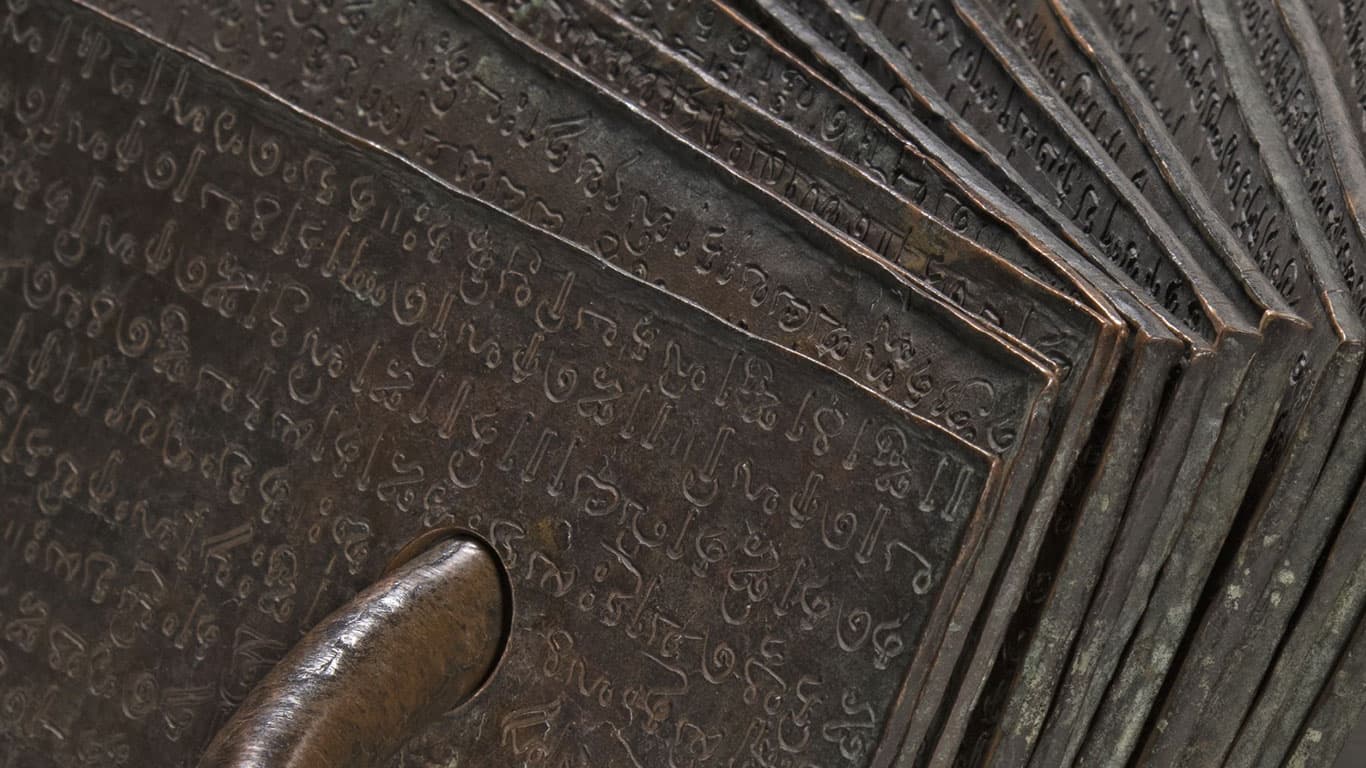
Cœdès then goes on to look at two inscriptions made in the Chola kingdom of southern India in the early eleventh century. The first is now referred to as the Larger Leiden Copper-plate Inscription of Rajaraja I. Dating from 1005/1006, this inscription, to quote Cœdès, “commemorates the donation of a village to a Buddhist temple at Negapatam, begun by Cūḷāmaṇivarman and completed by Māravijayottuṅgavarman. The latter, son of the former, is called (l. 80) ‘king of Kaṭāha (Kaṭāhādhipati) and of Śrīviṣaya (Śrīviṣayādhipati).’”
The second Chola inscription that Cœdès discusses is the Thanjavur/Tanjore inscription of Rajendra Chola I, dated 1030–1031 CE. This inscription lists places that the Chola attacked in Southeast Asia. The list is below, and I have added the Chinese names that Cœdès referred to in identifying some of the placenames.
Kadāram = Jiecha / Kedah
Śrīvijayam = Shilifoshi / Sanfoqi /Srivijaya / Palembang
Pannai
Malaiyūr = Moluoyu’er / Malāyu
Māyirudiṅgam = Riluoting
Ilaṅgāśogam = Langyasijia / Langkasuka
Māppappālam
Valaippandūru
Talaittakkolam = Takola
Mādamāliṅgam = Danmaling / Tambralinga
Ilāmurideśam = Lanwuli / Lamuri
Mānakkavāram = Nicobar Islands
Working from False Assumptions
In attempting to decipher these names with the assistance of Chinese sources, Cœdès worked from a few false assumptions.
One was that Sanfoqi was Palembang. This was false, and was based on erroneous information that started to appear in Chinese texts after Sanfoqi no longer existed.
Another assumption that he had was that a place called Shepo was Java. We can see this because 1) that was (and still is) the generally-held belief and 2) Cœdès does not even consider Shepo in his investigation even though it was clearly related to the topic of this article.
As I just explained in the post, “The Pyu, Tircul, Javanese, and Shepo,” and as I have explained many other times before, Shepo was an exonym used by Arabs and Chinese in the ninth and tenth centuries to refer to the area of the trans-peninsular crossing in the greater Lake-Songkhla area, the precise area that the Chola attacked.
With these assumptions, Cœdès began by attempting to locate Kadāram (Katāha/Kidāram), as it was mentioned in both Chola inscriptions, and in the Leiden Charter, it included the names of two of its kings.
While earlier scholars had suggested various locations for Kadāram, mainly along the coastal region of Burma, Cœdès pointed to a piece of information in the History of the Song that previous scholars had overlooked.
In a translation of a passage from that text about Sanfoqi that had been made in 1876 by Dutch Sinologist Willem P. Groeneveldt, Cœdès noticed that the names of Sanfoqi kings who had sent tribute in 1003 and 1008 matched the names of two kings of Kadāram in the 1006 AD Great Charter of Rājarāja.
Those two names were: Sili Zhuluowunifomadiaohua 思離咮囉無尼佛麻調華 and Sili Maluopi 思離麻囉.
While I agree that these names match the names recorded in the Larger Leiden Copper-plate Inscription of 1005/1006, one needs to examine the context in the account of Sanfoqi where those names appear. When we do so, we find that we cannot simply equate those names with “kings of Sanfoqi.”
Sanfoqi and Shepo
The account of Sanfoqi in the History of the Song contains information about tribute sent to the Song court by certain Sanfoqi “kings,” and yes, I put kings in scare quotes because what is recorded reveals a complex situation. Here is a list of the first “kings” to present tribute to the Song:
960 Xili Hudaxialitan 悉利胡大霞里檀 sent envoy Li Zhedi 李遮帝
961 Shili Wuye 室利烏耶 from the kingdom of Shengliu 生留 sent envoys Chayeqia 茶野伽 and Jiamozha 嘉末吒
961 Mirilai 迷日來, the son of the king, Lixilin 李犀林, also sent envoys
962 Shili Wuye again sent envoys Li Lilin 李麗林 and 李鵶末
971 Envoy Li Hemo 李何末 was sent (not clear by whom)
972 Tribute again arrived
975 Envoy Pu Tuohan 蒲陁漢 and others presented tribute
980 King Xiachi 夏池 [Haji] sent the envoy Cha Longmei 茶龍眉
980 A foreign merchant, Li Fuhui 李甫誨, arrived from Sanfoqi
983 King Xiazhi 遐至 [Haji] sent envoy Pu Yatuoluo 蒲押陁羅
985 A shipmaster (bozhu 舶主) named Jin Huacha 金花茶 brought tribute goods
988 Envoy Pu Yatuoli 蒲押陀黎 was sent to offer tribute goods
992 Guangzhou officials reported: “Pu Yatuoli, after returning from the capital two years ago, heard that his home country had been invaded by Shepo 闍婆. He remained in Nanhai for over a year. This spring, he sailed to Champa, but because the seasonal winds were unfavorable, he returned again. He now respectfully requests that an imperial edict be issued to his home country.” This request was granted.
There are two important points to note here. The first is that there are numerous different names of “kings” here. The second is that in the decade before we see names of the kings that also appear in the Kadāram/Srivijaya in the Larger Leiden Copper-plate Inscription, we see that Sanfoqi was attacked, and presumably occupied (since the Sanfoqi envoy was unable to return), by Shepo.
As for the first point, as I have written extensively already, Sanfoqi was not “Palembang.” It is literally the word “Kambuja/Kampuchea” and it was a polity in the large “mandala” empire of Angkor where foreign trade took place. It was a place that was accessible from the southern coast of the Indochinese Peninsula. My guess now is that it was probably Longvek.
What we see in the above passage is that when the Song dynasty sought to establish tributary relations, there were various “kings” from “Sanfoqi” who responded. Some of these were perhaps the rulers of different polities in the area of Cambodia, while some others, like Li Fuhui, might have simply been powerful merchants who traded at Sanfoqi.
Meanwhile, Shepo, as I’ve also written extensively, was across the Gulf of Thailand in the greater Lake Songkhla area where it controlled the trans-peninsular trade coming from places like Kedah. As an exonym used by Arabs and Chinese, there must have been another term to refer to this place. To the Chola, I think this is what they referred to as “Srivijaya/Srivishaya.”
If such a place could control the trade that went across the Malay Peninsula as well as the trade that took place at Sanfoqi/Kambuja, then that would have made it immensely wealthy.
That is what I suspect the attack of Sanfoqi/Kambuja by Shepo/Srivijaya was about, and that is why I think we see the names of Kadāram/Srivijaya (Kedah/Lake Songkhla area) kings in the account of Sanfoqi after that polity had been attacked by Shepo (i.e., the name that Chinese and Arabs used to refer to the Lake Songkhla area and its routes to places like Kedah).
I will now cite the next section in full:
In the sixth year of the Xianping era [1003], the king Sili Zhuluowunifomadiaohua 思離咮囉無尼佛麻調華 sent envoy Li Jiapai 李加排 and deputy envoys Wutuolinanbei 無陁李南悲 to present tribute. They also reported that their country had constructed a Buddhist temple to pray for the emperor’s long life, and requested an official name for the temple along with a bell. The emperor appreciated their sincerity and issued a decree granting the temple the name “Receiving Heaven and Ten Thousand Years of Longevity” [Chengtian Wanshou 承天萬壽] and ordered a bell to be cast and bestowed upon them. [Li] Jiapai was given the title General Who Returns to Virtue [Guide jiangjun 歸德將軍), and Wutuolinanbei was granted the title General Who Embraces Moral Transformation [Huaihua jiangjun 懷化將軍].
In the first year of the Dazhong Xiangfu era [1008], its king, Sili Maluopi 思離麻囉皮, sent envoy Li Meidi 李眉地, deputy envoy Pu Polan 蒲婆藍, and adjudicator Mahewu 麻河勿 to present tribute. They were permitted to participate in the imperial pilgrimage to Mount Tai and were received with lavish gifts.
In the first year of the Tianxi era [1017], its king Xiachi Suwuzhapumi 霞遲蘇勿吒蒲迷 sent envoy Pu Mouxi 蒲謀西 and others, bearing a memorial written in gold characters. They offered pearls, ivory, palm-leaf Buddhist scriptures [fanlai jing 梵夾經], and Kunlun slaves. An imperial edict permitted them to visit the Huiling Temple, the Taiqing Temple, and the Jinming Pond. Upon their departure, the emperor issued a letter to their country and granted them gifts in recognition and encouragement.
Here we find the two names that are on the Great Leiden Charter. As should be obvious, Sili Zhuluowunifomadiaohua is very different from any of the previous names of kings recorded in the History of the Song as having sent tribute from Sanfoqi. Further, this name appears in a record from 1003 AD, the first record after a 992 AD record about an attack on Sanfoqi by Shepo. And as we will see below, these names are also very different from the names that are recorded later in this account of Sanfoqi in the History of the Song.
Another thing we see is that these guys were definitely trying to create friends. At the same time that they were building a Buddhist temple to pray for the Song emperor’s long life, they were donating a village to a Buddhist temple in the Chola kingdom. And there were other grants that they made at that time in the Chola kingdom as well.
Something was going on here.
Let us look at some relevant information in the next section of the account of Sanfoqi in the History of the Song.
In the eighth lunar month of the sixth year of the Tiansheng era [1028], its king, Shili Diehua 室離疊華, sent envoy Pu Yatuoluoxie 蒲押陀羅歇, along with a deputy envoy and adjudicator named Yakalu 亞加盧, and others, to present tribute goods.
. . .
In the tenth year of the Xining reign (1077 CE), the head chieftan [Dashouling 大首領] Dihuajialuo 地華伽囉 came as an envoy. He was granted the title “Great General Who Protects and Submits and Admires Moral Transformation” [Baoshun muhua da jianghun 保順慕化大將軍]. . .
. . .
In the second year [1079], the emperor bestowed 64,000 strings of cash and 10,500 taels of silver. Envoy Quntuobiluo 群陀畢羅 was appointed “General Who Pacifies the Distant” [Ningyuan jianghun 寧遠將軍], and Tuopangyali 陀旁亞里 was appointed “Commandant Who Protects and Submits” [Baoxun langjun 保順郎將]. . .
Here again we have a very different type of name for the “king” of Sanfoqi, Shili Diehua. This looks like Sri Deva or Sri Diva… Following that, there is no king, but instead, a head chieftan, who also has a name, Sihuajialuo, that looks like Divakara. Further, this same Divakara is mentioned in a record about a tribute mission from the Chola kingdom in 1082 (see The History of Cambodia You Never Knew About)
Here it is interesting to note that there is also a reference in a Chola inscription to a Kamboja king who presented a chariot to the Chola king, Rajendra I. This can be found in the 1020 Karandai Copper-plate Inscription of Rajendra I where it says:
“The Kāmbōja king, aspiring for his [Rajendra’s] friendship (and) in order to save his own fortunes sent him a triumphant chariot, with which he had conquered the armies of the enemy kings in the battles.”
This was translated in 1984 by epigrapher K. G. Krishnan who added a footnote after this passage where he said, “It is stated in the Tamil translation that the Kamboja king conquered his enemies with the help of Rājendra which is not correct.” (198)
That may not have sounded correct to Krishnan, but it fits with what I see when I read the Chinese sources and understand that Shepo was the place where Kedah and Srivijaya were, and Sanfoqi was in Cambodia.
What I see in the account of Sanfoqi in the History of the Song is Shepo/Srivijaya attacking Sanfoqi/Kambuja in the 990s, and then claiming to be its king when tribute was sent to the Song.
Meanwhile, for the same time period, there is no record of tribute from Shepo. In fact, the only record of tribute from Shepo is from 992 when a king called Muluocha 穆羅茶 sent tribute, and 1109, when tribute was recorded but not any king’s name.
This “Muluocha” was probably Ma(ha)raja, the title that we also see in Arabic accounts of Zabag and in the Ligor inscription, all of which, I argue, is connected to that area of the greater Lake Songkhla region.
The different type of king name in the account of Sanfoqi that we see in 1028 is, I would argue, related to the Chola attack. It looks to me that Shepo/Srivijaya attacked Sanfoqi/Kambuja in the 990s, and then a few decades later, the Chola helped the king of Kambuja defeat Shepo/Srivijaya, and in the aftermath, some Chola/Tamil officials were granted control of the trade at Sanfoqi/Kambuja.
Let us now look at how Cœdès wrote about what he believed he had discovered:
It is known that, on the basis of the Chinese forms (Fo-che [Foshi], Che-li-fo-che [Shilifoshi], Fo-ts’i [Foqi], San-fo-ts’i [Sanfoqi]) and the Arabic form (Sribuza), the name of the kingdom of Palembang has been restored as Śrībhoja. Now, one cannot have failed to notice that this name Śrībhoja has not appeared in the course of this study in any of the documents relating to the kingdom of Palembang where one would in fact have expected to encounter it. Concerning King Śrī Cûlâmanivarman, whom I have believed I could identify with certainty with the king of San-fo-ts’i [Sanfoqi] whom the History of the Song names Sseu-li-tchou-lo-wou-ni-fo-ma-tiao-houa [Sili Zhuluowunifomadiaohua], the charter of Râjarâja I says only that he was king of Katâha and of Śrīvijaya. The name Śrībhoja appears no more in the list of conquests that the epigraphy of Râjendracola I attributes to that prince, and in which I have believed I could recognize the vassal countries of Palembang; but the first name in the list is Śrīvijaya. Under these circumstances, one is entitled to ask whether, instead of Śrībhoja, the true name of the kingdom of Palembang might not in fact be Śrīvijaya.
1) The first sentence is completely wrong. There was no connection between Shilifoshi, Sanfoqi, and Sribuza, and the two Chinese placenames were definitely not on the island of Sumatra.
2) Śrībhoja is how scholars prior to Cœdès transcribed “Shilifoshi.” At the time of the Chola attack in the eleventh century, Shilifoshi was no longer mentioned in Chinese sources. Cœdès assumed that Shilifoshi was the same as a place that is mentioned in Chinese sources in the eleventh century, Sanfoqi, however there is ABSOLUTELY NO EVIDENCE of that. Cœdès, and all of the scholars before him assumed that (perhaps because they both contain the character fo 佛?). However, no one ever provided evidence to demonstrate that, because there is no such evidence, because they were two separate places in different locations.
3) We cannot identify King Śrī Cûlâmanivarman with the king of Sanfoqi because 1) from the many different “kings” that we find recorded in the account of Sanfoqi in the History of the Song as having sent tribute, it is obvious that those men were not all monarchs from a single monarchy (and in some cases they are clearly not monarchs), and 2) right before this king was mentioned, Sanfoqi was attacked by Shepo, and 3) if we look at the account of the Piao kingdom in the History of the Song, we can see that A) Shepo was in the area of the Malay Peninsula, and B) that its ruler was referred to as the “Maharaja,” a title that we find in the Ligor inscription and also in Arabic accounts, and also in the History of the Song as the king of Shepo who presented tribute in 992.
4) Cœdès is right that from the Chola inscriptions we must conclude that a place called “Srivijaya” was the most important among the places that the Chola attacked. However, in relying on false assumptions about Chinese placenames, Cœdès placed Srivijaya at Palembang. That is clearly wrong. While there is no information that can enable us to definitively locate Srivijaya, there is abundant evidence to place it in the greater Lake Songkhla area, where Shepo was clearly located.
As such, “Srivijaya” was not what the Chinese referred to as Shilifoshi or Sanfoqi. It was what they referred to in the tenth and eleventh centuries as Shepo.
My suspicion is that Chinese didn’t mention anything clear about that place prior to the tenth and eleventh centuries because it was the place that controlled the Songkhla-Kedah trans-peninsular crossing. Prior to that point, Chinese might not have needed to voyage so far south to obtain what they sought, and/or it could be the case that Shepo/Srivijaya only became dominant in the tenth and eleventh centuries and forced trade to pass through the territory that it controlled.
That the Chola saw the need to attack that territory in the early eleventh century, probably with the support or assistance of Sanfoqi/Kambuja, suggests that it was controlling the trade network in the region, and to the detriment of others who sough trade and wealth.
In conclusion, Cœdès’s discovery that information in inscriptions from Southeast Asia and southern India can be linked to information in Chinese sources was indeed a brilliant observation. However, Cœdès worked from flawed assumptions about what several Chinese placenames indicated. Further, his own effort to claim that Shilifoshi was literally the name “Srivijaya” was simply ludicrous.
The result is that the foundation that Cœdès created for the study of Srivijaya was flawed from the start. More specifically, that foundation is built on both flawed assumptions (Sanfoqi was at Palembang; Moluoyu was Malayo; Shilifoshi was near Moluoyu so it must be Palembang; Shilifoshi and Sanfoqi must be the same place; Shepo was Java) as well as actual historical facts and connections (the Chola Kingdom attacked Srivijaya; the names of the kings of Kadāram/Srivijaya in the Larger Leiden Copper-plate Inscription can also be found in the account of Sanfoqi in the History of the Song; the title “Maharaja” in the Ligor Inscription is also mentioned in Arabic accounts about Zabag and in the account of Shepo in the History of the Song).
What this means is that if one does not understand what in this foundation is flawed and what is not, then one cannot make clear advances in our knowledge on this topic, and that has precisely been the case with the scholarship from the past century on “Srivijaya.”


One of the strange things about Western scholarship on pre-modern Southeast Asia is the chauvinism shown towards Chinese-language sources. The VOC, the EIC, the Spanish, and the Portuguese can all be trusted (with all due caution) for their accounts of the Straits of Malacca or the Gulfs of Siam or Tonkin etc. But the Chinese are often considered inexorably other to the region. They must be treated with skepticism, doubt, or even dismissed. If their accounts cannot be reconciled with local sources, it is the Chinese materials that are wrong, never the local sources. Now, I am here speaking very generally, and I do not mean to say that Western scholars have not tried to take Chinese-language sources seriously into consideration. But when they have, they have often been hasty, dismissive, incompetent, and reliant upon old, inferior, and frequently bad translations.
This has been strangely true of the Cornell school and those trained by or in conjunction with Oliver Wolters, who could, allegedly read Chinese. Indeed, it was part of his responsibility as a former colonial official in Malaya. If Wolters is our measure of Chinese competence, no wonder the Malayan emergency became the massive, violent, civil war that it was. Is it any wonder that when he turned to Vietnamese history he wrote, long, expansive essays on a few lines by Le Van Huu, quoted by Ngo Si Lien, or similar; or that his final work was a contrivance of imaginative fiction about the Tran dynasty rather than a careful, finely grained study based upon epigraphy, Vietnamese, and Chinese sources? One might begin to think it’s imagination all the way down…
A strong grounding in Literary Sinitic is obviously a prerequisite for any study of Southeast Asia before ~1850. And I might venture for the later period too. It is also increasingly obvious that modern Chinese is an important language of scholarship for modern Southeast Asia. Responsible programs training people in the history of Southeast Asia should be requiring *at least* colonial and vernacular languages, literary Sinitic and modern Chinese, and also modern Japanese too, given the high quality of scholarship in that field. After all, if one went to Princeton to study “Late Antiquity” with Peter Brown, once upon a time, one had to command Greek, Latin, German, French, Persian, Arabic, Hebrew, and sometimes Syriac, Coptic, Armenian, and Ethiopic, among other languages. I would suggest that the study of pre-modern Southeast Asia (and much of its modern history too, taken regionally rather than nationally) is just as demanding and requires just as much careful study, attention, care, and linguistic control if not mastery. Why are we asking so little of our graduate students?
Thank you for preaching to the choir. I totally agree with you!! I can see that I wrote about this 5 years ago:
https://leminhkhaiblog.com/dismissing-china-the-chinese-in-the-field-of-southeast-asian-history-in-the-english-speaking-world/
However, there is much more that could be said on that topic.
Then on the need to know premodern languages, I can see that way back in 2012 I wrote about that: https://leminhkhaiblog.com/the-superficiality-of-scholarship-on-premodern-southeast-asian-history/
The “senior scholar” I mentioned listening to in that post was Kenneth Hall, an “expert” on premodern Southeast Asia who did not know any Asian languages, premodern or modern. . .
One bright spot is that that this Vietnamica project (https://vietnamica.online/) has finally gotten Vietnamese inscriptions scanned. They don’t have a searchable database yet, but I have found that if you download the highest quality versions of those scans and throw them into Gemini, it can do a decent job of transcribing and translating them.
Also, a lot of books are coming out of that project, but so far everything is in French and Vietnamese. But eventually that knowledge will make its way into English.
I’m trying to figure out how to write about Wolters. It’s so difficult because his “scholarship” is just a cesspit of chaotic and incompetent drivel. To explain that incompetent chaos to a general reader takes so much effort. In the Confucianism/State of the Field article that I wrote long ago, I have a few pages on Wolters, and those pages took so much effort to write, because you have to try to break down his illogical reasoning and find a way to logically explain it to people. . . It’s just brutal.
Finally, I really loved the introduction to the first Cambridge History of Southeast Asia when I read it so many years ago, because it provided a great overview of scholarship. However, as time went by, I kept waiting for it to get updated by someone. The narrative that it presented was that those “bad” colonial scholars were Euro-centric, and fortunately that changed with the emergence of “autonomous” histories and the rise of the scholars from the Cornell “Golden Age.”
Ok, but as decade after decade passed by. . . and since the members of every generation are influenced to some degree or another by the time in which they lived. . . I kept waiting for someone to say something about that generation’s scholarship and how it affected the field of Southeast Asian history but. . . crickets.