
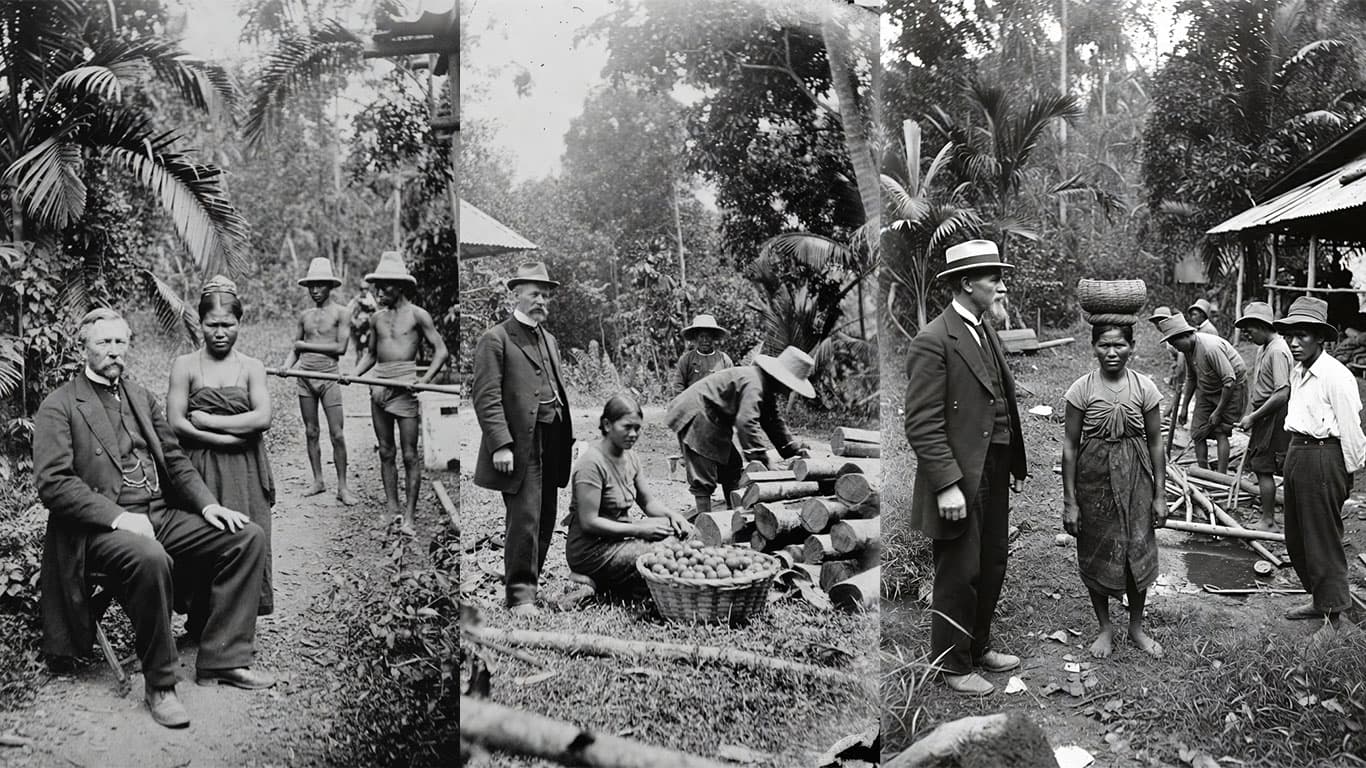
Last night I was looking through documents from British North Borneo and came across a record from 1886 about the murder the previous year in Palawan, then under Spanish rule, of a British subject by the name of J. W. Allen.
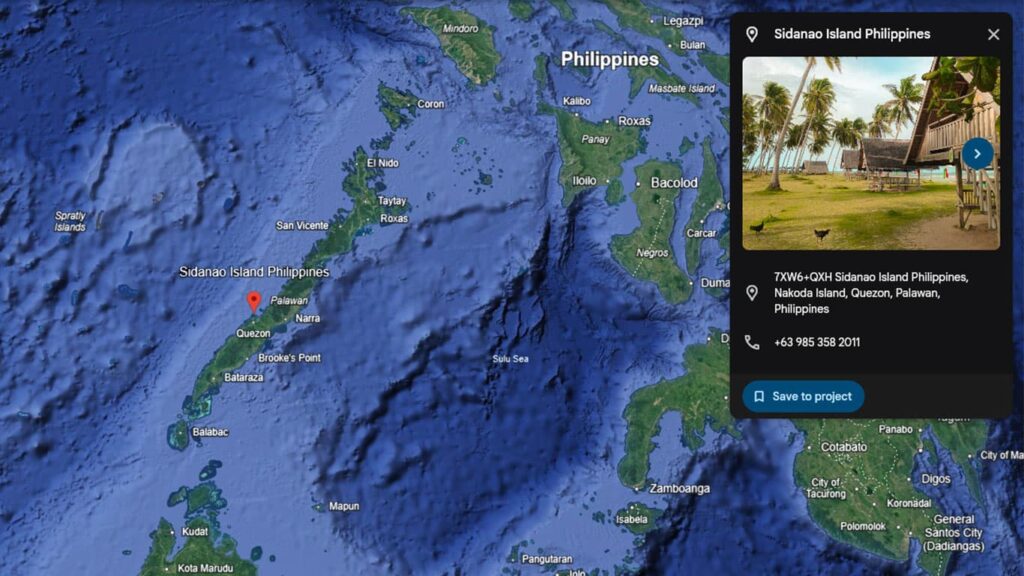
In this document, we learn that Mr. Allen lived at a place called Grave Island (Sinano), Nacodah Cove, on the west coast of Palawan. I’m guessing that this is what is now referred to as Sidanao Island.
From the document, we also learn that Mr. Allen lived on this island together with Popit, a “Sulu woman kept by Mr. Allen,” and two Chinese coolies, Ah Chow and Chook Ching. Additionally, there was also a carpenter by the name of Chin Ah Wang who worked for Mr. Allen, and a trader who was on the island when Mr. Allen was murdered, a certain Kop Tong Swee.
I love coming across details like this because they inspire me to try to imagine what life was like in the past. Who was this Mr. Allen? Who was Popit? How did they meet? How did she become his “kept woman”? What was their life like?
What did Ah Chow and Chook Ching do for Mr. Allen? How did they communicate? Did they all get along? Did Mr. Allen treat and pay them decently?
And what was it like for all of these people living on this small and remote island?
Given that we are now in the AI age, I decided to get some help in picturing this past world. I recently saw that Grok has a feature called “Imagine,” but I had not tried it. So, I clicked on it and wrote: “A picture of a British man in 1886 on the island of Palawan in the Philippines. He is standing in front of an attap house with a local woman and two Chinese coolies.”
What followed was something “magical” or “demonic,” depending on one’s view on this matter. Grok’s Imagine feature produces an “infinite scroll” of images. As long as you keep scrolling, Grok Imagine will keep imagining by producing images.
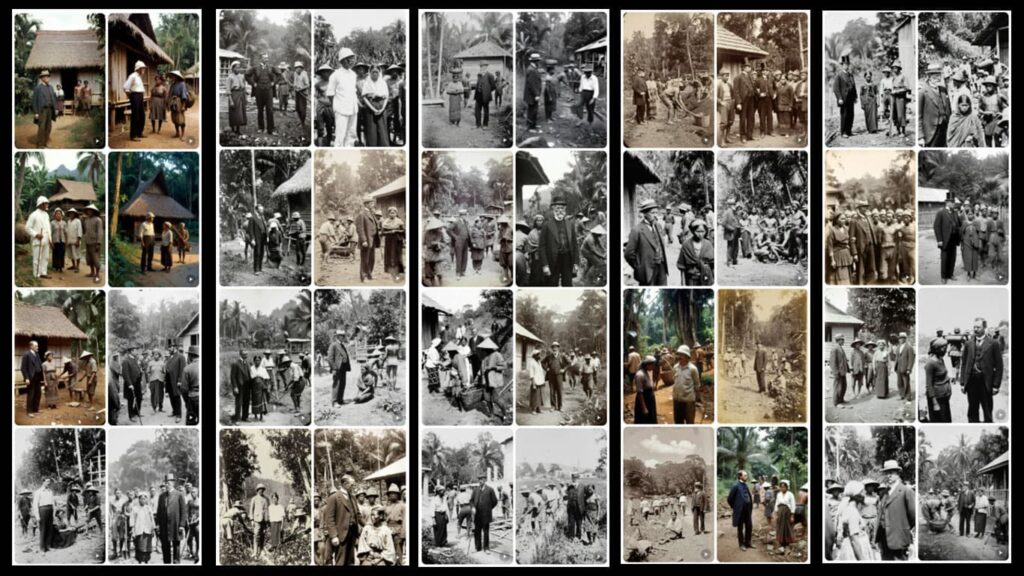
And you can click on any image and make it into a video (with sound!).
You can produce “historical” photos using other AI programs. However, there is something particularly surreal about having the same picture produced over and over.
At first, as I scrolled down, I kind of freaked out. I thought the program had gone haywire and was stuck generating images. Then I realized that this is what it is supposed to do.
And the fact that you can click an image and make it into a video is even more surreal.
I’m struggling to figure out what this all means. On the one hand, I love being able to “visualize” the past. On the other hand, there is something incredibly meaningless in seeing the same image produced over and over, and given random motion.
For anyone interested, here is the document about Mr. Allen’s murder.
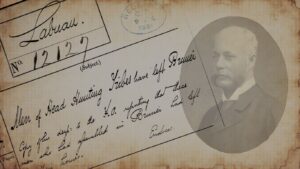

The report sounds like the premise for an episode of the original Star Trek series. Or a Victorian era novel.
I’m wondering whether any of these AI capabilities will increase the popularly perceived relevance of history. Will seeing a realistic visual simulacrum of a British subject who was murdered in Palawan more than a century ago stimulate students’ interest in learning more about that person, place, and time period? I think it’s cool. But I doubt the typical U.S. 18-year old is going to care.
When I was a graduate student in the 1990s, there was a History prof who taught Japanese history, John Stephan. He was a GREAT lecturer.
Before every class, he would go in 10 minutes early and write an outline on the chalkboard, underlying terms that would potentially be IDs on an exam. While he was doing that, he would play music that fit the time he was talking about, and his music came from a cassette player that he brought to class each day.
Then every once in a while, he would show slides. He turn of the lights, and turn on the slide projector and talk over the images he showed. As far as I can remember, pretty much everyone stayed awake and paid attention.
I started teaching around 2000/2001, and I had heard of this thing called “PowerPoint,” and from what I understood, I thought I could basically show slides during the class without having to turn out the lights. So, I went to Barnes & Noble or Borders and bought a book called “PowerPoint for Dummies,” because there was really no information anywhere online yet, and no one in my department was using it yet.
I had hoped to play music in the background while I went through the slides, but I quickly found that this didn’t work. So, like the prof, I played music before the class while I had an outline on the screen, and later, when Napster and then YouTube arrived, I got videos, and embedded them in the first screen and played them before class.
As for the slides, I basically just had big images and keywords, no detailed information.
What I found is that in the early 2000s, kids would watch the videos and pay attention to the images. I had one kid (smart but kinda lazy) – he would wait for a cool image to appear and then he would spend the rest of the class drawing it from memory. He showed me his drawings at one point. They were good!!
Then cellphones got texting capability, and at the beginning of class, most people would be looking at their phones, but some would still watch the videos. Then as we headed into the 2010s, pretty much no one paid attention to much of anything anymore.
So, from having observed those developments, no, I don’t see AI images exciting young people. By the 2010s, I just collected the images for myself, as I thought they were cool. I think it will be the same with AI. I’ll mess around with it because I find it interesting. At this point I have no illusion (or delusion) that it will be of interest to anyone else.