

Over the past several years, I have been going through the Chinese sources for Southeast Asian history and reinterpreting them. One big issue that I have found is that people have wrongly identified certain place names, and that has created a lot of confusion in the scholarship that bases itself on these misunderstandings.
While I have been able to resolve a lot, there are still placenames that I either haven’t addressed, or haven’t been able to fully figure out, such Foluo’an 佛羅安 and Riluoting 日羅亭.
The 1225 Zhufan zhi has a list of “vassals” of Sanfoqi, a place that I argue is Kambuja. This is what it says:
蓬豐、登牙儂、凌牙斯加、吉蘭丹、佛羅安、日羅亭、潛邁、拔沓、單馬令、加囉希、巴林馮、新拖、監篦、藍無里、細蘭,皆其屬國也。
Pengfeng [Pahang], Dengyanong [Terengganu], Lingyasijia [Langkasuka], Jilandan [Kelantan], Fuluo’an [??], Riluoting [??], Qianmai [??], Bata [??], Danmaling [Tambralinga], Jialuoxi [Chaiya], Balinfeng [Palembang], Xintuo [Sunda], Jianbi [Jambi], Lanwuli [Lambri], and Xilan [Sri Lanka] were all vassal states under its authority.
The first thing I would say about the names Foluo’an and Riluoting is that although they are written with three characters, I would argue that they are attempts to reproduce the sound of two-syllable words.
Why do I think that? It’s more of a hunch than a scientific linguistic argument, but in the list above, all of the terms are easy to pronounce except for these two (and I’m not just talking about their modern pronunciations). In particular, the first two characters in each of these terms are difficult to pronounce together. I’ve long felt that they were an effort to recreate a sound or consonant cluster that does not exist in Chinese.
In what follows, I will attempt to figure out what Foluo’an is referring to, and then in a subsequent post I will look at Riluoting.
In the passage above from the Zhufan zhi, it would appear that they are both on the eastern side of the Malay Peninsula, as the information appears to be presented in that way: it mentions places on the eastern side of the Malay Peninsula first, and then starting with Balinfeng (Palembang), it lists places on the eastern coast of Sumatra, as well as Sunda on the island of Java.
This is fine for Riluoting, but in the case of Foluo’an, there is some information in an earlier work, Zhou Qufei’s 1178 Lingwai daida, that can be (mis)understood to indicate that Foluo’an was located on the eastern coast of the Indochinese Peninsula. I previously misunderstood it to mean that.
To soften the blow on my ego, let me quote an article by Brian Colles (“Satingpra in Sung Dynasty Records,” Archipel 37 [1989]), as he made the same mistake, and I can see that he made the same mistake by following the same logic as I previously did. Based on a German translation of the Lingwai daida (by Netolitzky), Colles says of the text that:
“Then, enumerating significant countries lying to the immediate south of Jiaozhi (Tonkin), he names Zhancheng (Champa), Zhenla (Kambuja) and Foluo’an (Netolitsky: 36).
This puts Foluo’an on the same coastline as Vietnam, Kampuchea, that is, on ‘the Upper Coast.’ Thus, when describing Foluo’an, Zhou [Qufei] states that it produces aromatics which are superior to those of ‘the Lower Coast,” but which he means the Indonesian Archipelago (Netolitsky: 39).” (36)
In the Lingwai daida and the Zhufan zhi we see this concept of the “Upper Coast” and the “Lower Coast.” The Upper Coast included Jiaozhi, Champa and Zhenla, while the Lower Coast included Sanfoqi, Shepo and Dashi (I will provide this passage about this below).
The Lower Coast was not a reference to the Indonesian Archipelago. That is the conclusion that one will reach if one assumes that Sanfoqi was a place called Srivijaya at Palembang and Shepo was island Java (as Colless and Netolitsky apparently did). However, as I have explained and provided insane amounts of evidence by this point, that was not the case. Sanfoqi was Kambuja and Shepo was a reference to the area of the middle of the Malay Peninsula.
The dividing line between the Upper Coast and the Lower Coast was the southeastern tip of the Indochinese Peninsula, an area that is referred to in Chinese texts as “Kunlun” and an area that is clearly designated in Chinese texts as a divide between distinct regions.
Returning to the Lingwai daida, it appears to indicate that Foluo’an was on the Upper Coast. By mentioning that to the south of Jiaozhi some of the main polities were Champa, Zhenla (which I argue was a reference to the eastern access point of “Cambodia,” such as the Saigon River) and Foluo’an, one can get the sense that it must have been somewhere around perhaps the Mekong.
However, on now revisiting this topic, I see it differently. I recently made a translation of the parts of the Lingwai daida on Southeast Asia. I used AI to do it, and then went through and checked it (quickly). In looking at it now, I can see that AI translated the part on Foluo’an and the Lower Coast differently than I had previously understood it.
The passage appears in the section on Sanfoqi, and it states as follows:
其屬有佛羅安國,國主自三佛齊選差。地亦產香,氣味腥烈,較之下岸諸國,此為差勝。有聖佛,三佛齊國王再歲一往燒香。
Among its [i.e., Sanfoqi’s] vassals is the kingdom of Foluo’an 佛羅安, whose king is selected by and dispatched from Sanfoqi. This land also produces incense, though its scent is overly pungent [腥烈, hard to translate]. Compared to the other kingdoms on the lower coast, it is somewhat superior. There is a sacred Buddha there, and the king of Sanfoqi goes once every two years to offer incense.
This is the key phrase: 較之下岸諸國. AI translated it as “compared to the other kingdoms on the lower coast.” If I were to translate it myself, I would say “compared to the various kingdoms on the lower coast.” In other words, the word, “other,” is not in this phrase, but it CAN be understood that way.
The reason why I did not previously understand it that way is because earlier in the text it has this passage:
西南海上諸國,不可勝計,其大略亦可考。姑以交址定其方隅。直交址之南,則占城、真臘、佛羅安也。
The various kingdoms in the southwestern sea are beyond number, but their general layout can still be examined. Let us tentatively take Jiaozhi as the point from which to determine their positions. Directly south of Jiaozhi are Champa, Zhenla, and Fuluo’an.
What I previously did is precisely what I can see that Colless also did. This passage primes your brain to think that Foluo’an was on the mainland.
Further, as I said, there is something odd about those first two characters in the name Foluo’an. I think that they are trying to represent a sound that doesn’t exist in Chinese. If it was a reference to a place in the lower Mekong region, then the “ph” in “phnom” would be a strong candidate, as we find in the case of Funan 扶南 (or Banan 跋南). People have questioned whether this is in fact a representation of the name “phnom,” but I find it so obvious to be the case.
Finally, there is the statement that “There is a sacred Buddha there, and the king of Sanfoqi goes once every two years to offer incense.” Again, I imagined this as a place in the lower Mekong region where a Cambodian monarch visited by traveling from say Angkor to Phnom Penh (though this is probably too early for that name) or some place with a name that began with “Phnom.”
With all of that in my brain, when I read “compared to the various kingdoms on the Lower Coast,” the comparison that my mind made was between Foluo’an on the Upper Coast and “the various kingdoms on the Lower Coast.” However, As AI correctly indicated, that statement can indicate a comparison with the other kingdoms on the Lower Coast.
Here, fortunately, there is more information that can help us resolve this issue (and thank you to the anonymous reader who pointed out where more information about this is).
In the second chapter of the Zhufan zhi, there is a section on agarwood which states the following:
沉香所出非一,真臘為上,占城次之,三佛齊、闍婆等為下。俗分諸國為上下岸,以真臘、占城為上岸,大食、三佛齊、闍婆為下岸。
Agarwood [Chenxiang 沈香] does not come from only one place. That from Zhenla is the best, followed by Champa, and below them are Sanfoqi and Shepo. It is customary to divide the various kingdoms into the “Upper Coast” and the “Lower Coast” with Zhenla and Champa on the Upper Coast, while Dashi, Sanfoqi, and Shepo are on the Lower Coast.
Ok, let’s now return to that statement, “Compared to various kingdoms on the lower coast, [Foluo’an’s incense] is somewhat superior.”
From the above passage, we can see that the agarwood from the Upper Coast kingdoms of Champa and Zhenla was the best, and that Lower Coast agarwood from Sanfoqi and Shepo was inferior.
From this, I think it is clear that the AI translation, although not completely literal, was more accurate in its meaning: Compared to the other kingdoms on the lower coast, [Foluo’an’s incense] is somewhat superior.
In other words, incense/agarwood from the Lower Coast was not that good, but incense/agarwood from Foluo’an was at least better than the incense/agarwood from the other places on the Lower Coast.
However, there is even clearer information about this. The Zhufan zhi has a section on Foluo’an which places it clearly on the Malay Peninsula, that is, on the Lower Coast. To quote,
佛囉安國,自凌牙斯加四日可到,亦可遵陸。其國有飛來佛二尊,一有六臂、一有四臂。賊舟欲入其境,必為風挽回,俗謂佛之靈也。佛殿以銅為瓦,飾之以金。每年以六月望日為佛生日,動樂鐃鈸,迎導甚都;番商亦預焉。
土產速暫香、降真香、檀香、象牙等。番商以金、銀甆、、鐵、漆器、酒、米、糖、麥博易。歲貢三佛齊。
其鄰蓬豐、登牙儂、加吉蘭丹類此。
The kingdom of Fuluoan 佛囉安 can be reached from Lingyasijia [凌牙斯加, Langkasuka] in four days, and it is also accessible by land. In this kingdom, there are two Buddhas that are said to have flown there: one has six arms, the other has four. When pirate ships attempt to enter its territory, they are always driven back by the wind. The local people say this is due to the power of the Buddhas. The Buddha hall has a roof made of copper tiles and is adorned with gold. Every year, the full moon day of the sixth lunar month is celebrated as the Buddha’s birthday. Drums, gongs, and cymbals are sounded, and the procession is very grand. Foreign merchants also take part in the festivities.
The local products include suzhan incense [shzhan xiang 速暫香], jiangzhen incense [jiangzhen xiang 降真香], sandalwood, ivory, and other items. Foreign merchants exchange gold, silver, ceramics, iron, lacquerware, alcohol, rice, sugar, and wheat for them. The kingdom pays annual tribute to Sanfoqi.
Its neighbors, Pengfeng 蓬豐 [Pahang], Dengyanong 登牙儂 [Trengganu], and Jiajilantan 加吉蘭丹 [Kelantan] are similar.
Ok, so now is when the fun begins. Where was this place? What was this name? And what on earth was Sanfoqi/Kambuja doing appointing a king to rule over a polity on the Malay Peninsula?
In fact, this is where everything starts to get easier and to fall into place.
One of the most important archaeological sites on the Malay Peninsula is the Yarang archaeological complex in what is now Pattani Province. It is located inland from where scholars believe the historical kingdom of Langkasuka was located, and right on the trans-peninsular route between Pattani and the Bujang Valley, another important archaeological site, on the west coast of the Malay Peninsula.
One of the most important Buddhist sites on the Malay Peninsula during Tang dynasty times was a placed that is rendered in modern Chinese as Heling 訶陵. A thousand years ago, this would have been pronounced something like “Haliəng.” The reading of these Sinitic terms in modern Vietnamese, readings that entered the language during the Tang period, would be “Ha Lăng.”
In Arabic texts, one of the most important places in “Jaba” was a place called “Harang.”
And finally, in Song dynasty texts, like the two cited above, we get Foluo’an, which a thousand years ago could have been pronounced something like “Fhyt-la-an.”
Do you see the pattern?
I would need a linguist to help me out here, but I know from years of living in Taiwan that native Taiwanese speakers have trouble pronouncing “f” and change it to something like “hwa.” So “mei-ban-fa” 沒辦法 (“There’s nothing that can be done”) becomes “mei-ban-hwa,” etc. when a native Taiwanese speaker tries to pronounce the “f” sound in modern Mandarin.
As such, knowing that the sounds “f” and “h” can have such a relationship (even though I don’t know the exact linguistic reasoning/explanation), I have no problem seeing “Haliəng” and “Fhytla’an” as indicating the same term, especially when we consider that Heling appears in Tang-era sources but not later, while Foluo’an appears on Song dynasty sources, but not earlier.
What exactly was that term? Was it Harang? Was it Yarang? It was probably neither of those, but my guess would be that something like the “-arang” was probably in the original name. That final “-ang” is also a sound that can’t be reproduced in Chinese. Possible options are the “-əng” or “-an” that we see above here.
In any case, whatever came at the beginning of this name was probably difficult for people to pronounce, and the current Yarang could likewise be a simplification.
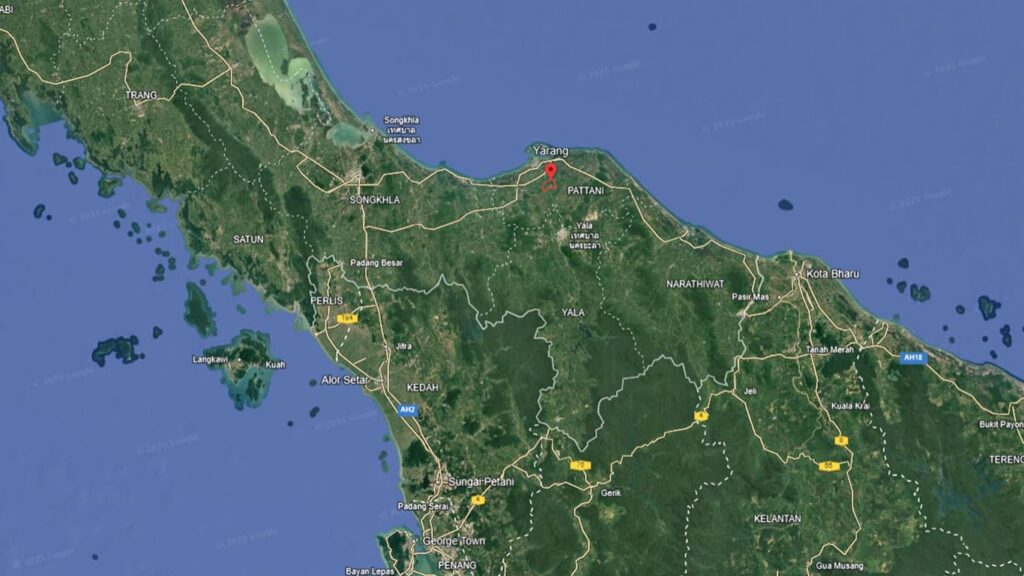
In conclusion, for me, this all adds up.
1. You had a major Buddhist center right on a main trans-peninsular trade route on the Malay Peninsula.
2. If you look at the account of Chitu in the History of the Sui, it contains information about a journey by a Chinese official who, I would argue, went right over this trans-peninsular route to the Bujang Valley (too many details to explain here, but I’m throwing that point out here for later reference).
2. We see in the writings of Tang dynasty monk Yijing that several Chinese Buddhists spent time in Heling and that it was on the route to India.
3. It would make total sense that a Cambodian monarch would want to control a trans-peninsular route like the one between Pattani and the Bujang Valley. In earlier centuries we see Funan bringing areas further north on the Malay Peninsula under its control, presumably to control the trans-peninsular trade routes there, so it would be totally logical for the same thing to happen further south.
4. This relationship between Sanfoqi and Foluo’an comes after the Chola attack on the Malay Peninsula world of Shepo (which I suspect might have come at the request of Sanfoqi, since Shepo had attacked Sanfoqi right before that point).
The New History of the Tang records that Heling was also called Shepo. What I suspect the reality was is that Heling at that time was one of the more important polities in the larger “mandala state” of Shepo. What seems to have happened by the Song dynasty period, is that, following the Chola attack, Sanfoqi/Kambuja had taken control of areas formerly under Shepo control/influence.
This would have constituted another episode in the ongoing rivalry between Shepo and Sanfoqi.
Finally, I had long thought that Heling could have been “Talung,” an earlier name for Phatthalung, but given that you have clear archaeological evidence at Yarang, and given that I now can see that Heling and Foluo’an could easily be variations of the same term (one earlier, one later), unless someone gets out the LIDAR and finds something significant in the Phatthalung area, for now I’m going to assume that both of these names were a reference to Yarang.
Ok, that’s Foluo’an. Next is Riluoting. . .


Alright this section, according to translations raised a few questions: assuming they are correct and Sanfoqi is Cambodia:
____
1. How did Cambodia supposedly control Palembang and Sri Langka in those years? Or at least how did the Chinese got that impression?
2. In the 16th century, Spanish governors stated that there are superb Cambodian ships remaining in the Philippines. (Source: BP Grosier) So great ship-building and navy would not have been stranger to the Angkorian Khmers, but the idea that they can subjugated Sri Langka in the medieval age that far away is too much beyond belief.
3. Early histories on Burma by Luce suggests from the Sri Lanka chronicles that the island was able to take Ramanadesa (which could included Upper Burma). We know that Sri Lanka was invaded by the Cholas, which was allied with Angkor around the 11th century. (honestly, I haven’t got a grasp on it yet) Whatever it is, it sounded that the medieval trade world is very connected.
4. It may have been Sanfoqi, as suggested by other researchers is that it is an more like an alliance? Maybe Zhenla was the more centralized government, (like Austria) and Sanfoqi was an alliance (like the Holy Roman Empire or the Teutonic League)? Just a thought. No ideas how it would work.
___
Also, Zhenla capital being Luwu (if translated to Longvek) can refered to the other cities beside the 16th century capital. All it meant was that it is a crossroad. Longvek is a crossroad/intersection between the rivers, just like CanTho and Phnom Penh. Just like there are many “Angkors” in Cambodia today, not just the most famous one.
Thanks for the comments!!
As I said recently in a comment somewhere, “is a vassal” of does not always literally mean that. It simply means that there is some kind of relationship between the two places, such as these smaller polities presenting tribute items to Sanfoqi, but beyond that, there would be nothing else to the relationship (i.e., no political aspect).
The key point to understand is that there was a major rivalry between Shepo (a place that controlled key trans-peninsular trade routes in the mid-Malay Peninsula) and Sanfoqi/Cambodia (as accessed through Ha Tien). So, in other words, you had two places right across from each other in the Gulf of Thailand who were rivals.
In the late 900s, Shepo attacked Sanfoqi/Cambodia and appears to have at least gained control of their trade. Not long after that, the Chola attacked the area of Shepo, and after that, there is evidence of the Chola (or Tamils) taking charge of the trade of Sanfoqi/Cambodia.
The information that is recorded about the vassals of Sanfoqi/Cambodia comes from the 1225 Zhufan zhi, in other words, it comes from the post-Chola attack period. In that text, there is still a Shepo, but we see that Sanfoqi/Cambodia has “vassals” all the way down the Malay Peninsula (skipping the area where Shepo was) and up the coast of Sumatra.
I think this was an effort to create a trade network around Shepo. I wrote about that a long time ago here.
https://leminhkhaiblog.com/the-singora-angkor-rivalry-the-greatest-story-of-premodern-southeast-asian-history-youve-never-heard/
As for the alliance idea, I’m not sure. Is an alliance different from a trade network?
At different points in the past, we can find Funan conquering areas of what is now southern Thailand, stationing officials at what is now Nakhon Si Thammarat, and as I mention in this post above, perhaps around Pattani/Yarang as well. So, Sanfoqi clearly could project power and maybe didn’t need an alliance, but it did want precious trade items from places.
An alliance with the Chola kingdom? That might have happened, but I don’t know exactly how we would describe the relationship with these other places.
I think Fuloan is kedah, because one of srivijaya vassal is kedah, but kedah not mention in there..and kedah neighbor with langkasuka kelantan terengganu and pahang..there is no perak and selangor during that time..kedah sometime written as gu lou, pronounce as kalah and ‘an’ maybe aman because kedah called as darul aman.
Thank you for your comment!
It is hard to respond to this, because the way I have come to understand this issue from examining the sources for the past 5 years is different from the way everyone else sees this.
How does everyone else see this?
1) Most people think a place that the Chinese called Shilifoshi was “Srivijaya at Palembang.” – I disagree, I think Shilifoshi was an early polity on the Malay Peninsula perhaps where Chaiya is today (and to be fair, many other people have made this point, as the historical evidence overwhelmingly places it in that area).
2) Based on #1, most people have interpreted the mention of Kedah (Jiecha) in an annotation to a text written by the Chinese Buddhist monk, Yijing, who traveled through the region in the late 600s, as evidence that Kedah was a vassal of Srivijaya.
I disagree, and argue that Shilifoshi was not “Srivijaya,” but instead, was a polity somewhere around Chaiya that attempted to control the trans-peninsular routes on the northern half of the Malay Peninsula, and this included Kedah. In other words, Kedah was connected to places to its north, not to its south. (https://leminhkhaiblog.com/i-finally-figured-out-yijing/)
3) Most people think Sanfoqi = Shilifoshi = Srivijaya. I don’t think this at all. As I said, Shilifoshi was far up the Malay Peninsula. I have by now written a ton to demonstrate that Sanfoqi = Cambodia (and more specifically, the access point to the Cambodian world on what is now the southern coast of the Indochinese Peninsula probably at what is now Ha Tien.
4) Most people think Shepo = the island of Java. I disagree, and have written a lot about this too. I think Shepo was somewhere in the Lake Songkhla region. I think it probably emerged in competition with Shilifoshi to its north, and eventually came to dominate the trans-peninsular trade. Indeed, I think there is a major “lost history” of this region which is all about competition for control of the trans-peninsular trade routes.
I also think that 1) this is where “Srivijaya” (the “royal district”) was (and that the inscriptions in southern Sumatra were part of an attempted southern expansion of this polity’s influence), and that 2) Kedah eventually became its main vassal, which is not surprising given that it was located at the end of a trans-peninsular trade route that crossed over from the Lake Songkhla region Further, I argue that Shepo was the place that Arabs referred to as Jaba, and likewise, they saw Kedah (Kalabar) as its main vassal.
Finally, all of these different views that I have are not “guesses,” but are based on an extensive examination of the relevant texts, and I have documented all of this in numerous writings.
Having said all that as background, I don’t think Foluo-an is Kedah. First, the limited geographic information about it doesn’t place it on the west coast of the Malay Peninsula. Second, I think Kedah is actually referred to in the Zhu fan zhi, just not explicitly.
What I have argued, is that the Zhu fan zhi represents a post-Chola-attack picture of the region. Prior to that attack, Shepo [Jaba/Java] was the dominant trading hub in the region (this is how the 12th-century Lingwai daida describes it), and it attacked Sanfoqi (southern coast of Cambodia). The Chola attack was in response to this (For a sense of the history at that time see this: https://leminhkhaiblog.com/the-history-of-cambodia-you-never-knew-about/).
The 13th-century Zhu fan zhi describes the scene after the Chola attack. I wrote about this years ago.
(https://leminhkhaiblog.com/the-singora-angkor-rivalry-the-greatest-story-of-premodern-southeast-asian-history-youve-never-heard/)
What do we see? First, Sanfoqi’s vassals are mentioned, and they follow a line down the eastern coast of the Malay Peninsula, skipping by Shepo, and up through the Straits of Melaka to the northern tip of Sumatra.
Those Sanfoqi vassals are then followed in the Zhu fan zhi by information about Shepo. In this work, Shepo is no longer referred to as a trading powerhouse, however, I suspect that what was left of Shepo was still connected to Kedah. The Zhu fan zhi mentions that from Shepo, the sea could be reached in the four directions, and the direction to the south clearly appears to be a reference to Kedah, as it says that from there one could reach the place where Dashi (traders from South Asia and the Middle East) were (could be a reference to the northern tip of Sumatra).
Finally, the mention of a connection between Sanfoqi (Cambodia) and Foluo’an in the earlier Lingwai daida makes sense in this context. Foluo’an was, I argue, on the Kedah to Langkasuka trans-peninsular route. From the 1183 Grahi inscription, we see evidence of a Cambodian presence in the area of Nakhon Si Thammarat, at the end of another trans-peninsular route.
However, we don’t have evidence of a Cambodian presence in the Lake Songkhla region. I don’t think this is a coincidence. This was the area of Shepo/Srivijaya, the main rival of Sanfoqi/Cambodia. While the Chola appear to have destroyed that area, it looks like it continued to exist, albeit with much less power and influence, and Kedah probably still remained connected to it. However, Sanfoqi/Cambodia had many ways to bypass a weakened Shepo, and that’s what we see to a limited extent in the Lingwai daidai, but more clearly in the Zhu fan zhi.
So, that’s a long answer, but judging from what you wrote, it looks to me like we probably have different understandings of the historical sources, so that’s why I felt the need to explain more.