
If you don’t know what this title means, then you can read these blog posts to find out more:
“Yijing did NOT Visit Jambi/Srivijaya”
“I Found “Malayu / Malaya / Malāyur!!!”
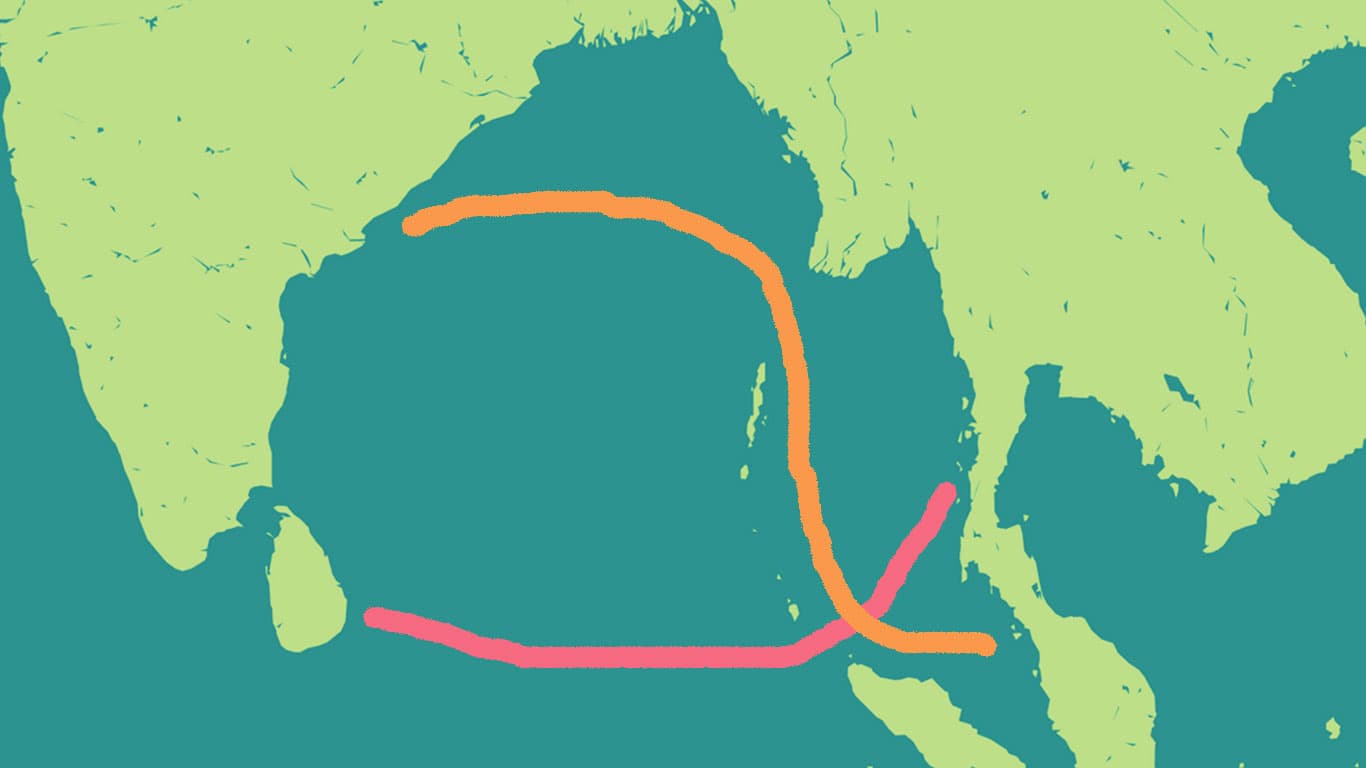
The gist is that there is a Tang dynasty monk, Yijing, who traveled to India and back in the late seventh century. The route that he took has been discussed in many writings, and everyone (that I know of) thinks that Yijing went around the Malay Peninsula.
I argue that he went across the Malay Peninsula from the area of what is now Surat Thani in southern Thailand to the area of what is now Phang Nga province.
However, in writing about this before, I struggled to make sense of some information that Yijing recorded about the return journey. The way I’ve seen everyone understand that passage, and the way that I previously understood it, is that Yijing described a route from northern India to Kedah, and then south to a place called Moluoyu.
I think everyone out there thinks that this Moluoyu here refers to a place on the island of Sumatra. However, I have found convincing evidence (see the second post linked above) that indicates that this Moluoyu (also appearing in Arabic texts as Malāyur and in other Chinese texts variously as Mulayou 木剌由, Moulayou 沒剌由, Maliyu’er 麻里予兒, Wulaiyou 巫来由/無来由, and Malaihu 馬來忽 – and note the “r” at the end) was on the western side of the Malay peninsula TO THE NORTH of Kedah, perhaps somewhere around what is now Phang Nga province in Thailand.
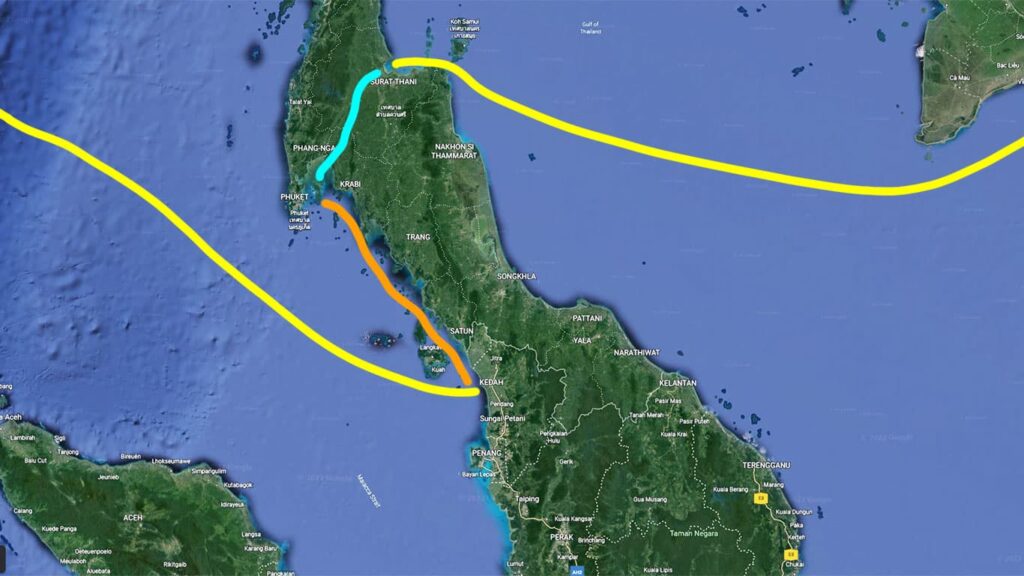
So, how could Yijing go SOUTH from Kedah to get to a place to its NORTH? In fact, in his text, Yijing uses an unconventional expression here, “nanshang” 南上, literally meaning “south up.” This made me wonder if he was indicating that he took a boat “coming up from the south,” but I wasn’t sure.
Now, however, I realize that we have all been reading this passage incorrectly.
To recap, let’s look at the information about Yijing’s journey from China to India. To quote, Yijing recorded the following:
未隔兩旬果之佛逝。經停六月漸學聲明。王贈支持送往末羅瑜國(今改為室利佛逝也)復停兩月轉向羯荼。至十二月舉帆還乘王舶漸向東天矣。從羯荼北行十日餘至裸人國。
In less than twenty days I reached Foshi 佛逝. I passed six months gradually learning the Śabdavidya. The king bestowed support and sent me off to Moluoyu (This has now been changed to Shilifoshi), where I again spent two months and then changed direction toward Kedah. At the time of the twelfth lunar month, the sails were hoisted and I boarded the king’s ship headed for India. From Kedah I went north for more than ten days and reached the kingdom of Naked People.
Ok, so Yijing went first to Foshi. I argue (based on the amount of time that it took to get there mentioned in this and other texts) that this was somewhere around the area of what is now Surat Thani, and which would then have been on the eastern side of a trans-peninsular route. Yijing then crossed over to Moluoyu, somewhere on the western side of that trans-peninsular route.
He then went south to Kedah, and from their headed north again, with the kingdom of the Naked People possibly indicating some place in the Andaman and Nicobar Islands (that’s what scholars have guessed).
Now let’s look at what Yijing said about how one returned from India.
The passage about Yijing’s return journey was translated in 1961 by geographer Paul Wheatly in his The Golden Khersonese as follows:
“[Tāmralipti] is the place where we embark when returning to China. Sailing from here towards the south-east, in two months we come to Jiecha [Kedah]. By this time a ship from [Shili]Foshi will have arrived, generally in the first or second month of the year. . . We stay in Jiecha until winter, and then embark on a ship for the south. After a month we come to the country of Moluoyu which has now become Foshi. . . We generally arrive in the first or second month. We stay there until mid-summer, when we sail to the north and reach Guangfu (Guangdong) in about a month. The voyage is completed by the end of the first half of the year.” (42)
There are serious problems with this translation, and I addressed them the first blog post linked above. However, there was one aspect of this passage that I didn’t fully understand at that time.
Notice the ellipses (. . .) in Wheatley’s translation. In this passage, Yijing also talks about how one travels to Sri Lanka from the western side of the Malay Peninsula (although he doesn’t indicate where one departs from). This is what Wheatley left out, but in fact, he didn’t leave out enough. Some of the information Wheatley has here describing the return journey to China is actually about the journey to Sri Lanka AND BACK.
This is what I did not realize before. Yijing provides information about the journey to Sri Lanka AND BACK to the western side of the Malay Peninsula.
This is how I now see this passage should be translated:
即是昇舶入海歸唐之處。從斯兩月汎舶東南到羯茶國此屬佛逝。舶到之時當正二月。若向師子洲西南進舶傳有七百驛。停此至冬汎舶南上一月許到末羅遊洲今為佛逝多國矣。亦以正二月而達。停至夏半汎舶北行。可一月餘便達廣府經停向當年半矣。
[Tāmralipti] is the place where one boards a ship and enters the sea on the return journey. From here one sails for two months to the southeast until one reaches the polity of Kedah [Jiecha 羯茶]. This belongs to Foshi 佛逝. One arrives in the second lunar month.
To travel to the island of Sri Lanka [師子洲 Shizi zhou], one heads by boat forward into southwest for [the equivalent of] 700 courier stations. One stays there until winter, and then in taking a boat coming up from the south, one reaches Moluoyu in a little over a month. Now this is the kingdom of Foshiduo 佛逝多. It is also in the second lunar month that you arrive.
One waits until the middle of summer, and then taking a boat to the north, one can reach Guangfu. . .
The first thing to note is that in this passage, Yijing is not recounting his personal journey (although this is probably the way he went). He is talking in general about the routes between China and India, the northern route across the Bay of Bengal and the southern route to Sri Lanka.
What I did not previously realize, is that in talking about the route to Sri Lanka, Yijing mentions the route there and back.
What I have translated as “coming up from the south” (nanshang) needs to be seen in opposition to what I have translated somewhat literally as “forward into the southwest” (xinan jin 西南進, literally “southwest entering”).
Further, the information about timing is also crucial. In traveling from northern India, you leave in winter and arrive in Kedah in the second lunar month. In traveling from Sri Lanka, you also leave in winter and arrive in Moluoyu in the second lunar month. Again, Yijing describes here the journey to Sri Lanka and back.
As for the names, Foshi and Foshiduo, those are both references to Shilifoshi, and as said, I believe that this place was probably located on the eastern side of the trans-peninsular crossing between what is now Surat Thani and Phang Nga province in Thailand.
Further, that both Moluoyu and Kedah would be mentioned as being under the control of Shilifoshi makes perfect sense for a trans-peninsular empire. Shilifoshi was controlling the two main ports that ships coming from the west first stopped at.
In the years that followed, I argue that a trans-peninsular empire in the Songkhla-Kedah area rose up to overtake Shilifoshi’s dominance. This is the place that foreigners would refer to as “Jaba/Java,” and which would become a major rival of Sanfoqi/Kambuja.
But wait, if Moluoyu was to the north of Kedah, as I argued, why would boats taking the northern route leave from and arrive at Kedah, further south down the coast, and why would boats coming from Sri Lanka arrive at Moluoyu?
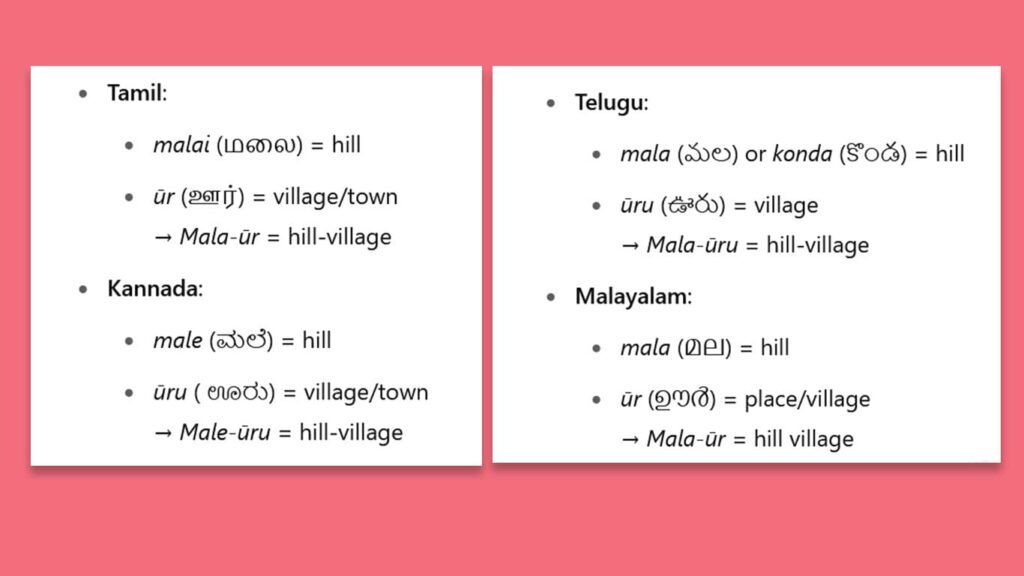
A couple years ago, a colleague mentioned to me that in several Dravidian languages in southern India, “ur” is the word for village. As I stated above, this Moluoyu is recorded in other texts, both Arabic and Chinese, as something like “Malayur.”
I don’t think that this is a coincidence. The idea that there were “Indian colonies in the East” was never taken very seriously in the West. . . but why not? Why wouldn’t there have been South Asian trading communities that had permanent settlements on the west coast of the Malay Peninsula at the end of a cross-peninsular trade route?
After all, trading in exotica was serious business.
This, I would argue, is what the eleventh-century Chola attack was all about. That attack was directed at the Songkhla-Kedah trans-peninsular route, and by people from southern India.
Controlling those ports was a big deal, and that is why Shilifoshi earlier extended its control over both Moluoyu/Malayur and Kedah. This is the world that Yijing documented.
And again, when you put aside the Srivijaya theory and just study the sources. . . they really make sense!!