
There is a place name in early Chinese sources called “Linyi” 林邑.
For 100+ years, scholars have been trying to figure out where exactly it was, and how it was related to other places like one called “Huanwang” 環王 as well as the term that came to be used for what we call “Champa,” Zhancheng 占城.
I have just spent the past two days looking at some of the main sources, and I find it extremely straight-forward. I have no idea why this topic has been such a struggle for so many scholars and for so long.
One main question has been whether Linyi was in the area between the Hải Vân and Ngang Passes, or whether it was to the south of there, in the area of the Thu Bồn River valley, what people see as a Cham “heartland,” in no small part thanks to the existence in that area of archaeological remains and inscriptions.
I think everyone agrees that Linyi established itself as a polity at the southern frontier of a Chinese administrative unit known as Rinan Commandery. The question is, was that southern limit at some place to the north or the south of the Hải Vân Pass?
With the help of Gemini 3, I just translated the passages on Linyi (and in one case, Huanwang) in the History of the Sui (636), the History of the Jin (648), the Tongdian (801), the Old History of the Tang (945), the New History of the Tang (1060).
The first point I would make is a basic one. If Linyi was in the area of the Thu Bồn River valley, which is to the south of the Hải Vân Pass, then I find it extremely odd that no mountain is ever mentioned in any of the sources above.
Instead, for instance, we learn from the History of the Sui that:
仁壽末,上遣大將軍劉方為驩州道行軍總管,率欽州刺史甯長真、驩州刺史李暈、開府秦雄步騎萬餘及犯罪者數千人擊之。
At the end of the Renshou era [c. 604 AD], the emperor dispatched General-in-chief Liu Fang as the Commander-in-Chief of the Huanzhou Route Marching Army. He led Ning Changzhen, the regional inspector of Qinzhou; Li Yun, the regional inspector of Huanzhou; Commander Qin Xiong; along with over ten thousand infantry and cavalry and several thousand convicts to attack [Linyi].
So, these guys marched and rode over the Hải Vân Pass and made no mention of it? Ok. . .
Meanwhile we learn in the Tongdian that “Linyi lacked [arable] land and therefore coveted the territory of Rinan,” and that this is why it periodically attacked Rinan.
Again, there is no mention of mountains here, but let’s just put that aside and think: if you are in the Thu Bồn River valley and you lack land, why would you cross a major mountain pass to the north and try to hold land on the other side of that mountain, land that is claimed by another polity? How would you be able to maintain, or even tax, that land?
Further, we see in these texts that over the centuries there was a back-and-forth rivalry between Linyi and Rinan, where one would attack the other or try to take control of the other’s territory.
Again, there is no mention of a mountain ever serving as a potential obstacle that had to be crossed. Instead, it looks like it was pretty easy for these two sides to attack each other.
All of this leads me to see Linyi as being at the southern end of the area between the Hải Vân and Ngang passes.
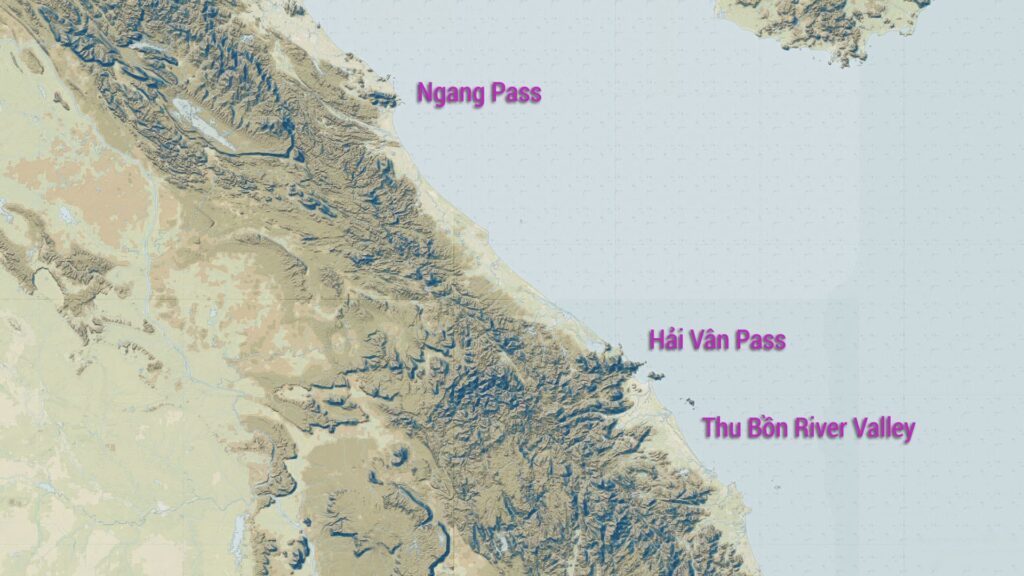
It’s location there also explains why it suddenly “disappears” from Chinese sources after the Tang dynasty period. From the Han to the Tang dynasties, that area was part of the empire. Linyi gets mentioned in Chinese sources during those centuries precisely because it was right there on the edge of the empire.
After the Tang, “Vietnam” broke away, and the southern edge of the Chinese empire moved far northward to the Sino-Vietnamese border. Hence, there was no reason for Linyi to appear in Chinese sources anymore as the Chinese didn’t have anything to do with the place anymore.
Before that happened, the Chinese gave Linyi one last beating. According to the New History of the Tang, this kingdom had, by that point, “changed its name” to Huanwang. It then states that:
In the early Yuanhe era [806–820 AD], they did not pay court or offer tribute. The Protector General of Annam, Zhang Zhou, captured their bogus (wei 偽) governors of Huan and Ai prefectures, beheaded thirty thousand ranks, captured fifty-nine princes, and seized war elephants, boats, and armor.
元和初不朝獻,安南都護張舟執其偽驩、愛州都統,斬三萬級,虜王子五十九,獲戰象、舠、鎧。
What we can see in this passage is that “Huanwang,” had attempted to extend its control to places even beyond the Ngang Pass, Huan Prefecture. However, Zhang Zhou appears to have caused some serious damage to them.
What exactly was Huanwang? In 604, the Sui sent Liu Fang to attack a Linyi king called Fan Zhi. The Tongdian says that after the attack, “Fanzhi gathered the remaining people and built a different capital city” while the History of the Sui records that “Fang withdrew his army. Fan Zhi recovered his former territory and sent envoys to apologize for his offenses. Thereupon, the tribute missions continued without interruption.”
Several decades later, in the mid-600s, there was a lot of political turmoil in Linyi, and there is an annotation in the Tongdian following this information that states, “The current lord of the Kingdom of Huanwang is a descendant of Fanzhi. The kingdom is located to the west of Rinan Commandery, and one arrives there after traveling more than twenty days by land.”
The Tongdian doesn’t indicate that Linyi had come to an end or that Huanwang had replaced it. Further, the term “lord” (guozhu 國主) refers to someone of a lower status that a king, such as the lord of a vassal state.
There are other brief comments in various sources that place Huanwang to the west of Rinan, and an itinerary I recently wrote about also suggests such a location. [https://leminhkhaiblog.com/wendan-was-sambor-prei-kuk/]
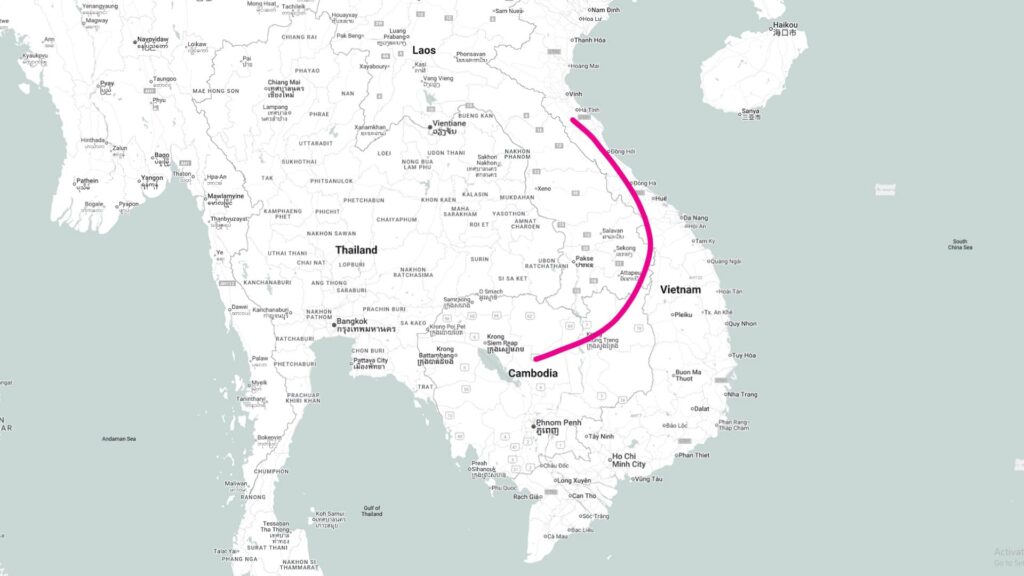
What does all of this mean? Besides the fact that “Linyi” kept fighting over the centuries with the Chinese for control of the area of Rinan, they also undoubtedly fought amongst themselves (the mention of brick walls in some texts and wooden palisades in others might suggest this or might be because a place was destroyed by the Chinese).
Huanwang was perhaps an inland/highland kingdom created by a prince who fled such conflict, but given that it was on a trade route that connected “Vietnam” with “Cambodia” at that time, he may have benefited from his kingdom’s location, and that is why we see “Huanwang” trying to take over Rinan in the early 800s, as it had obviously become powerful, and perhaps by that point it had overpowered whatever remained of Linyi.
That is my speculation, but what we can see is that Linyi and Huanwang were separate polities in separate places, and I don’t see evidence that either was in the Thu Bồn River valley. The only evidence that could suggest at least a connection with that area are three statements in the New History of the Tang that “Huanwang was originally Linyi; it is also called Zhanbulao [Cham Pulau],” “to the south, it reaches Benlangtuo Prefecture [Panduranga?],” and “The king resides at Zhancheng 占城 [Zhan/Cham Citadel]. His other residences are called Qiguo 齊國 and Pengpishi 蓬皮勢.”
That’s pretty much the only new information in this text. The rest is largely information that had already appeared in earlier texts.
However, if we then go and look at Song dynasty sources, we see that they talk about Zhancheng (“Champa”), and that they make no mention of Huanwang or Linyi. See, for instance, Geoff Wade’s translation of the section on Zhancheng in the Song Huiyao.
If these were the same place, then it’s very odd that this doesn’t get mentioned as it was extremely common in the Chinese historical tradition to mention the history of a place when talking about it. Instead, the Song Huiyao states of Zhancheng that, “In previous dynasties, this country rarely had contact with China,” and mentions the first contact as taking place in the mid-tenth century. The History of the Song contains the same information.
Hmmm. . .
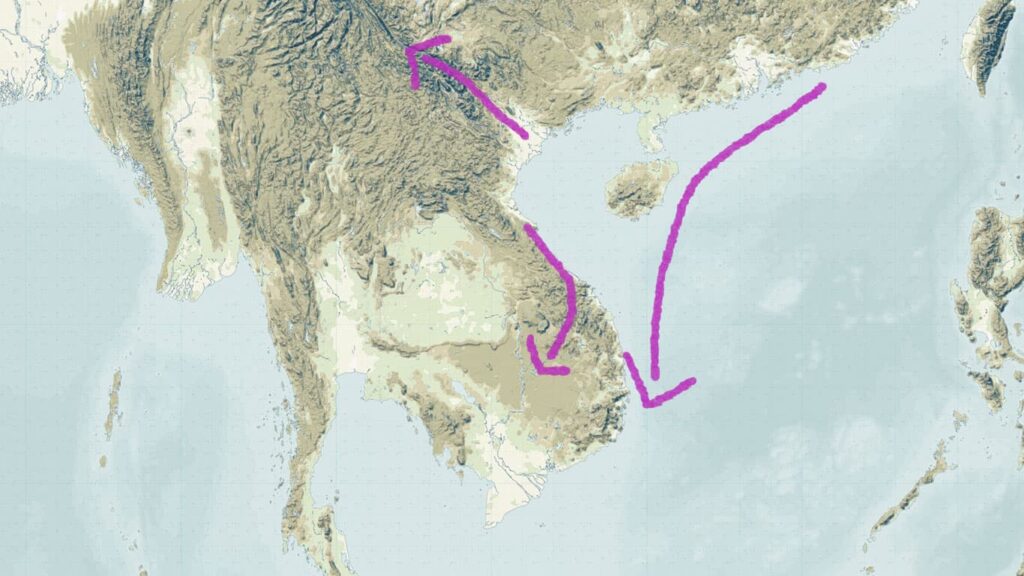
If we take a step back, I think we can see a major shift in the Song dynasty period. A lot of information got recorded about Zhancheng for the first time, and a lot of information got recorded about Sanfoqi 三佛齊 for the first time. Why was that?
I think this was at least in part related to the loss of Vietnam. As I wrote recently, during the Tang dynasty period, there was an overland trade route that went westward to India from the Red River plain. There was a maritime trade route that went from Guangdong down to the end of the Indochinese Peninsula and then over to the Malay Peninsula and then westward to India.
And finally, there was an overland trade route that went from roughly the Ngang Pass to Huanwang, and then to Cambodia, and then southward to the sea at (I argue) the area where Ha Tien is, where it connected with the maritime route to India and even further to the Middle East.
In losing Vietnam, the Chinese lost an important trade route – the one from the Ngang Pass to Ha Tien. The one from the Red River plain to India could still operate by going from Yunnan.
It’s logical to assume that the maritime route would have therefore gained in importance at that time. And that is why, during the Song, we see a lot of interactions with Zhancheng and Sanfoqi, which I’ve argued ad nauseum was a reference to the “access point” to “Cambodia” at Ha Tien.
Previously, the Chinese probably didn’t need to interact with Sanfoqi so much, because there was an overland trade route that went from that seaport all the way to the Ngang Pass, which was in territory that they controlled.
And if they didn’t need to go to Sanfoqi, then there was no reason to pass by Zhancheng either (obviously some people must have been doing this, but my argument is that it was not on the scale that it would be later during the Song period).
Further, I suspect that the unique statements in the New History of the Tang about Huanwang that “Huanwang was originally Linyi; it is also called Zhanbulao [Cham Pulau],” “to the south, it reaches Benlangtuo Prefecture [Panduranga?],” and “The king resides at Zhancheng 占城 [Zhan/Cham Citadel]. His other residences are called Qiguo 齊國 and Pengpishi 蓬皮勢” might reflect new information that was entering the Chinese world as the focus of attention moved from the former imperial lands in Vietnam to the maritime zone to its south.
The New History of the Tang was compiled in 1060, during the Song dynasty period, and yet in the History of the Song and the Song Huiyao, there is no mention of Huanwang. Further, the above details do not appear in earlier texts. So, where did that information come from?
It’s possible that the mention of three residences is pointing to some kind of trade “empire” that stretched down into the Thu Bồn River valley from the highlands, where other sources suggest Huanwang was located. But given the previous information about Huanwang, and the fact that there is no information about it in Song dynasty sources, makes it difficult to see this as a reference to a polity based in the Thu Bồn River valley.
As such, when it comes to trying to link Linyi and Huanwang kings with the names of rulers in inscriptions that have been found south of the Hải Vân Pass, as some scholars have attempted to do, that makes little sense to me. Linyi and Huanwang were clearly not based in that area.
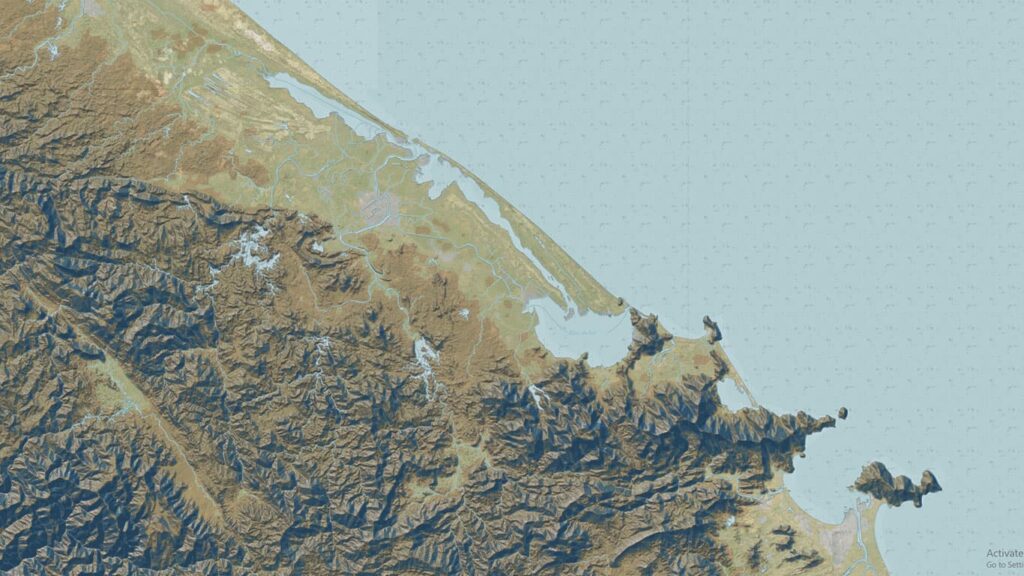
So, where exactly was Linyi? The image above is of the coastline to the north of the Hải Vân Pass, where Hue is located today. I think it is obvious from that image that the coastline there must have changed a lot over the past 1,500 years.
Later I will write about information about Linyi in the sixth-century Shuijing zhu 水經注, however, what I can say now is that it was in an area of numerous rivers and inlets or estuaries. I’m not a historical geologist, but just looking at the image above, I would bet money on it that the area to the north of the Hải Vân Pass was precisely such a place 1,500 years ago.


There’s another historian/linguist who speculated that the majority of Linyi people were Austroasiatic of the Katuic branch while the people in power spoken Austronesian. Though after all the Chamic branch itself is very Austroasiatic (SVO sentence structure, analytic, derivational prefixes, registers to tonal, significant Austroasiatic loans…) distinct from the majority of Austronesian languages.
Gérard Diffloth 1939-2023
Thank you for the comment! If you know/remember where Diffloth wrote about that, please let me know.
It’s logical that there would be Austroasiatic speakers there. However, I find it difficult to find evidence. I asked a linguist colleague of mine about a term that appears in the Shuijing zhu, jiu 九, that means something like “rapid” or “mountain stream” or something like that. He checked to see if there was a match/resemblance between how this term might have been pronounced [Pulleyblank reconstructs *kuwH (while Late Middle Chinese, around turn of 2nd mill., is kjuwH)] and terms in Austronesian and Austroasiatic languages, but could not come up with a match.
I’ll paste below here what I wrote.
I’ve started looking at the Chinese sources for “Linyi,” and the Shuijing zhu in particular. There is a term that gets used there, 究, which is clearly a local term, and I’m wondering if it’s possible to determine what it might be.
Here is a passage where it appears (in chapter 36):
九德浦內逕越裳究、九德究、南陵究。按《晉書·地道記》,九德郡有南陵縣,晉置也。竺枝《扶南記》:山溪瀨中謂之究。《地理志》曰:郡有小水五十二,并行大川,皆究之謂也
Inside the Jiude Inlet/Estuary, [the route] passes the Yueshang Jiu, the Jiude Jiu, and the Nanling Jiu.
According to the Record of the Land and Roads of the Book of Jin, Jiude Commandery contains a Nanling County, which was established by the Jin dynasty.
Zhu Zhi’s Records of Funan states: “Mountain streams flowing through rapids are called jiu.”
The Treatise on Geography states: “The commandery has fifty-two small waterways flowing alongside the great river; these are all what are referred to as jiu.”