

From the late 1980s into the early 2000s, there was a trend in the field of early modern Asian history to write synthetic volumes that tried to document economic and social changes over long periods of time.
If I remember correctly, I think this started with works like Janet L. Abu-Lughod, Before European Hegemony (1989) and Andre Gunder Frank, ReORIENT: Global Economy in the Asian Age (1998), and then culminated roughly a decade later with works like Kenneth Pomeranz, The Great Divergence: China, Europe, and the Making of the Modern World Economy (2000) and Victor Lieberman, Strange Parallels: Southeast Asia in Global Context, c. 800–1830 (Vol. 1, 2003).
These were all thought provoking works, but they were also problematic because many of the claims that these authors made required quantitative information that the sources simply do not provide.
I was reminded of this type of scholarship yesterday when I was reading a chapter that was published three years ago and which talked about population growth in Vietnam in the fifteenth century and said, “According to some estimates, the population may have tripled in less than a century between 1417 and 1490, even as Vietnam’s territorial expanse had remained largely unchanged since before independence.”
The source of this information was one of the above works, page 386 in the first volume of Victor Lieberman’s Strange Parallels. Knowing that Lieberman cannot read classical Chinese or Vietnamese, and knowing that this information is in one of these problematic works, I decided to take a look at where Lieberman got his information.
So, I went to page 396 of the first volume of Strange Parallels and found the following:
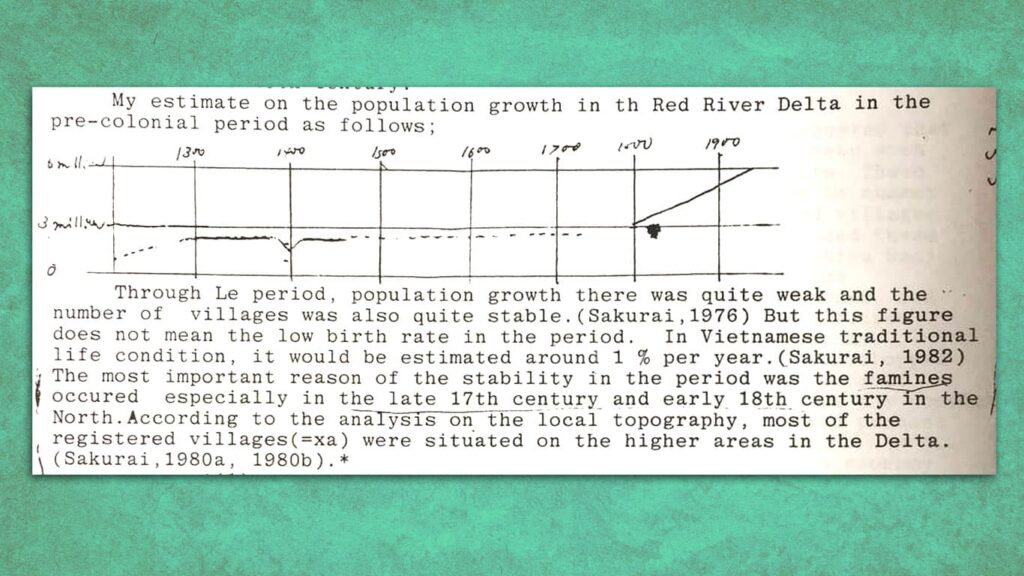
Sakurai estimates that the delta population rose from its nadir of 1.6 million in 1400 to about 2.5 million in 1490, which was at or above its 14th century peak. After analyzing chronicles, censuses, and village records for frontier areas as well as the delta, Li Tana has estimated that the population of northern Vietnam as a whole tripled during the early Le, from 1,862,000 in 1417, to 4,373,000 in 1490, to 5,625,000 in 1539. The number of villages (xa) rose proportionately (see Figure 4.2).
For Sakurai, the reference is: Sakurai, “Age of Commerce,” 3.
There is no bibliography in the first volume of Strange Parallels, so I had to go looking back earlier in the book to see if there is more information about this publication in the place where it was first mentioned, and there is. On page 362 it is listed as: Yumio Sakurai, “Vietnam After the Age of Commerce” (ms).
Ok, so I then see that it is an unpublished manuscript. . .
For most people, that’s where the trail would end. You’d just have to trust Lieberman and Sakurai that the information is accurate. . . That’s not what I would consider a good scholarly practice.
Someone I know, however, reached out to Professor Lieberman for a copy of this manuscript, and Professor Lieberman graciously obliged. Years later, that person shared it with me. I was able to locate it now. It is a 5-page typed letter that historian Yumio Sakurai sent to Victor Lieberman in which Professor Sakurai shared his ideas about various topics.
In some cases, Professor Sakurai would place in paratheses a form of citation to indicate the published work where the information was coming from, such as “(Sakurai, 1980),” but there is no bibliography included.
In the case of the claim that “Sakurai estimates that the delta population rose from its nadir of 1.6 million in 1400 to about 2.5 million in 1490, which was at or above its 14th century peak,” I didn’t see this written on page 3, so I looked through all five pages, but still couldn’t find this written anywhere.
Then I realized that it’s not written, but instead, it appears in the following hand-drawn table with no indication of where the estimated numbers come from:
Oh boy. . .
Then I decided to check the claim that “After analyzing chronicles, censuses, and village records for frontier areas as well as the delta, Li Tana has estimated that the population of northern Vietnam as a whole tripled during the early Le, from 1,862,000 in 1417, to 4,373,000 in 1490, to 5,625,000 in 1539. The number of villages (xa) rose proportionately (see Figure 4.2).”
First of all, a tripling of 1,862,000 would be 5,586,000, not 4,373,000, so Lieberman got a bit too excited about how much growth Li Tana claimed took place.
Beyond that, even before checking, I already knew that there basically are no “censuses, and village records for frontier areas as well as the delta” in the fifteenth century that can enable us to come up with a comprehensive view of the total population, so I was really curious to see what Li Tana actually cited.
The reference is to Li, Cochinchina, 159–72, esp. Table 4. That’s a reference to Li Tana’s 1998 work, Nguyễn Cochinchina: Southern Vietnam in the Seventeenth and Eighteenth Centuries where there is an appendix in those pages on “Population Change in Vietnam from the Sixteenth to Eighteenth Centuries.”
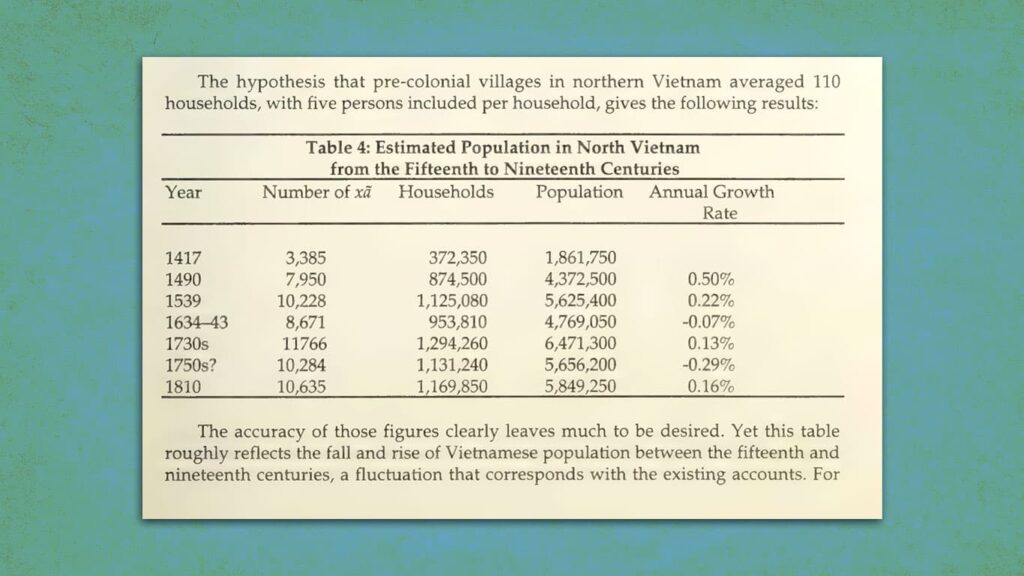
So, I look at Table 4, and see that it has columns for “Number of xã,” “Households,” and “Population.” A “xã” is like a village, and Li has a formula for calculating the number of households per xã and the population is then similarly calculated from the number of households.
Without going into all of that, the first thing that we would need to know is where a number like the “3,385” for the supposed number xã in 1417 comes from, as this number is the starting point for the calculations that lead to the population number.
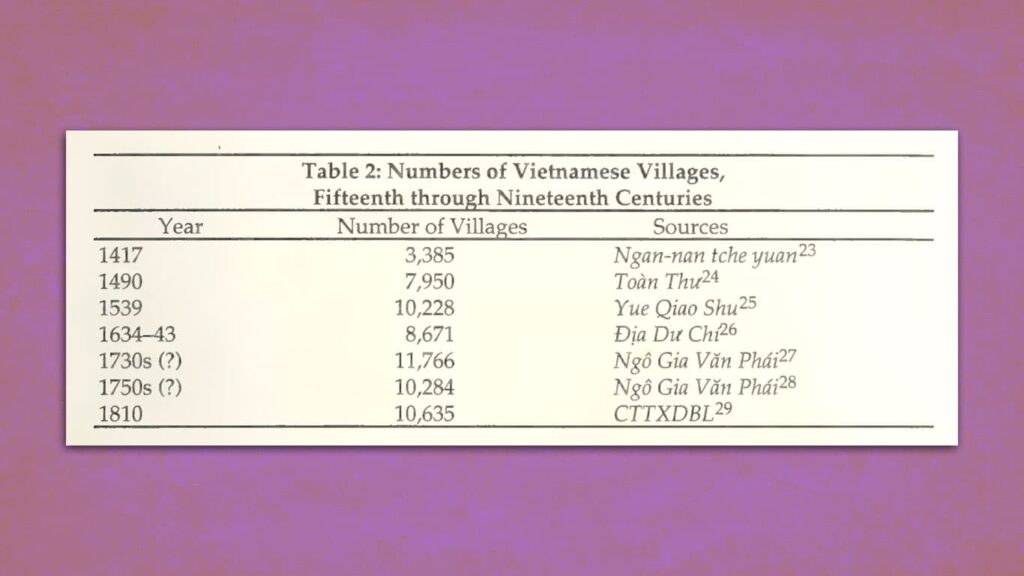
The source for that information is referenced in Table 2, which cites page 60 of “Ngan-nan tche yuan.” This is the Annan zhiyuan 安南志原, a Ming-ocupation-era gazetteer of Vietnam.
The number 3,385 does indeed appear on page 60, at the end of a passage about “Wards, Lanes, Townships, and Towns.” However, it is not a total of the number of xã or what I have in the translation below as “communities,” but of something else. Take a Look.
坊廊鄉鎮。
交趾之地。原無城廓鄉鎮等名。僞越外紀。唐刺史丘和。始於州縣內外。分縣置小鄉大鄉。小社大社。小社自十戶至三十戶。大社自四十戶至六十戶。小鄉自七十戶至一百五十戶。大鄉自一百六十戶至五百四十戶。貞元間。都護趙昌。廢大小鄉。總謂之鄉。咸通中高駢。分置鄉屬。凡一百五十九。梁開平中。節度曲灝。又改鄉為甲。增置一百五十。通前為甲三百十四。李陳之時。或因或革。今據各州縣開報。於鄉社之外。又有曰坊。曰街。曰市。曰村。曰場。曰册。曰庄。曰峒。曰澚。曰廊。曰汀。曰路。曰寨。曰地。曰圭。曰況。曰羅。曰峙。其名雖不同。然所以為坊廊鄉鎮之類。則一也。今依見報之名收之。其總數列於下。通計坊廊鄉鎮村市場册等項。共三千三百八十五。
Wards, Lanes, Townships, and Towns
The land of Jiaozhi originally had no named walled cities or villages and towns. According to the Pseudo Yue/Việt Outer Records [a reference to a Vietnamese historical text]:
In the Tang dynasty, Prefect Qiu He was the first to divide the areas inside and outside the prefectures and counties, establishing small townships and large townships, as well as small communities [xã 社] and large communities. A small community comprised 10 to 30 households; a large community, 40 to 60 households. A small township comprised 70 to 150 households; a large township, 160 to 540 households.
During the Zhenyuan era [785–805 AD], Protector-General Zhao Chang abolished the distinction between small and large townships and collectively referred to them simply as “townships.”
In the Xiantong era [860-874 AD], Gao Pian divided and established the township jurisdictions, totaling 159.
During the Kaiping era [907-911 A] of the Liang dynasty, Military Commissioner Qu Hao changed the townships into jia 甲 units and added another 150, bringing the total (including the previous ones) to 314 jia.
During the Lý and Trần dynasties [1009-1400 AD], some arrangements were retained and some were reformed.
Now, based on the reports submitted by the various prefectures and districts, in addition to the townships and communities there are also units called:
– wards 坊
– streets 街
– markets 市
– villages 村
– fields/markets 場
– registers [aboriginal settlement] 册
– estates 庄
– grottoes/valleys [aboriginal settlement] 峒
– inlets/bays 澚
– lanes 廊
– sandbars/shoals 汀
– roads 路
– forts/camps 寨
– lands 地
– plots 圭
– areas [?] 況
– collectives 羅
– peaks 峙
Although their names differ, they all belong to the same category as wards, lanes, townships, and towns. We now record them according to the names as reported. Their total numbers are listed below.
In total, counting all items such as wards, lanes, townships, towns, villages, markets, fields, registers, and the like, there are altogether 3,385.
Oh!! So, 3,385 is not the total number of “villages,” but instead, the total number of wards, lanes, townships, towns, villages, markets, fields, registers, and the like.
Clearly these administrative units could not possibly have all had a similar number of households. Therefore, Li Tana’s calculation of the population which takes as its starting point a proposed generic unit of the xã/village and which she argues had a common average number of households. . . that calculation is completely invalid, as this is not what the number “3,385” indicated.
We have no idea how many households were in these different various administrative units. Therefore, if we wish to use the household to calculate population, we have no way of doing so.
One thing we can see is how these units were distributed, and that’s fascinating. The above passage in the Annan Zhiyuan, for instance, goes on to record the following information:
交州府。社四百四十二。坊二十九。街四。市三十八。村七。汀八。
太原府。鄉二。社一百五十九。街一。市一。庄三十一。地七。
清華府。社三百二十五。街五。市三。册一百二十七。村二。庄九。澚十八。沉三。峙二。
北江府。社二百四十一。街七。市十九。
諒江府。社二百十七。街四。市十二。
諒山府。社一十一。坊四。街三。市二。村一百二十一。峒三十。
新安府。社三百五十五。街一。市一。
建昌府。社七十六。坊四。市七。
鎮蠻府。社八十二。市六。
奉化府。社八十一。市二。村一。
建平府。社九十七。坊四。街四。市十。
三江府。社一百五十五。街四。市十二。
宣化府。鄉十七。社五十八。坊三。市一。庄二十一。
乂安府。社一百一。庄二。册六十二。
新平府。社三十七。
順化府。社七十九。
廣威州。社五。册二十七。廊五。街五。
嘉興州。册二十七。
歸化州。村四。庄十八。路二。羅二。場一。册十。寨十一。
寧化州。市一。廊四。册四十四。
演州。社十三。册五。
Jiaozhou/Giao Châu Prefecture. 442 communities. 29 wards. 4 streets. 38 markets. 7 villages. 8 shoals.
Taiyuan/Thái Nguyên Prefecture. 2 townships. 159 communities. 1 street. 1 market. 31 estates. 7 plots.
Qinghua/Thanh Hóa Prefecture. 325 communities. 5 streets. 3 markets. 127 registers. 2 villages. 9 estates. 18 bays. 3 areas. 2 peaks.
Beijiang/Bắc Giang Prefecture. 241 communities. 7 streets. 19 markets.
Liangjiang/Lạng Giang Prefecture. 217 communities. 4 streets. 12 markets.
Liangshan/Lạng Sơn Prefecture. 11 communities. 4 wards. 3 streets. 2 markets. 121 villages. 30 caves.
Xin’an/Tân An Prefecture. 355 communities. 1 street. 1 market.
Jianchang/Kiến Xương Prefecture. 76 communities. 4 wards. 7 markets.
Zhenman/Trấn Man Prefecture. 82 communities. 6 markets.
Fenghua/Phụng Hóa Prefecture. 81 communities. 2 markets. 1 village.
Jianping/Kiến Bình Prefecture. 97 communities. 4 wards. 4 streets. 10 markets.
Sanjiang/Tam Giang Prefecture. 155 communities. 4 streets. 12 markets.
Xuanhua/Tuyên Hóa Prefecture. 17 townships. 58 communities. 3 wards. 1 market. 21 estates.
Yi’an/Nghệ An Prefecture. 101 communities. 2 estates. 62 registers.
Xinping/Tân Bình Prefecture. 37 communities.
Shunhua/Thuận Hóa Prefecture. 79 communities.
Guangwei/Quảng Oai Department. 5 communities. 27 registers. 5 lanes. 5 streets.
Jiaxing/Gia Hưng Department. 27 registers.
Guihua/Quy Hóa Department. 4 villages. 18 estates. 2 roads. 2 collectives. 1 field. 10 registers. 11 forts.
Ninghua/Ninh Hóa Department. 1 market. 4 lanes. 44 registers.
Yanzhou/Diễn Châu. 13 communities. 5 registers.
That’s all fascinating information, but we can’t figure out the population from it. In fact, it shows us the opposite.
It makes it extremely clear how impossible it would be to gain an accurate sense of what the population of such a diverse polity might have been.
Finally, as is the case with every time I “deconstruct” some extant scholarship, this isn’t a lone, “one-off” example. This is characteristic of the Southeast Asian history variety of this type of scholarship, a type of scholarship that pretty much reigned supreme for a couple of decades or more. While the works that came from scholars of other areas had limitations, as would be expected in any scholarship that attempts a grand synthesis, they were not anywhere to this degree.
This is because the basic work on places like premodern East Asia is much stronger than the basic work on premodern Southeast Asia.
In the 1990s, the field of premodern Southeast Asia was far from ready for synthesis, but people went ahead and did so anyway, because producing works that were almost entirely reliant on translations and secondary writings in English was far easier than doing the hard work of reading primary sources and figuring them out, as people in the world of East Asian Studies had long already done by that time.



It’s the worst kind of junk science. Sanjay Subrahmanyam has a typically caustic discussion of Tony Reid’s “Age of Commerce” and the heroic assumptions and sloppy methods behind many of Reid’s economic calculations (and Reid was Li Tana’s thesis adviser, so the apple doesn’t fall far from the tree). In most cases, it would be better to consult chicken entrails, as did the ancient Romans, to find the answers to these economic questions than to read this nonsense.It also has a terrible knock on effect since it makes its way into things like the late Angus Maddison’s GDP project, which tries to push back “national” GDP estimates into the medieval period. Broadberry et al claim to have estimates of Chinese GDP in the year 1000. Sand castles upon sand castles.
A reader left a comment on FB in which he pointed to this passage in the History of the Ming:
六年六月,輔等振旅還京,上交阯地圖,東西一千七百六十里,南北二千八百里。安撫人民三百一十二萬有奇,獲蠻人二百八萬七千五百有奇,象、馬、牛二十三萬五千九百有奇,米粟一千三百六十萬石,船八千六百七十餘艘,軍器二百五十三萬九千八百。於是大行封賞,輔進英國公,晟黔國公,餘敍賚有差。
“In the sixth year [1408], in the sixth month, [Zhang] Fu and the others returned to the capital in triumph, and presented a map of the Jiaozhi region. Its extent was 1,760 li east–west and 2,800 li north–south. They pacified 3,120,000-plus people; captured 2,087,500-plus savages; seized 235,900-plus elephants, horses, and cattle; obtained 13,600,000 shi of rice and millet; took over 8,670 ships; and collected 2,539,800 items of military equipment. Thereupon, the court carried out grand bestowals of rewards: Fu was promoted to Duke of Yingguo, Sheng to Duke of Qianguo, and the rest received promotions and gifts in graded amounts.”
I don’t think the “savages” here means non-Viet peoples. I think it’s people who resisted or were in areas where people resisted. I doubt that people in the mountains were included in these numbers yet.
In any case, this gives us a population of at least 5,207,500+ people if these numbers are to be believed (I don’t know how they could be so precise during a period of conquest, and there would have been an incentive to boost the numbers, but there were surely areas that had not yet been included, so. . .). That’s almost a million more than what Li Tana claims the population grew to by the end of the century.
For me, this is just all more evidence that supports the point that we can’t really say what the population was in the fifteenth century and what happened over time, other than to say that there were probably a few million people.