

The other day I was looking for information about “Temasek,” an early name associated with Singapore, and I came across a webpage hosted by the National Library Board (NLB) of Singapore which stated the following:
The name “Temasek” is probably derived from the same root as the word tasek, which means “lake” in Malay. Tasek implies a reference to a piece of land surrounded by water. Early documents that mention the name Temasek include: a Vietnamese eulogy for a deceased prince dated 1330; Dao yi zhi lue (“Description of the Barbarians of the Isles”) by Wang Dayuan in 1349; and the Desawarnana or Nagarakrtagama by Prapanca, a courtier of Majapahit, in 1365.
I also interrogated the AI snippet that Google provided above the link to this page and it provided the same information, and linked to this same page.
Ok, so, I am aware that the Daoyi zhilue and the Nagarakrtagama mention Temasek (Danmaxi 單馬錫, Tumasik), but I had never heard that “a Vietnamese eulogy for a deceased prince dated 1330” mentions it.
Fortunately, a reference of sorts was provided: The Vietnamese Royal Chronicle Dai Viet Su Ky Toan Thu on Temasek. (Record of 1330, Vol. 2, p. 118). And this gave me sufficient information to track down the passage.
It’s in Chapter 7 of the main annals of the Đại Việt sử ký toàn thư, the main chronicle of premodern Vietnam. There, in a passage marking the death of a member of the royal family, Trần Nhật Duật, it states the following:
佐聖太師昭文大王日燏卒,年七十七。日燏好與外國人遊,常騎象遊婆伽村其村廻李聖宗征占城,虜獲占人居之,以占語命名多加離,後訛為婆伽,或三四日,後返又遊祥符寺,與宋僧談語,信宿乃回。凣外國人來京者,徃徃雜至其家,如宋客則對坐交床,講話竟日,占人雜蠻,亦各以其國俗接之。仁宗時,册馬錫國使來貢,求能通語者不可得,獨日燏能之,或問其故,曰:「太宗時北國使至,因與之遊,故少通其語耳。」
Grand Preceptor Aiding the Sage, Great Prince Illustrious in Letters, Nhật Duật died at the age of seventy-seven.
Nhật Duật liked to associate with foreigners. He often rode an elephant to visit Bà Già village. The village had originally been called Đa Gia Ly in the Cham language, because when Lý Thánh Tông campaigned against Champa, he captured Cham people and settled them there; later the name became corrupted into Bà Già.
At times he would be away three or four days; then he would return, and again go to Tường Phù Monastery, where he would converse with a monk from the Song. After spending two nights there, he would come back.
In general, whenever foreigners came to the capital, they very often mixed in and came to his house. If they were guests from the Song, he would sit facing them on cross-legged couch beds and talk with them the entire day. If they were Cham people or various southern “barbarians,” he likewise received each of them according to the customs of their own country.
In the reign of Nhân Tông, an envoy from the kingdom of Sách Mã Tích came to offer tribute. They sought someone who could interpret his speech, but could not find anyone; only Nhật Duật was able to do it. Someone asked him the reason for this, and he said:
“Back in the time of Thái Tông, an envoy from the Northern Kingdom came; because I used to associate and go about with him, I came to understand a little of his language.”
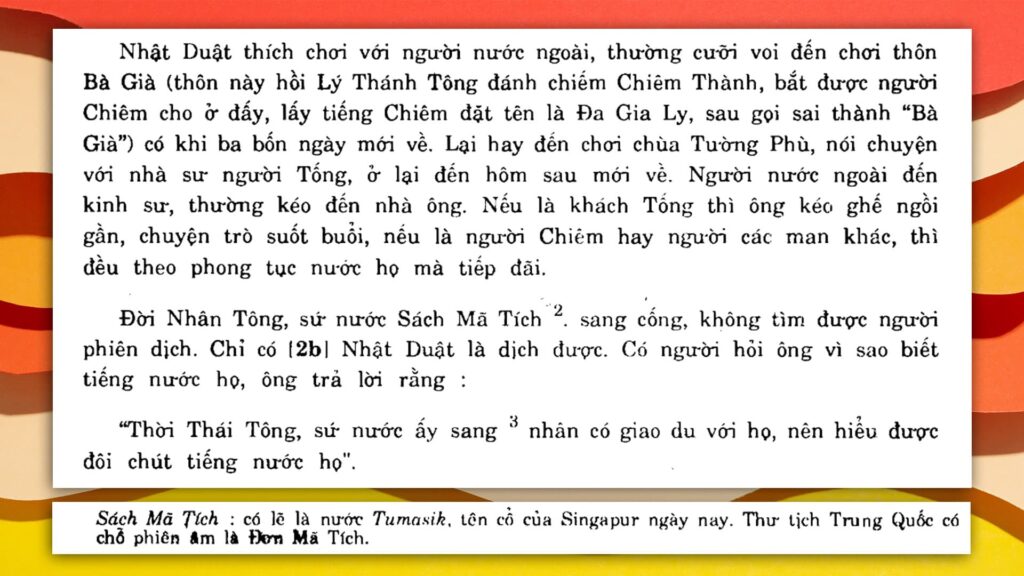
And then the translators of the Đại Việt sử ký toàn thư provided a footnote after “Sách Mã Tích” where they wrote, “Sách Mã Tích: Perhaps this is Tumasik, an old name for present-day Singapore. Chinese sources in some places have transcribed it as Đơn Mã Tích” (i.e., Danmaxi).
Ok, so, we have two problems here. The first is that Trần Nhật Duật was able to understand a bit of the language of the envoys from Sách Mã Tích because it was similar to something he had learned from an envoy from the Northern Kingdom (Bắc quốc 北國), that is, “China.”
So, from that information alone, it is clear that “Sách Mã Tích” was not “Temasek.”
However, there is another point, and that is that “sách” 册 is an administrative term that the Vietnamese historically used to refer to an area where “aboriginal peoples” lived, similar to “động” 洞, a term that literally means “grotto,” but which also indicated a mountain valley where aboriginal peoples lived.
In fact, we can find both of these terms used in the following passage from Chapter 15 of the Đại Việt sử ký toàn thư in reference to an event that took place in 1525 (Vol. 3, pgs. 103-104 of the translated version):
冬,十月初九日,莫登庸經行各處,自爲都將,總率天下水歩諸營,擊鄭綏于淸華源頭。二十八日,未時,接得光紹帝於淸都府良政州翠擧册高山安仁洞。
In winter, on the ninth day of the tenth month, Mạc Đăng Dung traveled through various places, acting personally as commander-in-chief and taking overall command of all the realm’s naval and infantry camps/units, and attacked Trịnh Suy at the headwaters of Thanh Hóa.
On the twenty-eighth day, at the vị [mùi] hour, he received [i.e., took into custody] the Quang Thiệu Emperor at Thanh Đô prefecture, Lương Chính district, at Thúy Cử sách, Cao Sơn [lit. “high mountain”] An Nhân động.
In Chinese word order, as we see in this passage, the term “sách” should come after the placename, whereas in Vietnamese word order it would come before the placename.
In the passage on Trần Nhật Duật, we see a combination of both Vietnamese and Chinese wording in “the kingdom of Sách Mã Tích” (sách Mã Tích quốc 册馬錫國), with “sách Mã Tích” or “Ma Tích aboriginal settlement” in Vietnamese word order followed by the Sinitic term “quốc/guo” meaning “kingdom.”
The “Mã Tích aboriginal settlement” was probably some autonomous polity in the area of the Sino-Vietnamese border region. Border officials on both sides played an important role in facilitating the movement of diplomatic missions between “Vietnam” and “China,” and my guess would be that the person from the “Northern Kingdom” who had taught Trần Nhật Duật a little bit of the language of the Mã Tích aboriginal settlement was one such person.
He may or may not have been from that settlement, as languages were shared across the border, and people moved across it as well.
As such, this brief passage is fascinating, but there is definitely no “Temasek” anywhere to be found here.
Time to update that website. . .
It seems that the original initial in /ʂacʲ5 ma4 ticʲ5/ was likely a [ʃ] or [t͡s] in Old Vietnamese before it evolved into retroflex voiceless [ʂ] in North Central and Southern Vietnamese, or deretroflexized [s] in Hanoi Vietnamese.
Thank you for this comment. That said, I’m not sure what your point is. My only guess, and I apologize if this is incorrect, is that you are indicating that the historical pronunciation might have been closer to “Tamasek,” and that therefore, we should take the idea that this was an envoy from Temasek seriously.
However, the information in the text makes it clear that regardless of how that name was pronounced, it was not referring to a place to the south of Vietnam, nor was it referring to a place where an Austronesian language similar to Cham, like Malay, was spoken. The DVSKTT says that Trần Nhật Duật was familiar with Cham, but that he understood a little bit of the language of the person from Sách Mã Tích because he had spent some time with an envoy from the Northern Kingdom (China).
The only way we could get this to be Temasek would be 1) to come up with some “exta-textual” explanation for which there is no evidence, like “the person from the Northern Kingdom must have earlier spent time on Temasek where he had learned the variety of Old Malay or Old Javanese that was spoken there, a variety of an Austronesian language of which even its basic words were incomprehensible to speakers of other Austronesian languages (other, obviously, than “tasek”), like Cham, and that this person then later taught Trần Nhật Duật some words from this language, etc,” and 2) to ignore the meaning and usage in the DVSKTT of the character 册.
Again, I’m not sure if this is what you were implying or if you were just being helpful and providing some more information, but regardless of how this term was pronounced, the context makes it abundantly clear that it was not referring to Temasek.