
A few years ago I visited a farm in the countryside of Vietnam. The farmer had two types of pigs: he had several Vietnamese pigs, “our pigs” (lợn ta), and one “American pig” (lợn Mỹ).
The Vietnamese pigs had a rather spacious pen outside and they were running around in it and digging in the soil. Meanwhile, the American pig stayed in a special building with a concrete floor and a fan that blew down cool air on the pig 24/7. . .
I wondered at the time where this idea that American pigs had to be raised in this manner came from, as I grew up on a farm in America where we raised pigs in the “Vietnamese way” by letting them move around freely outside in a spacious pen.
I was reminded of this “double standard” for raising pigs recently when I came across a book from 1930 in the French National Library entitled Raise Chickens in the American Way (Nuôi gà theo kiểu Hoa-Kỳ) by a certain Nguyễn Xuân Định.
Seeing this book, I realized that this division between Vietnamese, or “our/ta,” animals and Western/American animals is one that has been around a long time.
However, as I looked into this issue, I also discovered other things that I did not expect to see.

Nguyễn Xuân Định was not the first Vietnamese to write a book about raising chickens. In 1922, a man by the name of Trương Tấn Ngọc published a book called The Technique of Raising Chickens (Phép nuôi gà), and a certain Nguyễn Trọng Trử later published a book with the same title in 1929.
Further, it appears that both of these books were republished in the years that followed, so there appears to have been a need for knowledge about raising chickens in early-twentieth-century Vietnam.
But wait, you ask, didn’t Vietnamese already know how to raise chickens? Hadn’t they already been doing so for millennia? Why did some people in the 1920s and 1930s get the idea that Vietnamese needed manuals about chicken raising?
The introductions to the books by Trương Tấn Ngọc and Nguyễn Trọng Trử both provide us with answers to this last question.

In the introduction to his 1922 book, Trương Tấn Ngọc notes that raising chickens was a common practice in Vietnam.
However, he points out that most families only raised about 50 chickens, and that they did not raise more chickens than that because they were afraid of epidemics (bệnh dịch) and contagious diseases that could wipe out their entire flock.
In other words, “traditional knowledge” had taught people that by keeping the number of chickens below a certain number (~50), it was possible to maintain hygiene (and perhaps chicken social distancing) so that diseases would have a more difficult time of taking hold and spreading.
What Trương Tấn Ngọc understood in 1922, however, was that by employing certain “scientific” techniques, it was possible to raise more chickens without them getting sick and dying from a disease, and in his book, he provided information about how to do precisely that.

Meanwhile, a man by the name of Nguyễn Đình Ngân wrote an introduction to the 1929 book on raising chickens by Nguyễn Trọng Trử where he also talked about preventing disease.
However, Nguyễn Đình Ngân didn’t talk about a disease that affects chickens, but a disease that affects humans: “poor people disease” (bệnh dân nghèo).
To Nguyễn Đình Ngân, poverty was a “disease” that needed to be “cured,” and the way to cure it was by putting people to work, and one of the most basic forms of work was raising animals, particularly chickens.
So, to tie the ideas in these two introductions together, in order to cure the human disease of poverty, it was essential to prevent chickens from getting diseases so that they could be raised in larger numbers.
To these authors, all of this was possible with the right scientific knowledge.

As I was reading through these Vietnamese chicken manuals, I looked to see what kind of chicken raising books were written in the past in America.
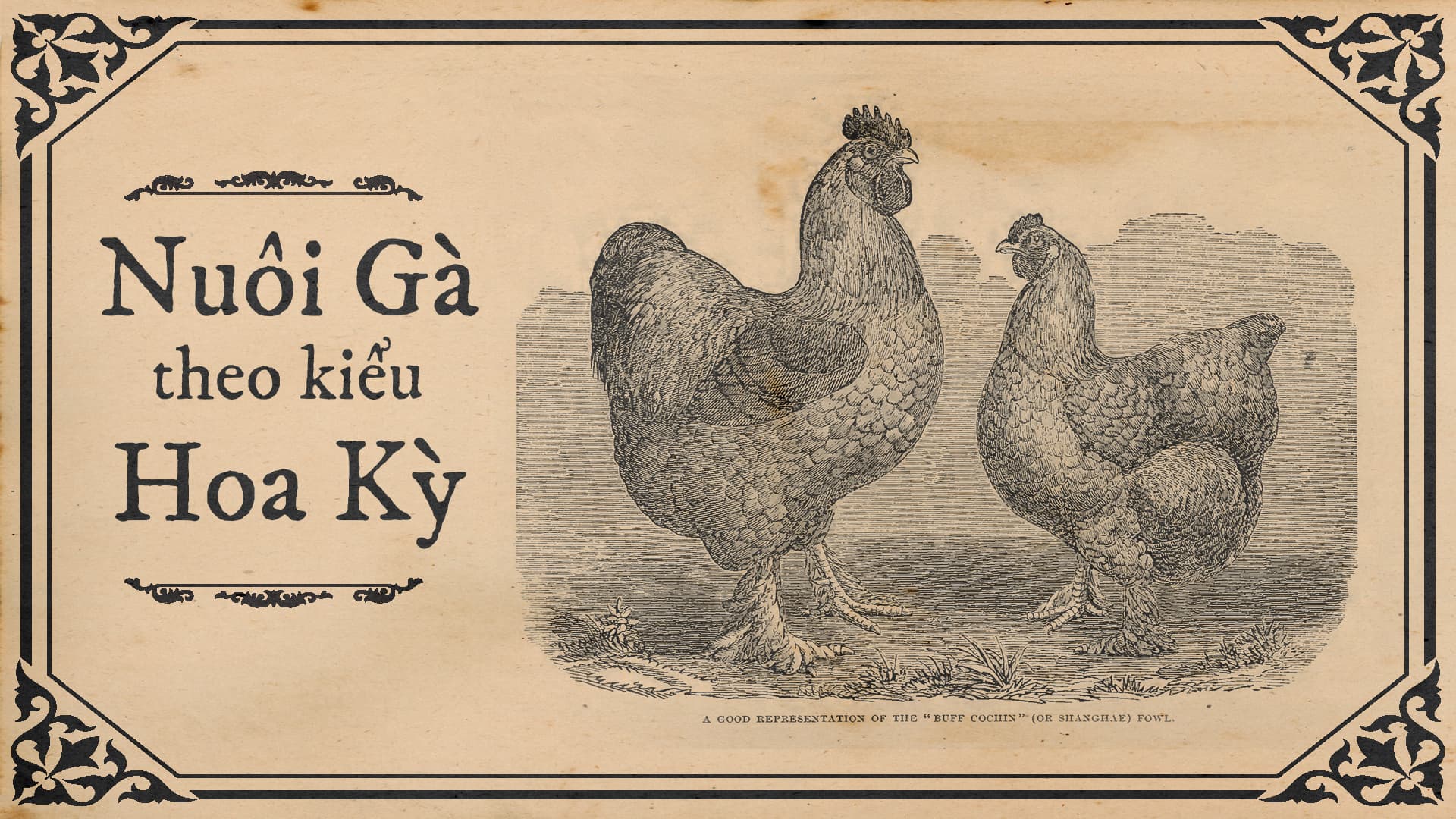
There were various such manuals, and other writings, and one topic that caught my attention was the interest in nineteenth-century America with chickens from Asia. Alongside the tea that American merchants brought back from China, they also brought chickens with names like “Shanghae” and “Cochin China.”
Indeed, I remember that when I was young, we raised various breeds of chicken with names from around the world. I don’t think we were aware of Vietnamese traditional knowledge, but we never had more than 20 or 30 chickens at one time, and they never got sick.
At the time, I never thought about why we had chickens with “exotic” names, but now as I look at these books on raising chickens from Vietnam and America, I can see the global economic order that brought the ancestors of our chickens to America.
And while I never thought much about why that Vietnamese farmer treated his American pig differently, in reading Vietnamese chicken manuals from the early twentieth century, I get a better understanding of what might have been in his mind.
Finally, as I sit here writing this post in COVID lockdown, I find myself thinking about how seemingly innocent acts – bringing chickens from Asia to America, teaching people how to raise more chickens in colonial Vietnam – have all contributed to creating a global economic order that has pushed the human-animal-nature balance past its limits.
