

I recently wrote a blog post on the problems with the work of Japanese historian Tatsuo Hoshino, and what I see as the bigger problem of how scholars deal (or more accurately, don’t deal) with bad scholarship.
Someone just left an anonymous comment stating, “A quick check through google scholar showed six citations of the article by Tatsuo Hoshino since the publication of the paper. Hence I would suggest that his/her research has remained inconsequential, and when it is cited, it is done so critically, as, for instance,” and then the writer lists two papers that are behind paywalls and have not been made available on either ResearchGate or Academia.edu.
Yes, this is exactly what I’m talking about. Let’s talk about scholarship that is consequential and scholarship that is inconsequential.
In fact, I wrote about Tatsuo Hoshino because I realized that his work has become very consequential. Over the past several months, a person writing under the name of “Thomson Walt” has been creating Wikipedia pages that claim that many Tang-era placenames for places in Southeast Asia refer to places in what is now Thailand.
A key source for these claims in many of these pages is, yes, you guessed it, Tatsuo Hoshino.
Let’s take a look at some examples.
1. Ganbi 甘畢 [https://en.wikipedia.org/wiki/G%C4%81n_B%C3%AC] (created 14 August 2025)
“Gān Bì (Chinese: 甘毕) was a medieval petty Tai kingdom mentioned in the Chinese New Book of Tang and the leishu Cefu Yuangui, located east of Champa [sic.]. Hoshino proposes that it situated in the central Mekong Valley in modern Mukdahan province–Savannakhet province.”
My comment: The New History of the Tang says that “Ganbi is located on the South Sea, bordering Huanwang to the east (甘畢在南海上,東距環王). Yes, scholars think that Huanwang was a Cham state, but where exactly it was located and how far to the west its authority extended are unclear. This could be a kingdom in the Central Highlands that traded with “Champa.”
2. Zhanbo 瞻博 [https://en.wikipedia.org/wiki/Zh%C4%81n_B%C3%B3] (created 14 August 2025)
“Zhān Bó (Chinese: 瞻博) in Mandarin Chinese or Dzim Bohk in Cantonese, also known as the Inland Champa, was a medieval kingdom in the central Isan region of Thailand mentioning in the New Book of Tang. . . Tatsuo Hoshino places the capital of Zhān Bó at Champasri, a large circular moated Dvaravati settlement in Maha Sarakham province of Thailand, where the state’s ancient name, that is, Champa, has thus been preserved to the present day.”
My comment: The New History of the Tang states, “Zhanbo, also known as Zhanpo. To the north, it borders the Jingjia River” (瞻博,或曰瞻婆。北距兢伽河。). This is the only mention of Zhanbo, and the only mention of the Jingjia River. There is no way to know where these were located.
3. Wendan 文單 [https://en.wikipedia.org/wiki/Wen_Dan] (created 17 August 2025)
“Wén Dān (Chinese: 文單; Thai: เหวินตัน), proposed to correspond to Mūladeśa, a toponym attested in the K.187 Inscription, refers to a group of early Tai political entities that existed between the 6th and 9th centuries CE in the interior of mainland Southeast Asia, primarily distributed across the central Mekong Valley in what is now northeast Thailand [the source cited here is a chapter by Hoshino]. . . Tatsuo Hoshino has suggested that Kantharawichai was likely the principal city of Wen Dan. . .”
My comment: See this recent post on “Wendan was Sambor Prei Kuk.”
4. Canban 参半 [https://en.wikipedia.org/wiki/C%C4%81n_B%C3%A0n_Kingdom] (created 6 July 2025)
“Cān Bàn Kingdom (Chinese: 参半国) or Sam Bun in Cantonese, which can be transliterated as Shampura, was a medieval petty Tai kingdom mentioned in the Chinese New Book of Tang and Cefu Yuangui. It was located more than a thousand li (500 kilometers) northwest of Wen Dan. [3 sources cited, see below] . . Japanese historian Tatsuo Hoshino places Cān Bàn in the upper Pasak Basin in the present-day Lom Sak—Lom Kao in Phetchabun province of Thailand, and says it was an early city-state of Tai-speaking people — as the character 参 is pronounced sam1 in Cantonese, potentially linking to the Siamese, and 半 bun seems to correspond to the variants of the Sanskrit term “pūra”, meaning town or city.”
My comment: In the opening passage, the author indicates that Canban is mentioned in the New History of the Tang. However, he cites the following three works for the claim that “It was located more than a thousand li (500 kilometers) northwest of Wen Dan.”
- Fukami Sumio. “The Trade Sphere and the Tributary Business of Linyi (林邑) in the 7th Century: An Analysis of the Additional Parts of the Huangwang chuan (環王伝) of the Xintangshu (新唐書)” (in Japanese).
- Hoshino, T (2002). “Wen Dan and its neighbors: the central Mekong Valley in the seventh and eighth centuries.” In M. Ngaosrivathana; K. Breazeale (eds.). Breaking New Ground in Lao History: Essays on the Seventh to Twentieth Centuries. Chiang Mai: Silkworm Books. pp. 25–72.
- Sharan, Mahesh Kumar (2003). Studies In Sanskrit Inscriptions of Ancient Cambodia. Abhinav Publications. pp. 31–34.
None of these works contain the information that “It was located more than a thousand li (500 kilometers) northwest of Wen Dan,” because no such information exists. Instead, the New History of the Tang states that “Wendan has a vassal state to the northwest called Canban” (文單西北屬國曰參半).
Indeed, Fukami cites this information, and then later states, “The location of Canban has various theories and is difficult to determine definitively, but in any case, it is either Cambodia or Thailand [see Chen 1986: 548]. The relationships between Zhenla and the surrounding countries during this period involve many related countries and are complex, so in this paper, which focuses on the countries attached to the Huanwang biography as its central theme, I will not delve into it.”
参半の位置は諸説あって定めがたいが、 いずれにせよカンボジアかタイである〔陳 1986: 548 参照〕。この時期の真臘と周辺諸国の関係 は関係する国が多く複雑なので、環王伝付伝諸国を中心テーマとする本稿では立ち入らないこ とにする。
“Chen 1986” refers to Chen Jiarong 陳佳栄, Xie Fang 謝方, and Lu Junling 陸峻嶺. 1986. Gudai Nanhai diming huishi (古代南海地名彙釈 [Glossary of ancient South Sea place names]). Zhonghua shuju (中華書局).
5. Qianzhifu 千支弗 [https://en.wikipedia.org/wiki/Syamapura_Kingdom] (created 7 November 2025)
“Syamapura Kingdom (Chinese: 千支弗, romanized: Qiān Zhī Fú) or Bàn Zhī Bá (半支跋), or Gàn Zhī Fú (干支弗), was a medieval polity located in the Southwest Sea region, with its political center at Si Thep in the Pasak Basin of central Thailand. . . Scholars such as Tatsuo Hoshino have suggested that Qiān Zhī Fú was one of the early Siamese kingdoms—later Taicized—that prospered through trans-Mekong trade connecting Champa in the east with the Menam Basin in the west.”
My comment: Qianzhifu is mentioned in the New History of the Tang. There is no information about its location.
I’m going to stop here, but this list goes on and on, and Hoshino appears again and again, like this:
6. Xiuluofen 修羅分 [https://en.wikipedia.org/wiki/Xiu_Luo_Fen] (created 9 January 2026)
“The Japanese historian Tatsuo Hoshino advanced the hypothesis that Xiū Luó Fēn represented an early Siamese polity that maintained strong commercial and cultural relations with other small-scale kingdoms along the trans-Mekong trade corridor, including Gān Bì, Zhān Bó, Wen Dan, Qiān Zhī Fú, and Cān Bàn. These polities were inhabited by an early Monic Siamese people as well as Tai-speaking populations, who are believed to have migrated into the region by at least the 7th to 8th centuries. Over time, these communities came into contact with another branch of Tai peoples migrating southward from Chiang Saen into the Menam Valley, thereby contributing to the broader ethnocultural consolidation of early Tai civilization in mainland Southeast Asia.
“Hoshino’s theoretical framework concerning the early Siamese polities is consonant with the historical narrative preserved in the Ayutthaya Testimonies, which assert that Indraraja, also designated as Pra Poa Noome Thele Seri—the progenitor of Ramathibodi I, the inaugural sovereign of the Ayutthaya Kingdom—was the filial descendant of Anuraja, the reigning authority of the polity at Phraek Si Racha. The dynastic lineage of Anuraja can be traced to the 8th century, reflecting a continuity of regional rulership over multiple generations. This account exhibits significant correspondence with the Legend of the Arhat (Tamnan Nithan Phra Arahant; ตำนานนิทานพระอรหันต์), which delineates the genealogical succession of Kalavarnadisharaja, the founding monarch of Lavo. Notably, one of his grandsons, Sai Thong Som, is recorded to have emerged in the 7th century as the offspring of a union between a Mon sovereign and a Tai princess.”
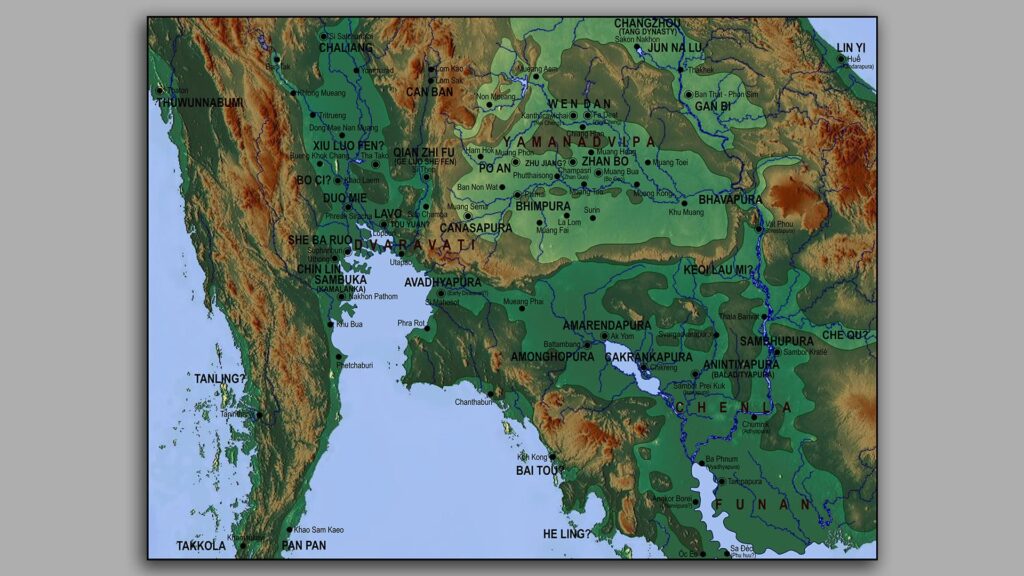
There are many more pages like this, and the above map gives a sense of how Thomson Walt is using Chinese sources to create a Thai-centric version of the past.
He is able to do this because the extant scholarship on these Chinese sources is lousy and inconsequential. It is lousy for multiple reasons. To begin, the first generation of scholars created a chaotic mess. Many of the scholars in subsequent generations produced more scholarship even though they did not have the linguistic skills to move beyond what the first generation created.
Those who could see problems, did what I accused Michael Vickery of in the earlier post, that is, make polite critiques in harmless places – footnote 60 on page 81. By not directly dealing with bad scholarship, such scholars made their own scholarship inconsequential.
Now that we are decades into the digital age, publishing behind paywalls, not making works available on ResearchGate or Academia.edu, and making no effort to speak beyond a tiny circle of experts has become the new digital-age equivalent of leaving a vague comment in footnote 60 on page 81.
All of this makes scholarship inconsequential, and it leaves the door open for people to take the lousy work of scholars like Tatuo Hoshino and put it to use as “evidence” in a Wikipedia page.
And in 2026, a Wikipedia page is much, much, much more consequential than an article behind a paywall.
As we know, Wikipedia is critical for the training of LLMs, which don’t have access (for now) to works behind paywalls, unless those works get talked about on the open web, but that doesn’t generally happen.
Finally, it could be a total coincidence, but it looks like Thomson Walt started creating these pages right around the time that the current border dispute between Thailand and Cambodia escalated in the summer of 2025. The 6 July 2025 page on Canban predates the July 24 armed confrontation, but the others were all created after that event.
The reason why I wonder this is because places that were clearly somewhere to the east of what is now Thailand are moved by Thomson Walt to the area of present-day Thailand. It is as if the historical information for areas to the east of what is now Thailand is being erased.
Again, the timing might be a complete coincidence, but whatever the case may be, what is clear is that over the past several months, Thomson Walt has created numerous Thai-centric Wikipedia pages, and he has been able to do this because there is an absence of solid scholarship on the Chinese sources for early Southeast Asian history.
Further, with these new Thai-centric Wikipedia pages, the work of Tatsuo Hoshino has become increasingly consequential.
Meanwhile, as for the work of scholars who politely critique Hoshino’s work in footnote 60 on page 81 or who leave their scholarship behind paywalls some three decades into the digital age. . . such work is utterly inconsequential.
Just ask Thompson Walt.
It is not the scholars who establish the paywalls, but the publishers.
Excepting full books, every publisher I’ve worked with allows scholars to upload some pre-publication version of their paper to “personal archives,” which includes sites like ResearchGate and Academia.edu.
In the worst-case scenario, you have to wait say 3 years.
I see no reason for not making one’s scholarship available online.
PS: You can always correct wikipedia entries.
Ok, but how we do that when 1) scholars don’t “vigorously reject” bad scholarship, and/or 2) leave their work behind paywalls?
When you change information on a Wikipedia page, you have to back up your changes with evidence.
Given #1 and #2, where exactly will that evidence come from?
I agree with your point that Wikipedia is now more than consequential when compared to works of scholarship behind paywalls. In fact, the same has been said about the journalism industry in that “the truth” is often behind a paywall, while fake news is free. Also, nationalistic tensions between the peoples of Thailand and Cambodia were already high before any gunshots were fired, so I would say that the timing of those wikipedia revisions is probably not a coincidence.
There is something really odd about Thomson Walt. He’s been contributing to Wikipedia for a few years, mostly to do with beauty pageants, like “Miss Grand Albania,” etc. And now suddenly he’s creating these well-crafted pages on early Southeast Asian history in Chinese sources. . .
Meanwhile, this blog pretty much never gets any visitors from China (I think WordPress is blocked there), but recently the city where the most views has come from is Lanzhou. . .
Coincidence? Conspiracy?
I am in a (relatively) sane state of mind and I have no plans on deleting this blog. So, if it suddenly gets vaporized, we’ll know why.