
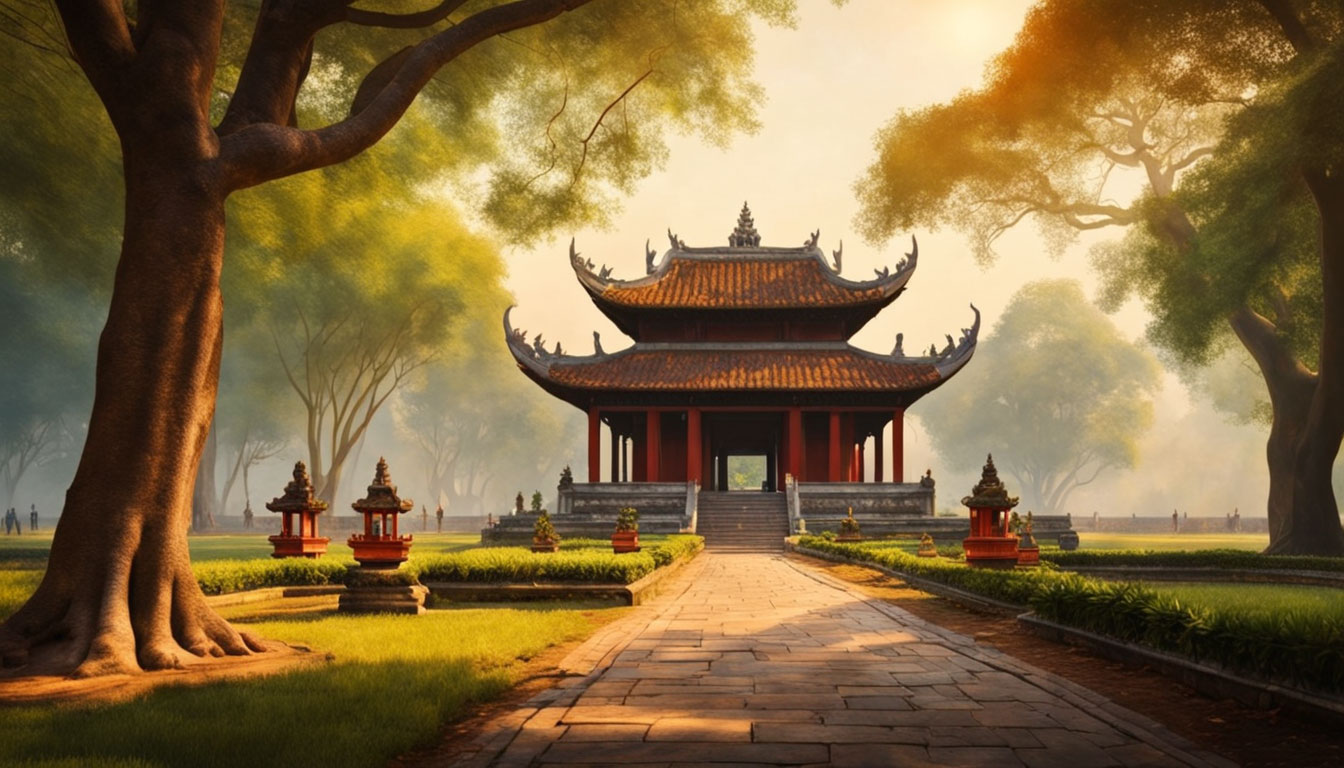
I do not know how many times I have heard or read that the Vu0103n Miu1ebfu (Temple of Literature) in Hanoi was u201cbuiltu201d in 1070 AD, but itu2019s a lot, and everyone seems to think this, however itu2019s not true.
If you read the modern Vietnamese translation of the main historical chronicles for premodern Vietnam, the u0110u1ea1i Viu1ec7t su1eed ku00fd tou00e0n thu01b0, it says that in 1070, this temple was u201cbuiltu201d (lu00e0m).
However, if you read the original classical Chinese version, it says that in 1070 the Vu0103n Miu1ebfu was u201ctuu201d u8129, which means u201crenovated.u201d
Here is the passage (and I prefer to translate Vu0103n Miu1ebfu as u201cTemple of Civilityu201d as vu0103n referred to much more than literature):
u79cbu516bu6708uff0cu8129u6587u5edfuff0cu5851u5b54u5b50u3001u5468u516cu53cau56dbu914du50cfuff0cu756bu4e03u5341u4e8cu8ce2u50cfuff0cu56dbu6642u4eabu7940uff0cu7687u592au5b50u81e8u5b78u7109u3002
In the eighth lunar month of autumn, the Temple of Civility was renovated, statues of Confucius, the Duke of Zhou and the Four Correlates were sculpted, and images of the Seventy Two Worthies were painted. Sacrifices were made at each of the four seasons and the Heir Apparent attended studies there [3/5a].
(Mu00f9a thu, thu00e1ng 8, lu00e0m Vu0103n Miu1ebfu, u0111u1eafp tu01b0u1ee3ng Khu1ed5ng Tu1eed, Chu Cu00f4ng vu00e0 Tu1ee9 phu1ed1i, vu1ebd tu01b0u1ee3ng Thu1ea5t thu1eadp nhu1ecb hiu1ec1n, bu1ed1n mu00f9a cu00fang tu1ebf. Hou00e0ng thu00e1i tu1eed u0111u1ebfn hu1ecdc u1edf u0111u00e2y.)
The term for u201crenovateu201d here, u201ctuu201d u8129, is a variant of the character, u201ctuu201d u4fee, which we can also find in the u0110u1ea1i Viu1ec7t su1eed ku00fd tou00e0n thu01b0 indicating u201crenovate.u201d
We can see this, for instance, with the extant information about Diu00ean Hu1ef1u Pagoda (Diu00ean Hu1ef1u tu1ef1 u5ef6u7950u5bfa), commonly known today as the One Pillar Pagoda (Chu00f9a Mu1ed9t Cu1ed9t), a famous historical site in Hanoi.
The u0110u1ea1i Viu1ec7t su1eed ku00fd tou00e0n thu01b0 records that this pagoda was u201cconstructedu201d (tu1ea1o u9020) in 1049 [2/37a]. It was then u201crenovatedu201d in 1101 (tu u4fee), 1105, and 1249 (tru00f9ng tu u91cdu4fee) [3/13b, 3/15a and 5/16b].
Back to the issue of the Temple of Civility, for 1171, the u0110u1ea1i Viu1ec7t su1eed ku00fd tou00e0n thu01b0 contains the following entry:
u8129u6587u5ba3u738bu5edfu6bbfu53cau540eu571fu7960u3002
Renovations were made to the Temple of the King of Exalted Civility and the Soil Deity Shrine [4/15a].
(Lu00e0m miu1ebfu u0111iu1ec7n thu1edd Vu0103n Tuyu00ean Vu01b0u01a1ng vu00e0 u0111u1ec1n thu1edd Hu1eadu Thu1ed5.)
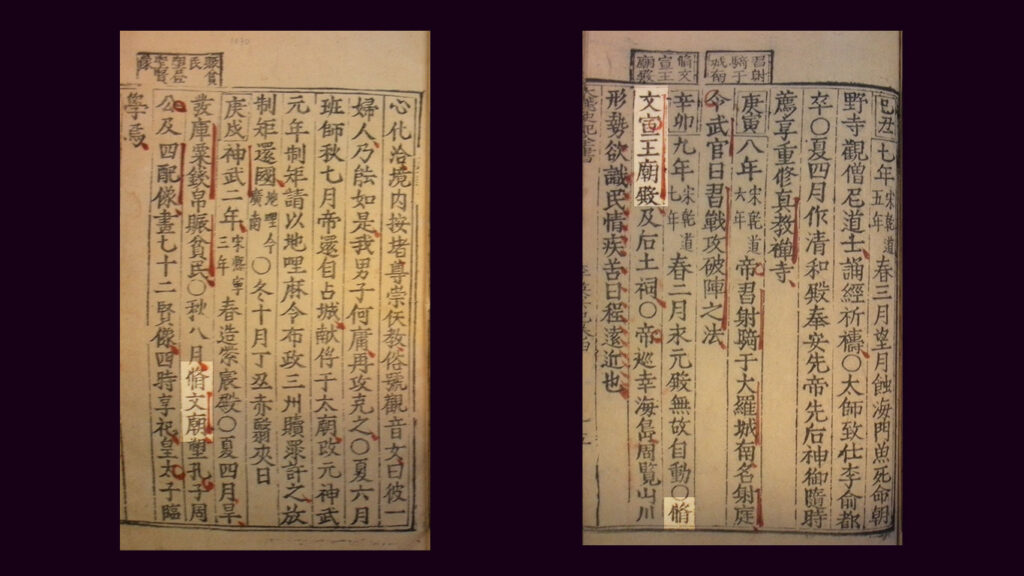
The same verb for renovate, u201ctuu201d u8129, appears here, and in the modern Vietnamese translation it is again rendered as u201cbuiltu201d (lu00e0m). Further, there is a footnote in the modern Vietnamese translation that indicates that the u201cKing of Exalted Civilityu201d is a reference to Confucius (Vu0103n Tuyu00ean Vu01b0u01a1ng: tu1ee9c Khu1ed5ng Tu1eed).
The modern Vietnamese translation does not equate the Temple of Civility (Vu0103n Miu1ebfu u6587u5edf) with this Temple of the King of Exalted Civility (Vu0103n Tuyu00ean Vu01b0u01a1ng Miu1ebfu u6587u5ba3u738bu5edf), however, this was in fact the same temple. The first name was just a simplified/contracted version of the longer second name (Vu0103n Tuyu00ean Vu01b0u01a1ng Miu1ebfu).
The history of the honoring and worship of Confucius is very long and complicated, and official state temples dedicated to him go back to Han Dynasty times. Over the centuries, the titles granted to Confucius, the internal layout of his temple, and the particular disciples included in the temple, all changed many times.
For instance, the name, u201cKing of Exalted Civilityu201d (Vu0103n Tuyu00ean Vu01b0u01a1ng u6587u5ba3u738b), was granted to Confucius in 739, during the period of the Tang Dynasty (618-907).
Prior to that point, the temples dedicated to Confucius in the Tang empire were referred to by other names, such as Confucian Temple (Kongzi miao u5b54u5b50u5edf or Kong miao u5b54u5edf). However, after the granting of this new title, the name, Temple of the King of Exalted Civility, started to be used, although never exclusively.
Finally, in 1530, during the time of the Ming Dynasty, there was a discussion at the Ming court that resulted in a decision to discontinue the use of the title, u201cKing of Exalted Civility,u201d the emperor and his officials felt that Confucius was of a higher status than that name implied. It was decided instead that he be referred to as Paramount Sage and First Teacher Confucius and his temple officially took that name as well, as the Temple of the Paramount Sage and First Teacher Confucius (Zhisheng xianshi Kongzi miao u81f3u8056u5148u5e2bu5b54u5b50u5edf). However, in Ming era sources we can see that shorter names, such as Temple of Civility and Confucian Temple, continued to be employed.
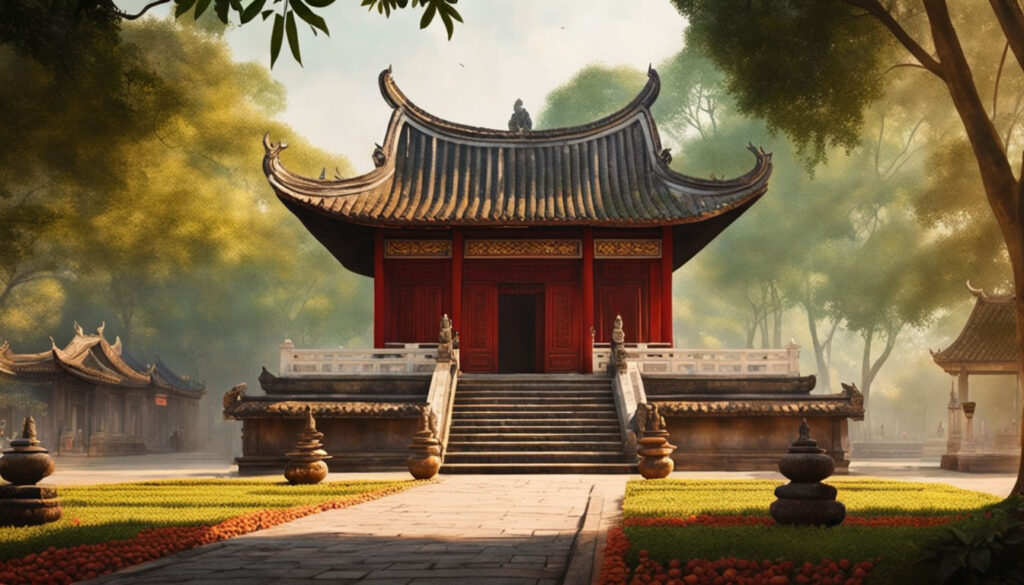
Ok, so given that the Temple of [the King of Exalted] Civility was u201crenovatedu201d in 1070 and again in 1171, then when was it first built? There is no direct evidence to answer that question, but there is indirect evidence that can give us a general idea of when it may have first been constructed.
There was a close connection between Confucian temples and schools, and we can see that both of these institutions existed across the Tang Dynasty empire.
In 619, for instance, the emperor ordered schools to be built in the prefectures, districts and villages of the empire (u5ddeu7e23u53cau9109uff0cu4e26u4ee4u7f6eu5b78u3002). In 670, it was ordered that any Confucian Temples (Kongzi miaotang u5b54u5b50u5edfu5802) in the prefectures and districts of the empire in need of repair should be renovated. In 738, it was ordered that schools be built in every village in the prefectures and districts of the empire. (u5176u5929u4e0bu5ddeu7e23u3002u6bcfu9109u4e4bu5167u3002u5404u91ccu7f6eu4e00u5b78u3002)
We also know that there were people from the area of what is now Vietnam who passed the civil service exams at the highest level of u201cpresented scholaru201d (tiu1ebfn su0129 u9032u58eb) during the time of the Tang Dynasty.
Therefore, there must have been schools, and if there were schools, then it is likely that there was a Confucian Temple (or perhaps multiple temples) as well.
In fact, a Confucian Temple may have been built in the area of Hanoi even earlier than the Tang, as it is reasonable to assume that the dynastic officials appointed there would have patronized such a temple. However, at the very least, I would argue that given the documented efforts of the Tang to build schools and maintain the upkeep of Confucian Temples across the empire, it is highly likely that such a temple existed in Vietnam from at least the period of the Tang Dynasty.
Hence, the need to RENOVATE that temple in 1070.


How interesting! Thank you very much for this article.
Remind me of the phrase “Domain of manifest civility”.
Dear Dr Kelley,
To date, I have greatly enjoyed reading your articles about the history of Vietnam. Your critical analysis on the current knowledge of this subject are much appreciated by myself.
Nonetheless, in this article, I found the way you constructed your entire argument on the word “脩” (Sino-Vietnamese: tu, English: renovate) is unsubstantiated because of the following reason:
Firstly, a word might have multiple meaning and that it could be incorrectly or vaguely used by the author/historian. I firmly believe that no one (even an editor in chief of a top journal in his/her field) can edit his/her own work. It is thus possible that in his notable work, the Đại Việt Sử Ký Toàn Thư (the original version in Chinese), historian Ngô Sĩ Liên used a less transparent word “脩” instead of “建” (Vietnamese: xây dựng, English: build). Like this, in this article, the way you used the English word “pagoda” for 寺 (Sino-Vietnamese, tự) is regrettable, as it should be interpreted as tháp (a component of a temple). The Britannica dictionary defines, “Pagoda, a tower-like, multistory, solid or hollow structure made of stone, brick, or wood, usually associated with a Buddhist temple complex and therefore usually found in East and Southeast Asia, where Buddhism was long the prevailing religion.” Thus, we should correctly note that, Tháp Một Cột là một phần của tổng thể Chùa Diên Hựu.
Secondly, probably like the way the Japanese engineers constructed the Kansai Airport out of nowhere instead of on a solid ground, you then vaguely concluded:
“In fact, a Confucian Temple may have been built in the area of Hanoi even earlier than the Tang, as it is reasonable to assume that the dynastic officials appointed there would have patronized such a temple. However, at the very least, I would argue that given the documented efforts of the Tang to build schools and maintain the upkeep of Confucian Temples across the empire, it is highly likely that such a temple existed in Vietnam from at least the period of the Tang Dynasty.”
In the language of research argument, how you could use the phrase “In fact” with “may have been…”?
Also, I have a great doubt about whether the Tang court would be willing to spend a large amount of money to build Confucius temples even in China, as this dynasty was largely known to overall embrace Buddhism. The construction of Văn Miếu (Temple of Literature) in Thăng Long might make more sense, as in this time, Chinese thinkers throughout China had attempted to revive Confucianism in the later part of 11th century leading to the revival of this religion in Đại Việt.
Thank you for your comments!!
I completely agree with you about the word “pagoda.” I only used it for Chùa Một Cột because I think English-language readers would be more familiar with that name (https://en.wikipedia.org/wiki/One_Pillar_Pagoda).
For some reason, many people have decided that the English word for chùa is “pagoda.” I agree with you that it’s not accurate, so you do not need to convince me. But please do your best to convince the thousands upon thousands of people in the world who use this term incorrectly. 🙂
As for this final comment: “Also, I have a great doubt about whether the Tang court would be willing to spend a large amount of money to build Confucius temples even in China, as this dynasty was largely known to overall embrace Buddhism,” it’s fine to think that way, but for this to be convincing, you have to be able to provide some evidence. Is there some historical source from the Tang where we can see people talking how there is not enough money to build something like schools or Confucian temples because too much money is being spent on Buddhism?
To build an historical argument, you have to provide some evidence. It doesn’t have to be direct evidence (because there may not be any), but indirect evidence can provide some support to an argument. That’s what I did when I provided information from the History of the Tang.
Now, as for 脩/修, yes, in certain contexts this could mean “construct.” I am aware of that, and I looked into the issue before I wrote the blog post. The main words for “construct/build” in the DVSKTT are words like 起, 構, 造, and 建.
脩/修 usually appears in compounds where it is clear that it means “renovate/repair,” like 重修. There are a few instances where it appears alone (including the record about the Văn Miếu). For a couple of those instances, we can determine that it means “renovate/repair” because we can see in the DVSKTT that the building had earlier been constructed.
I am providing below all of the relevant places where I have found 脩/修. Having looked at this, and having examined the places where terms like 起, 構, 造, and 建 are used, I am convinced that 脩/修 almost certainly (of course we can never be 100% certain, but if I was gambling on this, I would bet a lot of money on 脩/修 meaning “renovate/repair” here) means “renovate/repair.” When you add the information I provided from the History of the Tang, I beceome even more convinced.
The numbers below are for the chapters in the DVSKTT. You can look up the context for each passage here: https://zh.wikisource.org/wiki/%E5%A4%A7%E8%B6%8A%E5%8F%B2%E8%A8%98%E5%85%A8%E6%9B%B8
I. Places where “脩” appears:
2
,重脩之。
3
脩文廟
4
脩文宣王廟殿及后土祠。
5
及退,率家奴及親属,得千餘人,脩戰噐戰船,
II. Places where “修” appears:
2
,意欲重修之。
重修龍安、龍瑞二殿。
3
慶成永光殿重修故也。
修大内諸殿宇。 (“Built” the various palaces in the Đại Nội? But they were already built in 1010. There is a clear record of that. This has to mean “repair.”)
修延生殿五岳觀。
時帝重修延祐寺
修延祐寺。 (chapter 2, already built = 造延祐寺。)
修治大羅城。
4
重修太和橋。
重修真教寺。
5
及重修國子監。
重修延祐寺
7
時重修御史臺成
於是重修之,
修造舟船
修戰船戰噐
修諸陵寢廟。
8
修造城池。
10
修治戰噐船艘。
遣防禦使陳班督修棃花関
修治城池,
修戦噐。
令北江、諒江修橋梁、道路,
13
修治京城西邊墻。
14
修築之術,
以修理關隘。
15
命阮文郞重修國子監崇儒殿及兩廡明倫六堂,
旣命官重修國子監及新構碑室,
時上旣命重修國子監幷新構作碑室
16
重修國子監。
17
令修造昇龍城內太廟各殿。
莫令修理昇龍城外層,
令修作浮橋
遂議修築其城
Dear Dr Kelley,
Thank you for your enthusiastic comments. In this post, I would like to provide some evidence for my argument. I believe that the most useful way to figure out when the current Van Mieu in Ha Noi might have actually been built is through finding out whether this kind of building was built in China at the same period; who could pay for it; what it was used for; and who were required to attend.
I firmly stand by my doubt whether the Tang court would be willing to spend a large amount of money to build more Confucius temples even throughout China after the first temple was constructed in Confucius’s hometown one year after his death in 479 BC. Despite the decree of Emperor Taizong of Tang in 630 that every provincial and county school should build a Confucian temple, there was no historical record of any Confucius temples with equal size with Van Mieu in Ha Noi being constructed in China during the reign of the Tang dynasty. On the other hand, the Fuzi Temple in Nanjing was only built 404 years after Taizong’s proclamation.
There are two major factors that could have influenced this disappointing reality. First, as the construction of a Confucius temple is extremely costly, it is thus impossible to build one without the financial supports of the government. Because Buddhism had ascended to an imperially patronised religion for a long period of the Tang dynasty, through having been generously granted significant amount of public lands and allowed to collect taxes on those lands, as well as having been exempted from paying taxes, the wealth of Chinese Buddhist institution had greatly accumulated over the centuries. As a result, the financial gains of this Establishment had gradually and consistently depleted the revenue and limited spending of the Tang governments on major public works.
Second, in addition to the presence of government bureaucracies across provinces, cities, and districts, there should be good attendance of local degree holders in annual worship at any Confucius temple on his birthday. These two factors were not available in a remote and volatile Tang protectorate like Annan where the majority of its population were farmers and there were very few number of local officials (see Ben Kiernan, Vietnam: A History of the Earliest Times to the Present [New York: Oxford University Press, 1917], 109).
Yours sincerely,
Hung Ky Nguyen
Ps: I would like to correct the year of the publication of Ben Kiernan’s book. It is 2017 instead of 1917.