
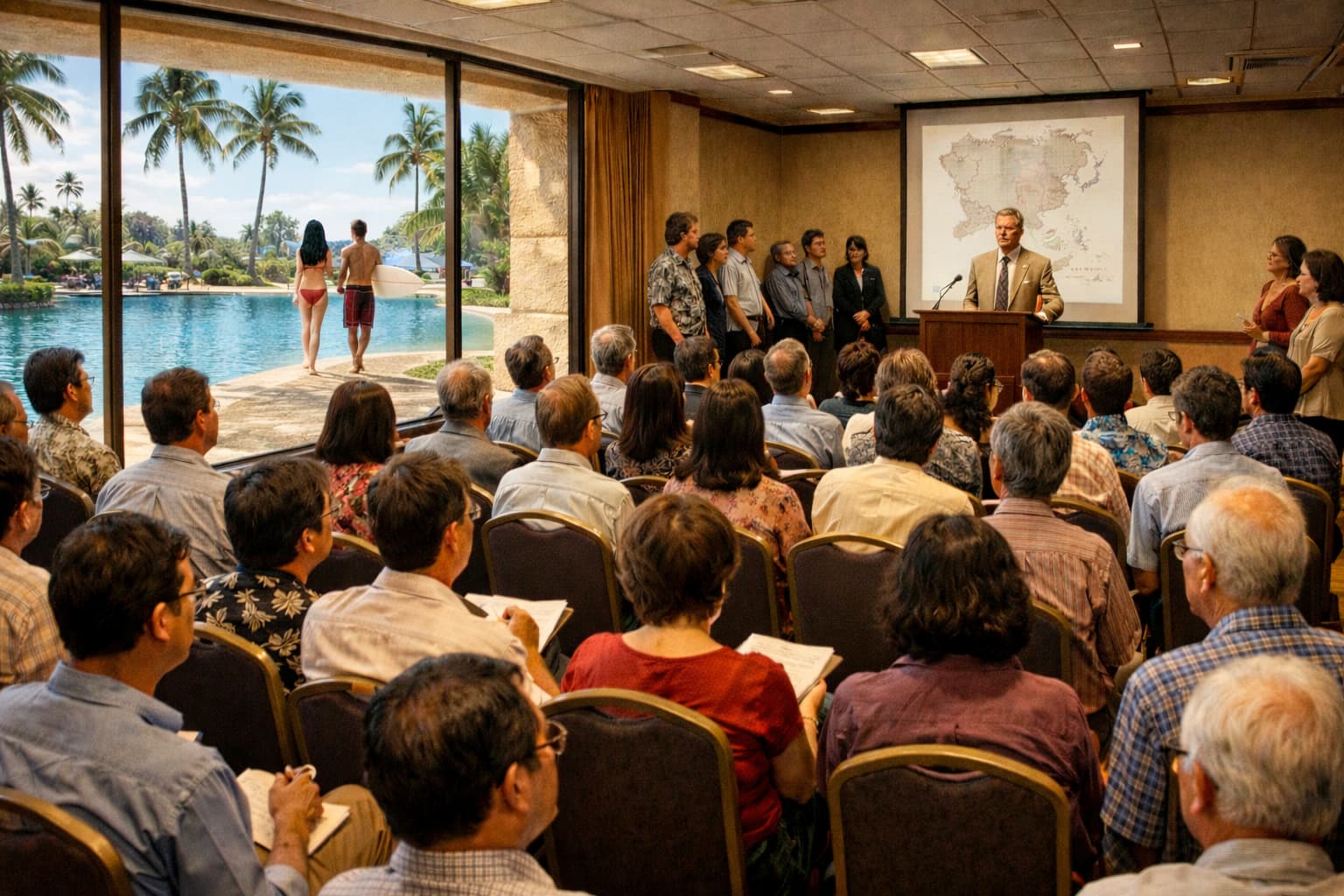
As I was having my morning coffee today, an announcement for the latest issue of the Journal of Asian Studies popped up on my screen. I took a look at the table of contents, and. . . couldn’t understand anything.
And no, it’s not because the coffee had not kicked in. My brain can still comprehend the English language without the need for caffeine.
It was because of another reason, a reason that becomes apparent if we take a “year of the fire horse” view of the Journal of Asian Studies.
The lunar year that has just recently begun is a fire horse year, a year that comes once every sixty years. So, I have compiled below the table of contents for the February issue of the Journal of Asian Studies for every decade since the last fire horse year, 1966.
Take a look and see if you can discern a change over time.
1966: February 1, – Volume 25, Issue 2
Preparation for the Occupation of Japan
Japan’s Response to the Chinese Revolution of 1911
A Case of Anomalous Values in Indian Civilization: Meat-Eating Among the Kanya-Kubja Brahmans of Katyayan Gotra
The Government of India and the First Non-Cooperation Movement—1920–1922
The Politics of Order: “Anti-Non-Cooperation” in the United Provinces, 1921
The “Foreign Reincarnation” of Rabindranath Tagore
From Snow to Plum Blossoms: A Commentary on Some Poems by Mao Tse-tung
The Controversy over Li Hsiu-ch’eng: An Ill-Timed Centenary
1976: February 1, – Volume 35, Issue 2
The Crisis of 1900 in Yunnan: Late Ch’ing Militancy in Transition
Buddhist Cosmography in Thai History, with Special Reference to Nineteenth-Century Culture Change
Symposium: Decline of The Mughal Empire
The Imperial Crisis in the Deccan
1986: February 1, – Volume 45, Issue 2
Some Observations on the “Seventeenth-Century Crisis” in China and Japan
The Political Uses of Crisis: The Bihar Famine of 1966–1967
The Sociopolitical Effects of Ideological Change: The Buddhist Conversion of Maharashtrian Untouchables
The Other Side of the 1945 Vietnamese Revolution: The Empire of Viet-Nam (March–August 1945)
Continuity and Change in Indonesian Language Development
1996: February 1, – Volume 55, Issue 2
Women, Resistance and the Divided Nation: The Romantic Rhetoric of Korean Reunification
Infanticide in Early Modern Japan? Demography, Culture, and Population Growth
The “Cult of Poetry” in Contemporary China
Desire for Meaning: Providing Contexts for Prākrit Gāthās
Rural Credit in Ming-Qing Jiangnan and the Concept of Peasant Petty Commodity Production
2006: February 1, – Volume 65, Issue 2
The Yearning for “Friendship”: Revisiting “the Political” in Minority Revolutionary History in China
Religion, Nostalgia, and Memory: Making an Ancient and Recent Tai-Ahom Identity in Assam and Thailand
Contingency, Knowledge & Colonial Rule
Rule and Representation: Transformations in the Governance of the Water Commons in British South India
Inscribing Colonial Monumentality: A Case Study of the 1763 Patna Massacre Memorial
Marco della Tomba and the Brahmin from Banaras: Missionaries, Orientalists, and Indian Scholars
2016: February 1, – Volume 75, Issue 2
Corruption, Anticorruption, and the Transformation of Political Culture in Contemporary China
Where’s the Omelet? Bad King Deng and the Challenges of Biography and History
Introduction to “Culture around the Bases: A Forum on the U.S. Military Presence in Northeast Asia”
Amerikamun: Consuming America and Ambivalence toward the U.S. Presence in Postwar Okinawa
My Car Modernity: What the U.S. Army Brought to South Korean Cinematic Imagination about Modern Mobility
The Soundproofed Superpower: American Bases and Japanese Communities, 1945–1972
The Shogun’s Chinese Partners: The Alliance between Tokugawa Japan and the Zheng Family in Seventeenth-Century Maritime East Asia
Environments of Law: Islam, Buddhism, and the State in Contemporary Sri Lanka
Absent Maps, Marine Science, and the Reimagination of the South China Sea, 1922–1939
Ecological Degradation and Endangered Ethnicities: China’s Minority Environmental Discourses as Manifested in Popular Songs
2026: February 1, – Volume 85, Issue 2
Criminalizing Job Performance: Brutal Perfectionism in Early Chinese Empires (221 BCE–9 CE)
Harmony Between In-Laws: Rethinking Yuan-Koryŏ Royal Marriages and Rulership
Gendered Denunciation, Sexual Misconduct, and the Regulation of the Maoist Cadres During the Socialist Education Movement
Between Sterility and Ecstasy: Sexual Perversion, Gender Ambivalence, and Aesthetics in Mori Ōgai’s Literary Fiction
Minor Transliteration: Korean Diasporic Feminist Aesthetics of Go-Saeng and the Narrative of Culinary Persistence in Min Jin Lee’s Pachinko
From 1966 to 1986, people wrote about events and historical processes, such as the occupation of Japan, the first non-cooperation movement in India, the decline of the Mughal Empire, the Bihar famine, the short-lived empire of Vietnam in 1945, etc.
And they also produced studies that explained fundamental aspects of Asian societies, like Buddhist cosmography in Thai history, and Indonesian language development.
In the 1990s, it was still largely the same, but the scope of interest expanded to start including the examination of demographics that had not previously been focused on, like women and children.
When we reach the 2000s, the examination of events and processes transformed into an examination of representations, memory, and discourses. In other words, instead of talking about what happened or what a people in a society do (did) or think (thought), people examined how meaning about all of these issues was constructed, and about the power behind those constructions of meaning.
In the 2010s we see more of the same. In addition, we also see that the use of “hip” academic language had become more or less universal by this point, and as a result, even when studies still took a more “traditional” approach, they still had to be packaged in language that mimicked the language employed in newer approaches.
That gets us to 2026. Other than rethinking Yuan-Koryŏ royal marriages and rulership, I basically cannot understand anything from the remaining titles in the current issue of the Journal of Asian Studies. I simply have no idea what people are talking about.
I started to get involved in Asian Studies/History in the 1990s, and the above overview of titles in the Journal of Asian Studies closely matches what I experienced in the years since.
I remember going to the Annual Conference of the Association of Asian Studies (AAS), the association that supports the Journal of Asian Studies, in the 1990s and being so interested in listening to different talks because they were about fundamental issues and presented ground-breaking scholarship, such as the New Qing scholarship and efforts to conceptualize Southeast Asian history around an “age of commerce.”
In the 2000s, there were far fewer such presentations, and I would end up going to presentations by people that I knew so that I could at least see what they were doing.
By the 2010s, I would look at the program, with 25 consecutive panels all filled with presentations that had titles like “The Optics of Oppression: The Materiality of Diacritical Imaginings and Gendered Transgressions in Colonial [put colony name of choice here], 1932-33,” and I would just give up and go to the bar.
So, have I officially become a cranky old fart who just simply doesn’t understand the advances in scholarship that the younger generations have made?
If I saw that the world of Asian Studies/History was thriving and I was there on the periphery, scratching my head, looking at all of the action, and not understanding what I was missing, then I would accept that I have become a cranky old fart.
That, however, is not what I see, and it is also not what I have experienced.
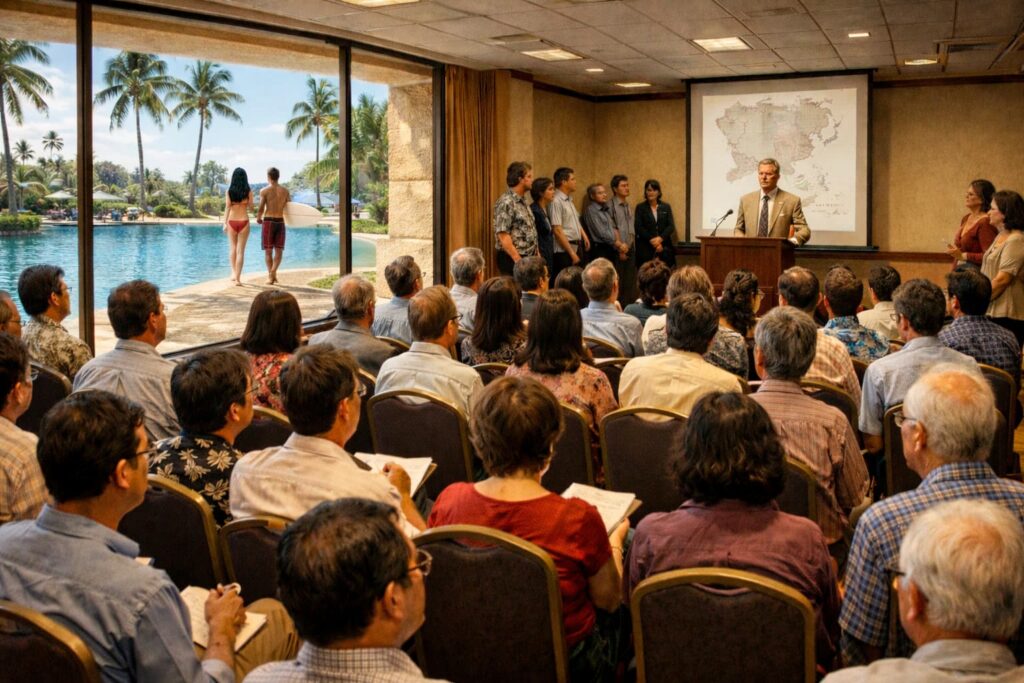
I remember going to my first AAS conference in, I think 1996, in Hawaii, where I was in graduate school. It was held at the Hilton Hawaiian Village.
I distinctly remember being in one panel on Southeast Asian history. It was in a room on the ground floor that had windows on one side that looked out on a blue lagoon and palm trees. It was a beautiful Hawaiian day, with glorious blue skies and sunshine.
Meanwhile, the room was packed. Not only were people standing against the walls, but there were people standing in rows in front of the people standing against the walls as well. And it was hot in there. The air conditioning could not compete with all the heat coming from that many human bodies.
I was one of the people standing against a wall. In fact, it was the wall in the back of the room, and I distinctly remember anthropologist Charles Keyes standing in front of me and then taking a step backwards and stepping on my feet and crushing me against the wall. . .
Professor Keyes moved away, but did not apologize. He was too engrossed in the talk, and perhaps thought that he had merely stepped back onto a lump in the carpet rather than onto another human being.
In fact, everyone else was engrossed in the talk as well. I can also distinctly remember another moment when a young couple walked by outside the window in swimwear and carrying a surfboard. Some people turned their heads to see what was moving outside the window, but realizing that it was just a couple of people enjoying life in Hawaii, they quickly turned their heads back. They were much more interested in the talk they were listening to than the beautiful Hawaiian world with all of its attractions right outside the window.
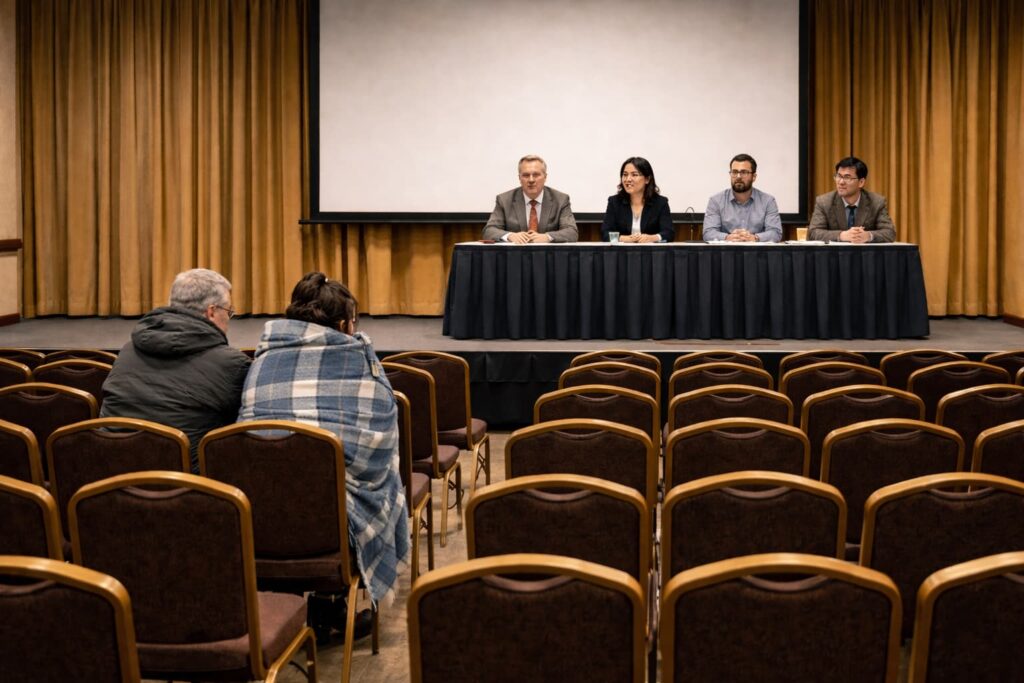
Then I remember going to the AAS conference in Hawaii in 2011, when I was working there. This time it was held in the Hawaii Convention Center, not far from the Hilton Hawaiian Village, and the experience this time was completely different. I can remember walking by freezing cavernous room after freezing cavernous room with only one or two people in the audience, people who were invariably close friends of one or more of the presenters.
And when I would run into people that I knew, they would tell me about how they had spent the previous day exploring the North Shore, etc. and were now parachuting in for their presentation, before heading off in the afternoon to Hanauma Bay. . .
How strange, I thought to myself, there are so many panels on “The Optics of Oppression: The Materiality of Diacritical Imaginings and Gendered Transgressions in Colonial [put colony name of choice here], 1932-33.” Weren’t these people interested??!
No, of course they were not interested!! And, yes, I’m cranky, and have always been, but when it comes to scholarship, I’m not an old fart. I simply understand that the world of Asian Studies/History scholarship has developed in a direction that renders it of little interest to virtually everyone in the world except for the authors themselves.
I don’t think anyone can seriously claim that the fields of Asian Studies/History are doing well these days, and of course, most people will blame this on anything but the people in the fields themselves.
However, this is where the North-American-based brand of Asian Studies/History is at in this 2026 Year of the Fire Horse. It’s about “Criminalizing the Sterility and Ecstasy of the Brutal Perfectionism of Maoist Cadres in the Socialist Education of Korean Diasporic Feminist Aesthetics of Sexual Perversion and Gender Ambivalence.”
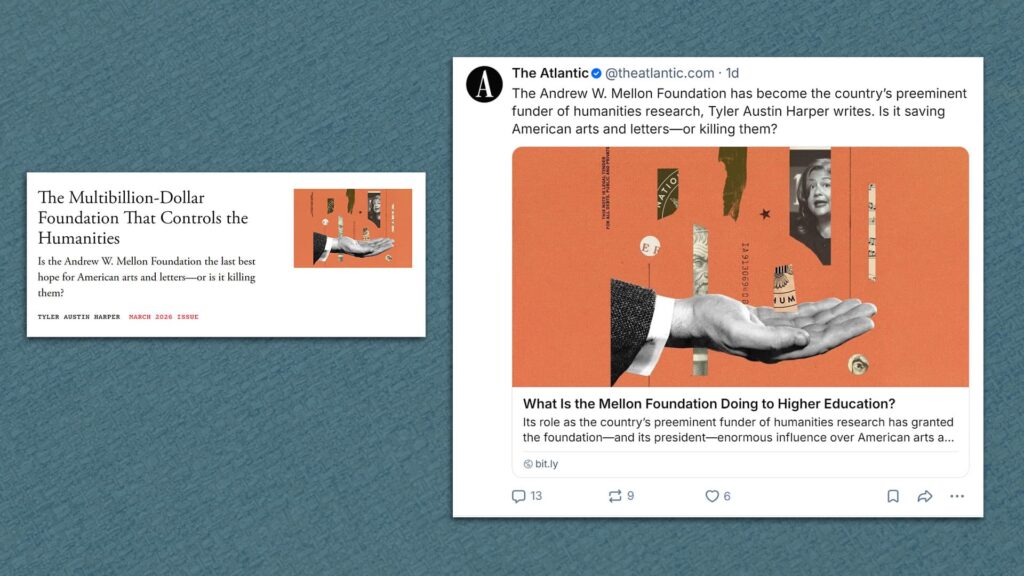
Recently there was an article related to the topic we’re addressing here published in The Atlantic magazine that went viral for a little bit. Written by Tyler Harper Austin, it was entitled “The Multibillion-Dollar Foundation That Controls the Humanities,” and it was about a private foundation that provides significant financial support for Humanities and Social Sciences scholarship, the Mellon Foundation.
The gist of the article is that starting around 2018, the Mellon Foundation declared that it would focus on social justice, and that as other forms of funding for the Humanities have dried up, the Mellon Foundation is now in a position where it can it can significantly influence the shape of the Humanities in the US.
One of the changes that Harper points out is that while there used to be a Mellon/ACLS Dissertation Completion Fellowship to help PhD candidates finish the work for their degrees, that has now become the Mellon/ACLS Dissertation Innovation Fellowships which are “supporting innovative approaches to dissertation research in the Humanities and interpretive Social Sciences.”
So, while previously the Mellon Foundation did not have a say in what people researched, but could only decide which dissertation topics they would help bring to completion, these new fellowships are “designed to intervene at the formative stage of dissertation development, before writing is advanced, and provide time and support for emerging scholars’ innovative approaches to dissertation research.”
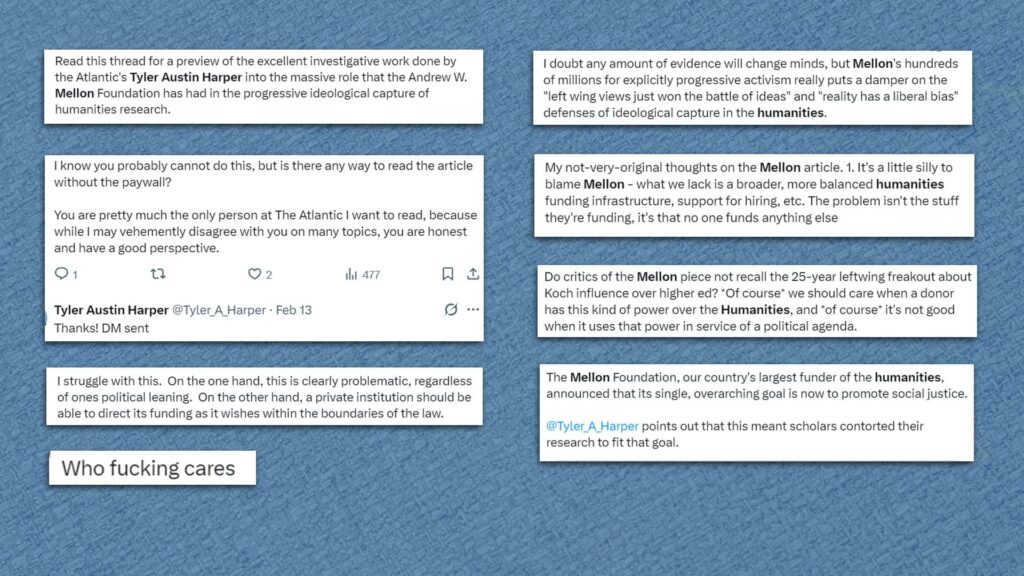
Curious to know what people think about this article, and the issues it addresses, I checked how it was being received on X and on Bluesky, the platform that many academics declared they were fleeing to in order to escape the “hate speech” on Twitter after it was purchased by Elon Musk and renamed X.
Tyler Harper Austin has an account on X, but not on Bluesky. However, The Atlantic has accounts on both platforms. On his X account, Harper always posts a thread of passages from his writings so that one can get the gist of what he wrote. In the case of the article about the Mellon Foundation, someone also gifted the article on X, so if you ask Grok to get a copy of it for you, it can.
In any case, there were quite a few people sharing the article on X and commenting on it, and Tyler Harper Austin responded to people’s comments as well. Here are some representative examples of what I saw:
“Read this thread for a preview of the excellent investigative work done by the Atlantic’s Tyler Austin Harper into the massive role that the Andew W. Mellon Foundation has had in the progressive ideological capture of humanities research”
“I know you probably cannot do this, but is there any way to read the article without the paywall? You are pretty much the only person at The Atlantic I want to read, because while I may vehemently disagree with you on many topics, you are honest and have a good perspective.” – [from Harper] “Thanks! DM sent.”
“I struggle with this. On the one hand, this is clearly problematic, regardless of ones political leaning. On the other hand, a private institution should be able to direct its funding as it wishing within the boundaries of the law.”
“Who fucking cares.”
“I doubt any amount of evidence will change minds, but Mellon’s hundreds of millions for explicitly progressive activism really puts a damper on the “left wing views just won the battle of ideas” and “reality has a liberal bias” defenses of ideological capture in the humanities.”
“My not-very-original thoughts on the Mellon article. 1. It’s a little silly to blame Mellon – what we lack is a broader, more balanced humanities funding infrastructure, support for hiring, etc. The problem isn’t the stuff they’re funding, it’s that no one funds anything else.”
“Do the critics of the Mellon piece not recall the 25-year leftwing freakout about Koch influence over higher ed? *Of course* we should care when a donor has this kind of power over the Humanities, and *of course* it’s not good when it uses that power in service of a political agenda.”
“The Mellon Foundation, our country’s largest funder of the humanities, announced that is single, overarching goal is now to promote social justice. @Tyler_A_Harper points out that this meant scholars contorted their research to fit that goal.”
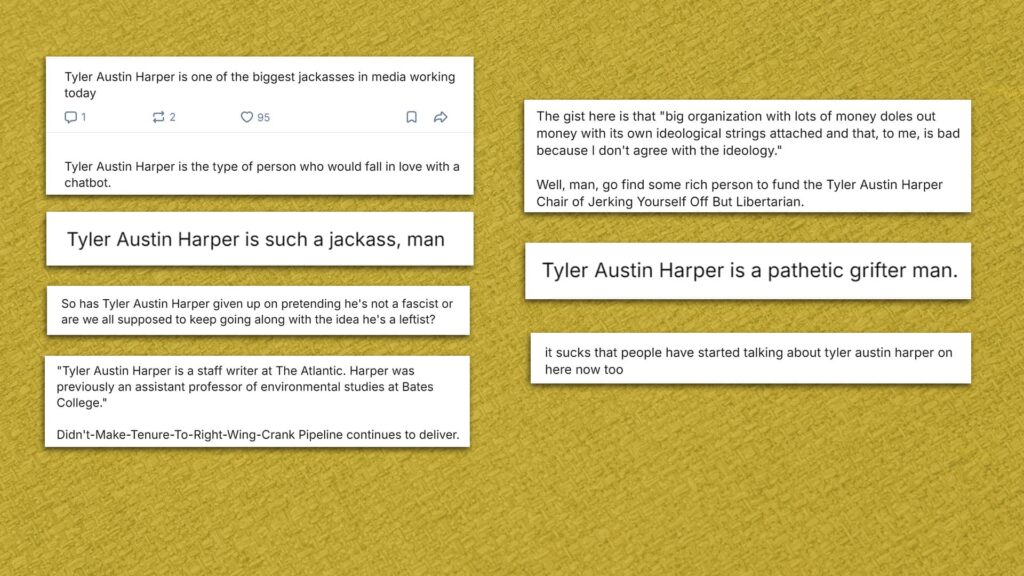
Then I went over the Bluesky, and this is pretty much all I found there (perhaps there’s more there now?):
“Tyler Austin Harper is one of the biggest jackasses in media working today.”
“Tyler Austin Harper is the type of person who would fall in love with a chatbot.”
“Tyler Austin Harper is such a jackass, man.”
“So has Tyler Austin Harper given up on pretending he’s not a fascist or are we all supposed to keep going along with the idea he’s a leftist?”
“‘Tyler Austin Harper is a staff writer at The Atlantic. Harper was previously an assistant professor of environmental studies at Bates College.’ Didn’t-Make-Tenure-To-Right-Wing-Crank Pipeline continues to deliver.”
“The gist here is that ‘big organization with lots of money doles out money with its own ideological strings attached and that, to me, is bad because I don’t agree with the ideology.’ Well, man, go find some rich person to fund the Tyler Austin Harper Chair of Jerking Yourself Off But Libertarian.”
“Tyler Austin Harper is a pathetic grifter man.”
“it sucks that people have started talking about tyler austin harper on here now too.”
Wait now, which platform is supposed to be filled with hate speech? 😊
To return to a more rational comment, one that was posted on X that “It’s a little silly to blame Mellon – what we lack is a broader, more balanced humanities funding infrastructure, support for hiring, etc. The problem isn’t the stuff they’re funding, it’s that no one funds anything else,” I would argue that the titles of articles from the past sixty years of the Journal of Asian Studies listed above tell a different story.
Historically, only a tiny percentage of Mellon fellowship recipients have worked in the fields of Asian Studies/History. And yet, if one compares the titles in the current Journal of Asian Studies with the latest awardees of the Mellon/ACLS Dissertation Innovation Fellowships, one sees clear parallels.
I would argue that everything was already moving in the progressive/activist direction already, and therefore, the Mellon Foundation just followed a development that was already in play.
As such, if there was additional funding for the Humanities at this point, unless that funding came with some specific stipulations, the output would be the same.
So, why has this happened?
I saw some people on X, and I think Harper himself say this too, that it was a “survival strategy.” As funding dried up in the 2010s and as universities had to prioritize certain programs over others, going progressive was a way to demonstrate “relevance.”
That’s probably true, but the one thing that people leave out is that the responses on Bluesky give a hint of how that “relevance” was at times argued.
It’s not necessarily the case that administrators came up with ideas of what they thought was relevant and faculty members joined the cause. At times it was that administrators didn’t want to receive the treatment on campus that Tyler Austin Harper just received on Bluesky, and followed the people who either shouted the loudest or could potentially cause the most damage.
This is my take on how we ended up with a table of contents that I can no longer understand.

I showed this post to my wife, who speaks English better than I do, and asked if the 2026 article titles resembled the literary criticism dreck that gets published in her field’s journals. She said yes. She also said you should turn this blog post into an article, submit it to the Journal of Asian Studies, and if the folks there don’t want it, send it as an opinion piece to The Chronicle of Higher Education or Inside Higher Ed.
I see a trend similar to what you describe in political science. Instead of comparing relevant cases from the past to identity potential solutions to current problems (which is what economists do), the field has split into two very different directions: the tedious and vague pontification of critical theory (signaled by made-up words like “gendered,” according to my wife) on one end, and arcane modeling of abstract, hypothetical scenarios on the other. You would think that a field called “political science” would be at the forefront of public policy-making, the creation of national security strategy, etc., but it’s not. The field is also absent from the public discourse about political matters. One indicator of this: the insignificant presence of political scientists in the world of podcasts. Political science went off the deep end of academic navel gazing about 40-50 years ago, because that’s what got published and that’s how people got tenure.
Yes, I agree that there are roots of the current state of affairs that go back decades, but I’m also convinced that something big has happened in the past 10+ years.
We are always influenced by the world we live in, and up until recently that influence was manifested in academia at least to some extent through intellectual developments. Now, however, I don’t see that anymore.
When I got into the game, people were starting to look beyond nations when globalization made them realize the limitations of not doing so. Influenced by feminism and the women’s rights movement, they started examining the history of women when they realized that women had been excluded from earlier histories. Influenced by global warming, they started looking at the history of the environment to try to see how that has influenced the past. etc.
All of these developments had some kind of intellectual rationale behind them: we can gain a more accurate understanding of the world if we look beyond nations, include the lives of women, and consider the role that the environment plays, etc.
In the past 10 years, by contrast, I have seen over and over people talking about genocide, every form of violence, trauma, settler colonialism, racism, etc. Did life on planet earth suddenly take an incredibly dark turn that academics are now responding to by attempting to find a way to intellectually deal with it, like they did with the issues above?
No, it did not. For most people on the planet (and including the people who write about these topics), life has never been more comfortable. So where is all of this stuff coming from?
Whenever you look at discussions about the decline of interest of students in certain majors, it is always tied to things like economics, and the 2008 economic crisis in particular, and a change to being more “practical” after that. For students, this means focusing on STEM. And now to explain this craziness in academia, the same argument is being made: people in the post-2008 period have been trying to show that they are “relevant.”
Meanwhile, no one ever talks about the elephant in the room: the Internet, smart phones and social media.
I spent some time recently with some kids in Europe who study “media and culture.” There is absolutely nothing practical about studying “media and culture.” Literally, there is nothing practical about it. They don’t actualy create media, and don’t learn any of the tools for doing so. They just learn how to talk about media and the production of cultural products. And it’s a very popular major. . .
Why are kids interested in it? Because they want to create content like they see every day on social media/the Internet and “media and culture” is the only major that seems, at least in terms of its name, to be close to that.
I think something Internet/social media-related is also going down with academics themselves. They are producing what makes them feel important on social media/the Internet. In a world where they are clearly unimportant (who reads what they write anymore? And like you said, political scientists are not producing influential podcasts or “at the forefront of public policy-making, the creation of national security strategy” etc.), writing about genocide/violence/racism, etc. and then posting about that on Blueksy or Threads while militantly trashing anything that in any way challenges their world bubble makes them feel important.
So, academia has ceased to be about knowledge and ideas, and is now a psychological crutch for a segment of society that has no idea what to do in the Internet age other than to be angry about their obvious unimportance.
That said, that’s for one segment of academia. There is another segment that just doesn’t do much of anything anymore. I think that is also attributable to the Internet and social media. It’s the product of a “brain rot” that has set in as people have become accustomed to doom scrolling and not actually engaging deeply with anything, but instead, just making snarky comments (which make them feel important at least for the brief period of that dopamine rush that they get when they post it) and then moving on.
Again, ultimately I think all of this is traceable to a sense of unimportance that the Internet age has brought to academics. Their world “worked” when it was closed off and they (and students) had nothing to compare themselves to. When the Internet opened everything up, suddenly there was a lot to see and do, but academics stayed in their traditional world and lost a sense of self-worth. Now the younger generation is declaring their importance by pointing out genocide, all forms of violence, trauma, etc. and militantly defending their positions on social media. However, I think that also stems from the same root. I think I’ll have to write another post on this one. . .
“n the past 10 years, by contrast, I have seen over and over people talking about genocide, every form of violence, trauma, settler colonialism, racism, etc. Did life on planet earth suddenly take an incredibly dark turn that academics are now responding to by attempting to find a way to intellectually deal with it, like they did with the issues above?”
I truly hope that many Vietnamese would take note of George Dutton’s “Việt Nam and the Genocide of Champa, 1470–1509″. I harbor the dark suspicion that most of them still think of this episode in the celebrabory terms of Hòn vọng phu trilogy.
Thanks for pointing this out. I’ll check it out.
George hasn’t updated his webpage since 2016. I can’t locate an Academia.edu or ResearchGate page for him either. . . So, how on earth is anyone supposed to know that this exists?
Don’t people want their work to be read??
This is an unfortunate essay, obsolete even at the time that it was published. It relies mainly on secondary and translated sources, is incorrect about the availability of second hand accounts, and ignores the archaeological record. (It also, astonishingly, ignores Griffiths, Hardy, and Wade eds. 2019). It is a typical of a volume edited by Ben Kiernan (to whose account of this episode it kowtows) that it should try to shoehorn every episode of inter-ethnic violence into the category of “genocide.”
Being a mere consumer of history, I assume that Dutton is a solid scholar of premodern Vietnam, given his study of the Tây Sơn uprising.
As I was reading this, I was thinking to myself, “This is the guy who wrote about the Tây Sơn uprising? What happened?!!”
“Cham found themselves sandwiched between the powerful, and significantly more populous, Vietnamese realm to their north and the Khmer kingdom to their south and west.” – uh, yea, and they also went and periodically beat the crap out of each of those peoples. . .
“the Cham states as being comfortably polyethnic in ways that were not always true of the Vietnamese” – oh, boy, here we go again with the beautiful, flexible, adaptable Southeast Asians and the evil, rigid Sinicized Vietnamese. . .
“Consequently [because of a supposed lack of economic resources rather than other possible factors like greed], the Cham leaders also relied to a degree on occasional raid and plunder activities in which their ships would engage in coastal piracy, or their armies would attack their Khmer and Viet neighbours. These military attacks were rarely designed to seize and hold territory, but rather to appropriate movable goods of value, including people for its population poor territories.” – again, the same tired Southeast Asia is beautiful trope. Southeast Asians didn’t kill each other. They just fought little wars to capture people (whom they then enslaved and hauled back to their polities. . . oh, but they were treated really well, not like slaves. . .)
And then having sections on “perpetrators” (the Vietnamese baddies) and “victims” (the innocent Cham). . .
What I think is really cool about this history is that it shows precisely the opposite. The Cham were powerful and badass for centuries. That is fascinating. And somewhere I think Tuong Vu has an article where he documented all of that. I think you are probably familiar with that piece. Seeing this 1470/71 in that context is what I would want to see, not “oh yea, there were some conflicts before, but it’s the Vietnamese who had the genocidal actions even though they’re not really genocidal actions.”
Also, he has a comment about how beheading was something that didn’t happen in the past, prior to the anti-Ming resistance, and he says “Thus, the act of beheading carried out by Vietnamese troops seems to be a deliberate act, one calculated as a form of ritual punishment meted out against the Cham populations collectively and also, as not merely enemies of the Vietnamese generically, specifically as Cham.” Ok, the DVSKTT does not say much about beheading prior to the Ming occupation period, but there is a TON of beheading that goes on at that time, on both sides. So, things need to be put in that context. But yea, that makes me wonder. Was that something new that started during the Ming occupation period, and if so, why? Or was that what warfare was like earlier, but that just wasn’t recorded in that way.
So, in the end, I think this was a real missed opportunity. But it also means that this is a topic that someone else can certain revisit.
Elucidating as always!
I think so many of these problems stem from the way in which GD uses sources in this and other essays – his reliance on old secondary scholarship; his reliance on translations of texts translated in romanised Vietnamese; his use of flawed and faulty translations into English (why would any serious scholar, especially one who can read literary Sinitic, quote from “Sources of Vietnamese Tradition” (even if they edited it)?); his lack of currency with work on the Cham in archaeology and art history; and his basically ignorant, regressive view of Chinese historiography and the Sinitic (and so Sino-Vietnamese) worlds.
I just read it and I totally see your point. Take these sentences from the conclusion, for instance:
“In many respects, the events of 1471–1509 represented not the culmination of Vietnamese genocidal actions against the Cham populations but rather one aspect of a protracted process of physical and cultural marginalisation of these people. . . In sum, Vietnamese genocidal actions against the Cham in the latter decades of the fifteenth represented only one particularly violent episode in a long-running contest between the two states.”
Ok, so it’s “genocide” but then it’s not actually “genocide”. . . Huh??
“a segment of society that has no idea what to do in the Internet age other than to be angry about their obvious unimportance” — this made me laugh out loud. My wife and I were just talking about many academics’ psychological need to feel important and how this gets manifested in bizarre ways. Our most recent example: a faculty committee that 1) meets online at night because its members are “too busy” during the workday, yet 2) discusses documents (to the extent of “I’m going to read this out loud, tell me what you think”) that can be asynchronously commented on and edited online at any time of the day or night. Also (3), the results of this committee’s “important work” will go into a digital file folder that will never again be opened.
“From 1966 to 1986, people wrote about events and historical processes, such as the occupation of Japan, the first non-cooperation movement in India, the decline of the Mughal Empire, the Bihar famine, the short-lived empire of Vietnam in 1945, etc.
And they also produced studies that explained fundamental aspects of Asian societies, like Buddhist cosmography in Thai history, and Indonesian language development.
In the 1990s, it was still largely the same, but the scope of interest expanded to start including the examination of demographics that had not previously been focused on, like women and children.
When we reach the 2000s, the examination of events and processes transformed into an examination of representations, memory, and discourses. In other words, instead of talking about what happened or what a people in a society do (did) or think (thought), people examined how meaning about all of these issues was constructed, and about the power behind those constructions of meaning.
In the 2010s we see more of the same. In addition, we also see that the use of “hip” academic language had become more or less universal by this point, and as a result, even when studies still took a more “traditional” approach, they still had to be packaged in language that mimicked the language employed in newer approaches.
That gets us to 2026. Other than rethinking Yuan-Koryŏ royal marriages and rulership, I basically cannot understand anything from the remaining titles in the current issue of the Journal of Asian Studies. I simply have no idea what people are talking about.”
Your remark reminds me of a famous aphorism often misattributed to Johann Gustav Droysen, Leopold von Ranke’s main rival: “Wer von der Sache nichts versteht, schreibt über die Methode.” (“He who does not understand anything about the matter, writes about the method.”