
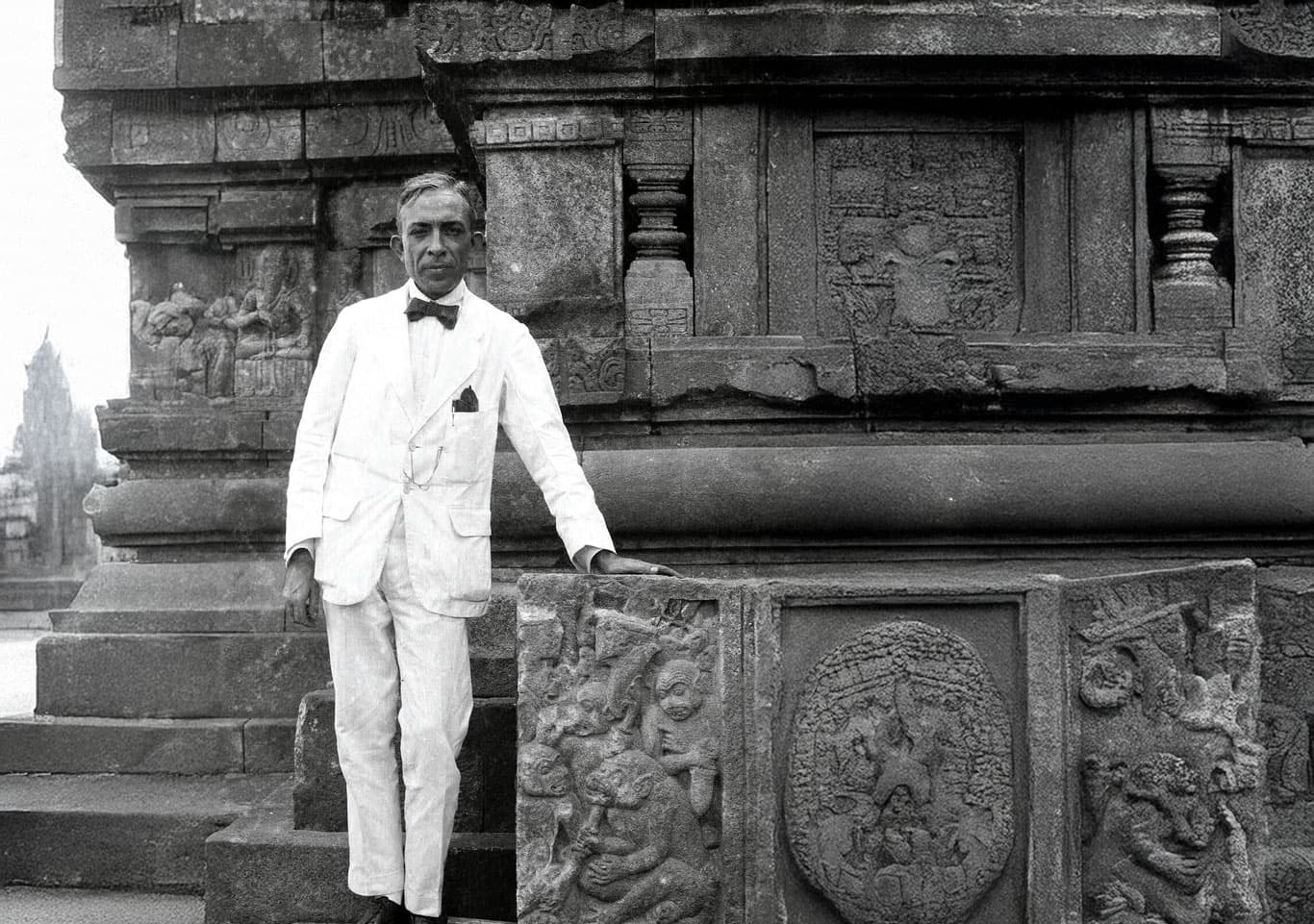
In thinking about how to explain the problems that we find in George Cœdès’s 1918 article, “Le Royaume de Çrivijaya,” I realized that it would be helpful for readers to have access to an English-language translation of that article. So, I made one with ChatGPT and shared it here.
However, before proceeding further with the examination of that article, I think it would also be helpful to give a general overview of the key problem with that article, and that is Cœdès’s use of information in Chinese sources.
Prior to the publication of “Le Royaume de Çrivijaya” in 1918, scholars had already been proposing connections between certain placenames in Southeast Asia that can be found in Chinese and Arabic sources. What Cœdès then did was to add inscriptions to that discussion, and to declare that one could connect the information in Chinese and Arabic sources to a polity that was mentioned in certain inscriptions, a polity called “Srivijaya.”
Much of what Cœdès wrote was correct, except when it came to his use of the Chinese sources. Cœdès could not read Chinese, so he had to rely on the work of others, and by the time he published his 1918 article, there were already significant flaws in their scholarship, and in particular, with the placenames Shilifoshi, Sanfoqi, Moluoyu, and Shepo.
1) In 1876, Willem P. Groeneveldt linked the Song dynasty-era name, Sanfoqi, with Palembang. This was a flawed association. The information that Groeneveldt cited for this came from a work by Ma Huan, a man who had participated in some of the Zheng He voyages in the early fifteenth century.
His work states that a place called Old Harbor used to be called Sanfoqi and that it was also known as the Bolin Polity (Bolin bang). Given that there was a place off the coast of Sumatra near Palembang that Chinese in his day referred to as “Old Harbor,” Groeneveldt concluded that Sanfoqi referred to Palembang and that the Bolin Polity (Bolin bang) should be read as a phonetic transcription of “Palembang.”
This is flawed because,
A) we can see from sources from the time of the Zheng He voyages that Sanfoqi, Old Harbor and the Bolin (or Baolin) Polity were three different and coterminous places,
B) the final character in “Bolin Polity” would not have been used to transcribe a foreign name, and in support of that point, we can see evidence that Chinese scholars understood this name to just be “Bolin,”
C) “Old Harbor” is a generic name, and there is evidence of Chinese recording more than one “Old Harbor” in the region,
D) Ma Huan’s text has a complex compilation and transmission history which makes it easily possible that the association between Sanfoqi, Old Harbor and the Bolin Polity, which appears right at the beginning of a passage, was added later, and
E) the imagined linking of different placenames, from the past and present, that we see in this case of Sanfoqi in Ha Huan’s account is very common in the works of Chinese scholars starting in the late-Ming period (late 1500s/early 1600s) when the extant versions of Ma Huan’s work were likely recopied for transmission, by which point
F) Sanfoqi had not been mentioned in sources for roughly a century.
2) In the 1880s, Samuel Beal argued that a place called Moluoyu was also either Palembang or someplace near it, and that Shilifoshi was the same place, because of some comments to that effect in the writings of the seventh century Chinese monk, Yijing. Beal made this association having seen a note in Henry Yule’s translation of Marco Polo’s travel account that in the early fifteenth century, Portuguese admiral Afonso de Albuquerque had noted a “Malayo” near Palembang.
This idea was flawed because there is information in Chinese, Arabic, and South Asian sources that locate a place pronounced something like “Moluoyu” in a different location, on the Malay Peninsula.
Beal also suspected, without providing any evidence to support this idea, that the Tang dynasty-era placename, Shilifoshi, might have been the same place as the later Sanfoqi. Finally, Beal also saw a similarity between a place mentioned in Arabic texts, Sarbaza, with Sanfoqi, which scholars at that time were sometimes transcribing as “San-bo-tsai.”
These points were made based on apparent similarities, but Beal did not provide evidence to support these points.
3) Multiple scholars had equated various terms that can be read as “java/jaba,” including “Shepo,” with the island of Java.
This idea is flawed because,
A) there is a geographic description of Shepo from the 1200s that does not fit the island of Java but which does fit the area of the Malay Peninsula around Lake Songkhla,
B) we can clearly see a transition in meaning of the term “Shepo” in Chinese sources from the 1200s and 1300s, from indicating a place on the Malay Peninsula to indicating island Java,
C) at that same time, there is mention of “two Javas” in the writings of Ibn Battuta and Marco Polo,
D) Chinese scholars who compiled the History of the Ming also recognized that the information in historical sources about “Shepo” was not about a single place.
In particular, in his 1918 article, George Cœdès relied upon these flawed ideas about placenames in the Chinese sources to interpret information in various inscriptions about a place called “Srivijaya.”
In doing so, Cœdès also attempted to demonstrate that the name “Shilifoshi” was literally the name “Srivijaya.” However, as we saw in the previous post in this series, his evidence for this was deeply flawed. This is thus a sixth flawed assumption.
Srivijaya Scholarship
With the publication of Cœdès’s 1918 article, an era of Srivijaya scholarship commenced. Scholars who followed Cœdès thus attempted to work on a topic for which there were multiple flawed assumptions.
Further, in the century that followed, scholars did not question or investigate many of those assumptions.
For instance, scholars did not,
A) check to see if it’s really the case that we can rely on works from the late-Ming and early-Qing period to determine the location of Sanfoqi, a polity that had ceased to exist for a century by the time those writings were produced;
B) check to see if there is any actual evidence that links Shilifoshi and Sanfoqi; and,
C) check to see if Cœdès’s linguistic argument that Shilifoshi is Srivijaya is valid or not.
Instead, whatever “disagreements” there were amongst scholars came from trying to get these flawed assumptions to work together and make sense.
In other words, the situation with Srivijaya scholarship is exactly the same as what we saw in the series on From Pelliot to Wade: Jia Dan’s Itinerary Through Maritime Southeast Asia. There we saw that scholars have not been able to get Jia Dan’s eighth-century itinerary through Southeast Asia to make sense because they have all worked from the same flawed assumptions about certain placenames, and this has led every scholar to erroneously assume that the itinerary went through the Strait of Malacca.
In the case of Srivijaya scholarship, there were scholars who at times might question one of the flawed assumptions (like the idea that Moluoyu was on Sumatra), but in doing so, they would still uphold all of the other flawed assumptions, and that would lead to an overall interpretation that was unconvincing.
In general, however, most scholars simply did not question any of the above assumptions.
Take, for example the issue that we discussed in the previous post, Cœdès’s attempt to find a way to get the Chinese placename Shilifoshi to mean “Srivijaya.” Part of his argument was a convoluted attempt to link a “Vijaya” in the tenth and eleventh-century Cham world with the term “Foshi” that was recorded 300 years earlier in the texts of monk Yijing.
Writing in 1967, historian O. W. Wolters stated that “One of [Cœdès’s] reasons for equating Shih-li-fo-shih [Shilifoshi] with Srivijaya was that Fo-shih [Foshi] was the Chinese name for the later Cham capital of Vijaya on the coast of Annam, an equation which was not in doubt” (fn. 32, 265-66).
I challenge everyone to read the previous post and not be in doubt about that equation.
Indeed, I challenge everyone to read that post and be anything less than completely unconvinced by Cœdès’s equation.
The above assumptions were precisely that, assumptions, and assumptions have to be tested, and when we test the above assumptions, they all fail the test.