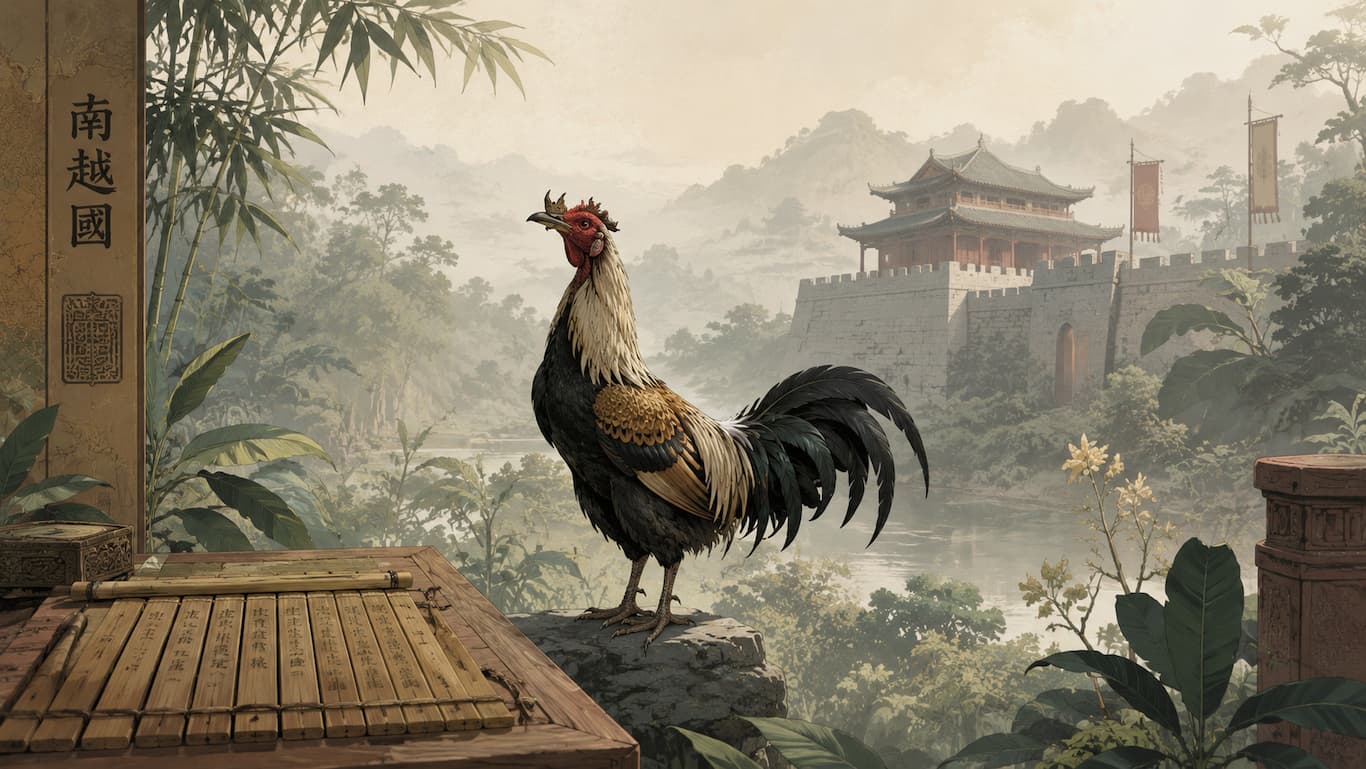
I have been spending some time recently looking at the wooden slips, or mujian 木簡 (Việt: mộc giản), that were excavated from the palace of the Nanyue Kingdom in Guangzhou.
Nanyue/Nam Việt 南越 was the kingdom established by Zhao Tuo/Triệu Đà 趙佗 after the collapse of the Qin Dynasty at the end of the third century BCE. Traditionally, most of what historians have known about this kingdom has come from later historical works such as Sima Qian’s Shiji 史記 (~100 BCE) and Ban Gu’s Hanshu 漢書 (~100 CE).
Those are extremely important sources, but they were not documents produced by the Nanyue government itself.
The wooden slips are.
During excavations at the remains of the Nanyue royal palace in Guangzhou in 2004, archaeologists discovered a group of wooden slips and fragments in a drainage or settling well designated J264. Eventually 136 pieces were identified, preserving roughly 1,200 written characters. Sixteen slips were initially published in 2006, while a volume presenting the complete corpus, Nanyue mujian 南越木簡 (Nanyue wooden slips), appeared in 2022.
That sounds like a lot of information, but it really is not.
Many of the surviving characters are on broken pieces of wood. Much of what survives consists of extremely brief administrative notations: names of people, names of offices, numbers of fruit on trees, references to punishments, mice, chickens, dried fish, deer, palace gates, and various other bits and pieces.
So, these slips do not suddenly allow us to reconstruct the government or society of Nanyue in any detailed way. What makes them important is something else.
They are rare documents that were actually written inside Nanyue. And among these fragments are two slips about chickens that have generated a surprisingly complicated scholarly debate.
Seven Chickens
Slip 072 contains just a short expression: ye xiong ji liu / dã hùng kê lục 野雄雞六.
Literally, the individual characters would seem to mean:
野 (ye / dã) = wild
雄 (xiong / hùng) = male, masculine, strong
雞 (ji / kê) = chicken
六 (liu / lục) = six
So, at first glance this looks something like: “Six wild male chickens.”
Then we get slip 073. The beginning can be read: ye xiong ji qi, qi liu ci yi xiong / dã hùng kê thất, kỳ lục thư nhất hùng 野雄雞七,其六雌一雄.
And the crucial part means: “Seven ye xiong [dã hùng] chickens, of which six were female and one was male.”
The characters “ci / thư” 雌 and “xiong / hùng” 雄 form the ordinary contrast between female and male.
So, we seem to have: “Seven male chickens, six of which were female and one of which was male.”
Hmmmm. . . Something clearly needs explaining. And scholars have come up with several very different explanations.
Maybe Yexiong/Dã Hùng Was a Place
One of the earliest solutions came from Mai Yinghao 麥英豪 and Li Jin 黎金.
They suggested that we should not divide the expression like this: ye / xiong ji 野 / 雄雞, that is, “wild / male chickens.”
Instead, they proposed that the two characters preceding the character for chicken, “ye xiong / dã hùng” 野雄 (Yexiong / Dã Hùng) was a place name. On that interpretation, when the character for chicken was added, you got “Yexiong / Dã Hùng chickens”—chickens originating from a place called Yexiong / Dã Hùng.
That solves the problem immediately. Seven Yexiong / Dã Hùng chickens could perfectly well include six hens and one rooster.
However, there is no known place called Yexiong / Dã Hùng 野雄. . .
So, to explain the chickens, we have to hypothesize a place whose existence is itself uncertain. That does not make the interpretation impossible, but neither does it make it particularly strong.
Maybe Xiong/Hùng Did Not Mean “Male”
Then Liu Rui 劉瑞 proposed a much more ambitious interpretation.
Liu also thought that “ye xiong ji / dã hùng kê” 野雄雞 was the name or designation of a kind of chicken, but he argued that the character “xiong / hùng” 雄 did not necessarily indicate the sex of the bird.
Normally, “xiong / hùng” 雄 means “male,” but it also carries associations of strength, vigor, heroism, or excellence.
Liu proposed that in the far south during the Qin-Han period, particularly in the region associated with Jiaozhi/Giao Chỉ 交趾, “xiong / hùng” 雄 was sometimes used as an auspicious or prestigious naming element.
If that was the case, then a female chicken could still belong to something called a “xiong ji / hùng kê” 雄雞, a “xiong / hùng” chicken, because the “xiong / hùng” 雄 was part of the name rather than an indicator that it was male.
That would solve the apparent contradiction on slip 073.
But Liu did not stop with the chickens.
This is where seven chickens in a palace account suddenly became connected to one of the biggest problems in early Vietnamese history.
From Chickens to the Lạc / Hùng Kings Debate
The traditional Vietnamese Hùng kings, or Hùng Vương, are written 雄王. The first character is the same “xiong / hùng” 雄 that appears in “ye xiong ji / dã hùng kê” 野雄雞.
However, the first Chinese text to mention the title of rulers in the Red River Plain referred to them as “Luowang / Lạc Vương” 雒王.
The characters “luo / lạc” 雒 iand “xiong / hùng” 雄 look quite different in modern print, but the fact that there are Chinese sources that first refer to “Luowang / Lạc Vương” 雒王 and then later to “Xiongwang / Hùng Vương” 雄王 has led scholars to debate whether one form arose through scribal corruption or misreading of the other.
Liu Rui used the Nanyue chicken slip as evidence in this debate.
His reasoning was essentially this:
If an actual document written in ancient Nanyue contains an unusual use of “xiong / hùng” 雄, then perhaps “xiong / hùng” 雄 really did have some special significance in the cultures of the ancient south. And if it did, then references to Hùng kings 雄王 in later texts might not simply be errors for Lạc kings 雒王.
Liu’s argument attracted attention, including among scholars interested in early Vietnamese history. Ming Chiu Lai (Li Mingzhao 黎明釗) later referred to it in an article on the Trưng sisters and Han administration. That article was subsequently translated into Vietnamese, helping introduce Liu’s interpretation to Vietnamese readers as well.
The chicken had entered the Hùng king debate.
But then other scholars looked at the slip and said, in effect: What if that character is not “xiong / hùng” 雄 at all?
Maybe It Says Luo / Lạc
Tang Zhibiao 湯志彪 and Zhou Qun 周群 proposed in 2009 that the disputed graph should actually be read: “luo / lạc” 雒 rather than “xiong / hùng” 雄.
This is obviously a major problem for Liu Rui’s argument. If the Nanyue slip actually says “luo / lạc” 雒, then the archaeological evidence does not demonstrate some special ancient southern use of “xiong / hùng” 雄 at all.
Indeed, it could point in precisely the opposite direction.
Xie Chong’an 謝崇安 subsequently made that argument directly in a 2016 article criticizing Liu Rui. Xie maintained that the excavators had mistaken “luo / lạc” 雒 for “xiong / hùng” 雄 and that the Nanyue slip therefore could not be used to demonstrate that Hùng Vương 雄王 was the original form of the title for a ruler in the Red River Plain.
At this point the chickens were thoroughly entangled with the Hùng kings.
Or Maybe It Says “Pheasant”
But there was still another possibility. . .
Hu Pingsheng 胡平生 suggested that the disputed character might be “zhi / trĩ” 雉 meaning “pheasant.”
The expression would then become: “ye zhi ji / dã trĩ kê” 野雉雞, meaning “wild pheasant chicken.” Another scholar, Wang Zijin 王子今, later adopted this reading.
This has one obvious advantage.
There is no longer a “xiong / hùng” 雄, “male,” at the beginning of the expression. So, there is nothing strange about saying that seven of these birds included six females and one male.
Problem solved?
Not quite.
Lai Leixin 賴磊鑫, in a detailed 2023 study of the Nanyue slips, pointed out that the expression “ye zhi / dã trĩ” 野雉, literally “wild pheasant,” does occasionally occur in early texts.
However, he could find no examples of the fuller expression: “ye zhi ji / dã trĩ kê” 野雉雞, “wild-pheasant-chicken.”
So, changing “xiong / hùng” 雄 into “zhi / trĩ” 雉 solves the sex problem but creates a new lexical problem.
What exactly is a “wild pheasant chicken”?
Lai therefore rejected this interpretation.
Maybe Somebody Just Made a Mistake
There is another explanation, and it is wonderfully mundane.
Maybe somebody wrote an extra character.
In 2015, He Youzu 何有祖 proposed that the first “xiong / hùng” 雄 on slip 073 was simply an accidental addition.
Paleographers call this a “yanwen” 衍文, an inadvertently added or repeated graph.
If we remove that first “xiong / hùng” 雄, the beginning of the text becomes effectively: ye ji qi, qi liu ci yi xiong / dã kê thất, kỳ lục thư nhất hùng 野雞七,其六雌一雄 which means:
“Seven wild chickens, of which six were female and one was male.”
Suddenly everything makes sense. No lost place called Yexiong / Dã Hùng is necessary. No special ancient southern use of “xiong / hùng” 雄 as an auspicious animal name is necessary. We do not have to change “xiong / hùng” 雄 into “luo / lạc” 雒 or “zhi / trĩ” 雉.
Somebody simply wrote one character too many.
Lai Leixin regards this as the most convincing solution. He finds the place-name argument unproven, Liu Rui’s theory of an auspicious regional “xiong / hùng” 雄 insufficiently demonstrated, and “ye zhi ji / dã trĩ kê” 野雉雞 difficult to support from other early texts.
Indeed, this is an attractive (and convenient) explanation. However, there is still a problem.
Remember slip 072? It also contains the character “xiong / hùng” 雄.
It simply says: ye xiong ji liu / dã hùng kê lục 野雄雞六, meaning “Six wild xiong/hùng chickens.”
So even if we delete “xiong / hùng” 雄 as a scribal mistake from slip 073, it still appears on slip 072. What does it mean there?
Could a similar error have occurred on both slips?
Perhaps.
Was “Yexiong / Dã Hùng” 野雄 really some kind of place name or product designation after all?
Perhaps.
Could the disputed graph still be something other than “xiong / hùng” 雄?
Also possible.
And this is what I find so interesting about these chickens.
What Do Seven Chickens Actually Tell Us?
The point is not that slip 073 has finally revealed some lost ethnic custom of ancient Nanyue.
It has not.
The point is not that these chickens prove that the rulers of ancient northern Vietnam were called Hùng Vương 雄王 rather than Lạc Vương 雒王, or vice versa.
They do not.
What the slip reveals particularly clearly is how historical knowledge gets produced.
We have a tiny piece of wood containing a handful of characters. One expression appears not to make sense: Seven “male chickens,” six of which were female.
So, scholars try to explain it. One proposes a lost place name. Another proposes a regional cultural preference for the word “xiong / hùng” 雄. Other scholars decide that the graph has been misread and should actually be “luo / lạc” 雒 or “zhi / trĩ” 雉. Another proposes the simplest possible explanation: a clerk made a mistake.
And in the midst of this debate, something else then happens.
Because the disputed character happens to be “xiong / hùng” 雄, the chickens became connected to the Lạc / Hùng Kings debate.
This happens a lot in the study of early history. The surviving evidence is extraordinarily limited, but the questions modern historians want that evidence to answer are at times much larger.
A wooden slip recording information about seven chickens can’t answer big questions. But once those questions already exist, it becomes very tempting to make the chickens participate in answering them.
At present, I do not think we know what “ye xiong ji / dã hùng kê” 野雄雞 means.
So, we are left with seven chickens.
Six were female.
One was male.
And more than two thousand years after someone wrote that information on a little piece of wood—and twenty years after archaeologists pulled it from a well in Guangzhou—we still do not know exactly what those chickens were called (or what they were up to).
That may sound like a very small historical problem.
However, sometimes small problems are useful precisely because they show us, with unusual clarity, how much distance there can be between what a source actually says and what historians want it to tell us.
For anyone wishing to delve deeper into the great Nanyue chicken debate, here are some sources:
廣州市文物考古研究所、中國社會科學院考古研究所、南越王宮博物館籌建處,〈廣州市南越國宮署遺址西漢木簡發掘簡報〉,《考古》2006年第3期。
劉瑞,〈“雄王”、“雒王”之“雄”、“雒”考辨——從南越“雄雞”木簡談起〉,《民族研究》2006年第5期,頁74–78、109。
麥英豪、黎金,〈南越木簡發現的聯想〉,《廣州文博(壹)》,北京:文物出版社,2007,頁5。
湯志彪、周群,〈廣州南越國宮署遺址所出西漢木簡釋讀二題〉,《社會科學戰綫》2009年第5期,頁243–245。
胡平生,〈南越宮署出土簡牘釋文辯證〉,收入《胡平生簡牘文物論稿》,上海:中西書局,2012,頁173。
何有祖,〈南越國宮署遺址西漢木簡已公布部分的釋文〉,簡帛網,2015年10月12日。
謝崇安,〈“雒王”與“雄王”問題考辨——與劉瑞先生商榷〉,《廣西民族師範學院學報》2016年第5期。
廣州市文物考古研究院、中國社會科學院考古研究所、南越王博物院編著,《南越木簡》,北京:文物出版社,2022。
王子今,〈秦漢“南邊”“南海”歷史文化新信息——讀《南越木簡》〉,2023。
賴磊鑫,〈《南越木簡》釋文校訂〉,復旦大學出土文獻與古文字研究中心,2023年9月5日。