
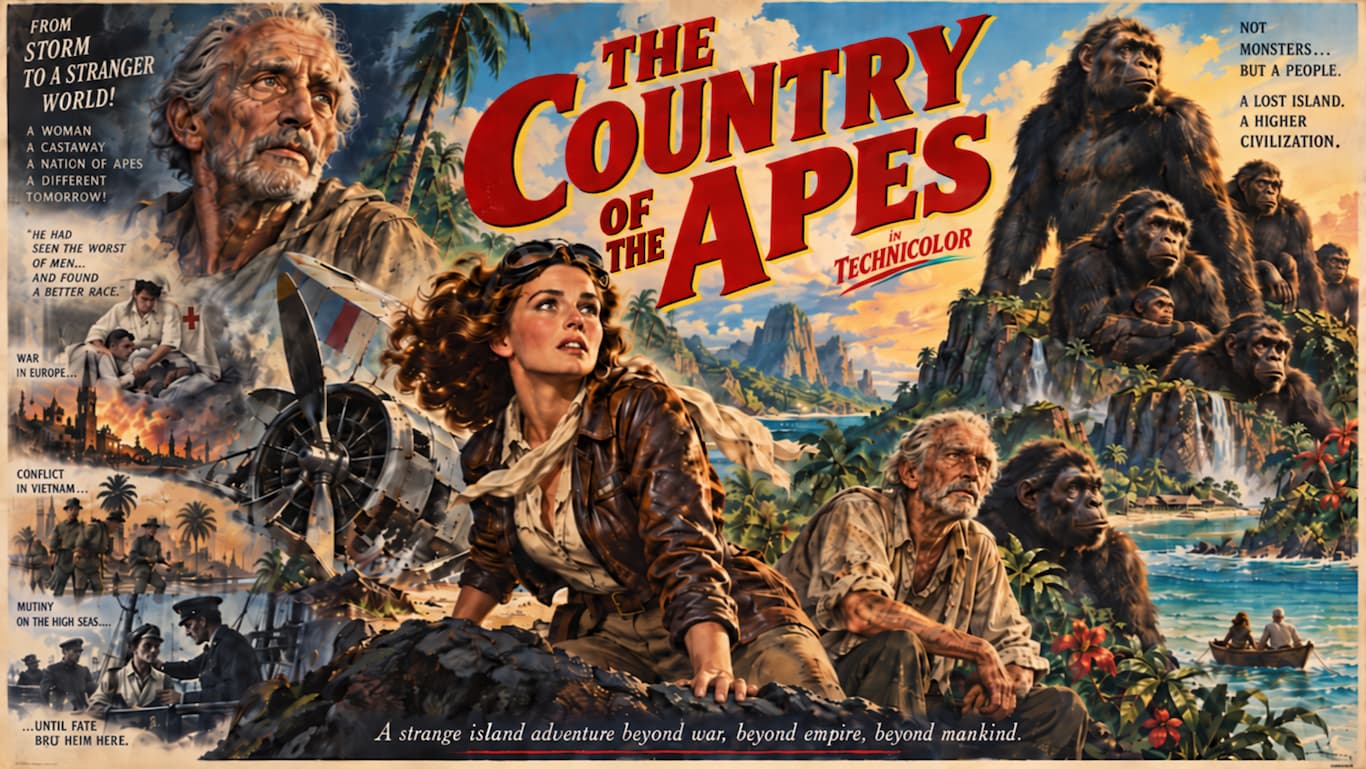
Have you ever heard of Vietnamese revolutionary Phan Bội Châu’s fictional writing “The Country of the Apes”?
No, you haven’t.
In fact, there are numerous writings by Phan Bội Châu that you have never heard of. That is because they were only “discovered” in 2007 by Taiwanese scholar Chen Qinghao 陳慶浩.
In fact, these writings were not really hidden anywhere. They were just in a journal that no one who studies Phan Bội Châu had looked at before, a journal called Military Affairs Magazine (Bingshi zazhi 兵事雜誌).
This journal was published in Hangzhou, China in the late 1910s and early 1920s. Phan Bội Châu and a small group of Vietnamese worked for this journal, publishing essays, technical articles on military affairs, and fiction. The other Vietnamese included Nguyễn Thượng Hiền, Hồ Học Lãm, Phan Bá Ngọc, and Trần Trọng Khắc.
In 2010, Chen Qinghao collected the literary works that Phan Bội Châu published in this journal and included them in the final volume of the 20-volume work, Compendium of Vietnamese Sinitic-Language Fiction (Yuenan Hanwen xiaoshuo jicheng 越南漢文小說集成).
That said, it can be difficult to identify who exactly wrote which work, as these men all used pen names. In the case of “The Country of the Apes” (Yuanguo 猿國), it is recorded that it was “written by BG and translated by Xianhan” (BG 著、憲漢譯), and Phan Bội Châu appears at times to have used both of these pen names himself. So, who wrote it, and who translated it, and from what language?
My guess is that this piece might have been created orally by someone (Phan Bội Châu?) and then written down in Chinese by someone else.
Luo Jingwen 羅景文, a student of Chen Qinghao and now a professor at Sun Yat-sen University in Taiwan wrote a dissertation (later published as a book) on the short fictional writings (xiaoshuo 小說) by Phan Bội Châu. In that work, he looked closely at the issue of authorship, and noted that some of the writings attributed to Xianhan are too technical to have been written by Phan Bội Châu himself.
This is what leads me to suspect that “The Country of the Apes” could have been Phan Bội Châu’s idea, but that someone else actually wrote it out, as it contains several elaborate, descriptive passages, a form of writing that (as far as I know) one does not see in the more well-known writings by Phan Bội Châu.
As such, I don’t think we can determine if Phan Bội Châu actually wrote “The Country of the Apes,” or came up with the idea, or both; however, there is no reason to think that he had nothing to do with this work. At the very least, it is a product of the small group of Vietnamese that he was a part of at that time.
As for the time, “The Country of the Apes” was published serially over a period of a few months in 1923–1924. It tells the story of a female pilot. She is American by nationality; her mother is French, so she can speak both English and French.
The story takes place in the not-too-distant future of the 1930s when the “Far Eastern War” (Yuandong zhan[zheng] 遠東戰[爭]) has broken out. Japan has attacked certain places in Asia, and the Vietnamese are rebelling against French colonial rule (quite prophetic!!).
The protagonist sets off from Canada on a reconnaissance mission. She crosses Borneo, Sumatra, and then crashes while heading back towards the Philippines.
The plane lands on a large sand dune where the protagonist is buried in sand up to her waist. From that vantage point, she can see a mountain in the distance with movement on it. Later, ape-like beings appear. They are “ape-like” rather than purely ape in that they cover their lower bodies and can understand both French and English. When they see the woman, they return to the mountain and bring back an old Frenchman who lives among the apes.
Together they all return to the mountain, and there the woman begins a new life in “The Country of the Apes.”
Eventually she learns about the old man’s past. Originally, he had been a doctor in France, and during World War I, he had served in the military. While he was away at war, his wife was killed by the Germans and his hospital was destroyed.
Disillusioned, the man traveled to Asia and arrived in Vietnam. Having left a land where white people had been killing white people, he now encountered a land where white people were oppressing yellow people.
Nonetheless, he stayed and did his best to not be an oppressive colonizer. However, when the Far Eastern War broke out in 1932, the Vietnamese rose in rebellion, and did not differentiate between “good” and “bad” French people. The man, therefore, decided to flee.
He boarded a French naval ship in Haiphong that was heading for Saigon. Along the way, it was learned that the Japanese had captured Saigon and that the only safe place to land was at Nha Trang. However, before the ship reached Nha Trang, the Vietnamese sailors on board mutinied and killed the French captain.
They then prepared to kill the man. However, one of the sailors found his crumpled medical diploma in his pocket, and their leader declared that it would be unrighteous to kill a doctor.
Eventually, the man lowered a lifeboat when the sailors were not paying attention and he floated to the same sand dune where the female pilot would later crash.
After the female pilot arrived, the old man explained to her about life in the Country of the Apes. The apes survived by eating fruit and none ate more than they needed, nor did any take from other apes.
The only apes that were different were the ancestor apes. They lived in a cave and were brought fruit by other apes.
The female pilot stated to one of the apes that she wished to see the ancestors, but the ape dismissed the request, stating that the ancestors did not like humans, and that the only way she could see them was to eliminate all traces of humanness from herself.
So, the woman started to emulate the apes, to sleep like them, etc. However, the old man said that this was not enough, and instead, that she had to internally eradicate all human traces, that is, everything that leads humans to covet, and conquer, and fight, and destroy.
Eventually she succeeded in doing so, and the old man took her to see the ancestors. On the way back, the old man said to the woman, “You once extravagantly discussed the Soviet Russian communist system, calling it a communist country. In reality, how was Russia ever communist? The confiscation of private business property and the issuance of bread coupons could not be thoroughly implemented; the rewards for mental and physical labor were both trapped in the inability to adjust. In the end, it still adopted the New Economic Policy and recognized the investment of foreign capitalists. In the future, the disaster of unequal wealth and poverty will probably be even worse than before. Where is its ability to be communist? Only a place like this is a true communist country.”
After describing how the Country of the Apes was truly egalitarian, the old man then stated, “I once said that as long as there are humans among living beings, the disaster of war can never be avoided. For war is manufactured by great inequality. If one wishes for no war, then one must empty all human inequality; if one wishes to empty all human inequality, then nothing is better than communism. But humans are selfish and self-interested evil creatures. As long as this creature still exists, the theory of communism will never have a time of realization. If there is a time of realization, it must be when humans have all become apes. Today, you and I are fortunate to have each thrown ourselves into the Country of the Apes, separated from humanity entirely. Among the beauties and blessings of the universe, is there any surpassing this?”
The woman then labels the old man as the “Chairman of the Communist Country.” The apes start to refer to him as such, and he tells the woman that when he dies, she will inherit that title.
And so the story ends.
There are many fascinating details in this story, as well as very interesting descriptive passages, that I have skipped over here. Further, this is only one of the fictional stories that Chen Qinghao collected. There are many others. Further, there are copies of Military Affairs Magazine floating around on the Internet, and in them one can see that there are other types of writings by Phan Bội Châu, and that his Vietnamese colleagues also wrote numerous works.
These “Hangzhou writings” are thus a real treasure trove of historical information. I plan on examining them further and writing more about them in the weeks and months ahead.
