
In the previous post, I wrote about how there is a body of writings that was produced by a small group of Vietnamese, including revolutionary Phan Bội Châu, who in the late 1910s and early 1920s wrote for a journal in Hangzhou, China called Military Affairs Magazine.
These writings were discovered by Taiwanese scholar Chen Qinghao in 2007, who then compiled the literary writings from this journal attributed to Phan Bội Châu and published them in 2010.
There are a handful or so of writings about animals. The most elaborate is the one that I wrote about in the last post, “The Country of the Apes” (Yuanguo 猿國). This title could also be translated more directly as “The Ape Country,” but as a kid, I was a major fan of the movie, “The Planet of the Apes” (MAJOR FAN!!!!!), so I just had to translate that title as “The Country of the Apes.”
I haven’t seen “The Planet of the Apes” in many years, but like “The Country of the Apes,” it contains a philosophical reflection on human civilization, and as such, Phan Bội Châu’s “The Country of the Apes” can be seen as an earlier example of a creative work that took the perceived behavior of our primate cousins to reflect on the human condition.
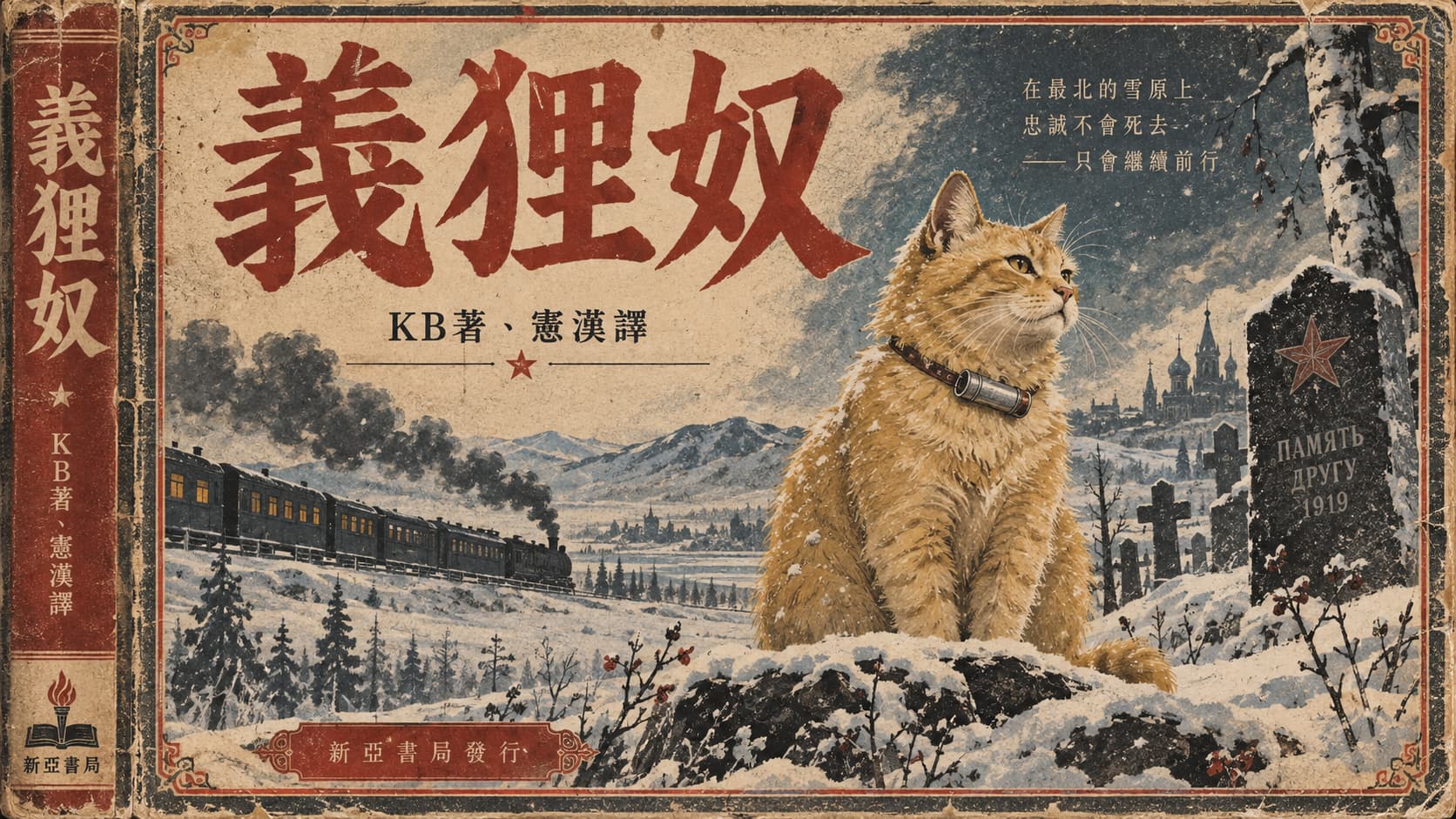
Another in this collection of animal stories is “The Righteous Cat” (Yi linu 義狸奴). As was the case with “The Country of the Apes,” it is difficult to determine the exact authorship of this work. This one is recorded to have been “written by KB and translated by Xianhan” (KB著、憲漢譯). It is not clear who KB was, but Xianhan is one of Phan Bội Châu’s pen names.
Chen Qinghao suggested that KB might be a Russian author, however 1) I can’t find any Russian story that this might be based on and 2) it doesn’t read to me like a Russian writing, and 3) there was a phenomenon of writing “pseudo-translations” (wei fanyi 偽翻譯) in the late Qing and early Republican periods in which authors would purport to be translating when in fact the work was their own creation.
Here is the story:
Setting and Inciting Incident
The story is narrated by a Russian revolutionary who, in the winter of 1914, is exiled to Siberia for opposing the Tsar. While traveling by train through a fierce snowstorm, the train stops in the vast, frozen wilderness. Late at night, the narrator hears the desperate meowing of a cat coming from the snowdrifts. He gets off the train and follows the sound, eventually finding a yellow cat trapped high up in a snow-covered tree. He rescues it and brings it back to the train.
The Discovery
Back on the train, the narrator feeds the starving cat and discovers a copper ring around its neck with a small, sealed iron tube attached. The tube has Russian text on it. The narrator and the cat become deeply attached. When they finally arrive at the remote exile destination (Sarilang 薩爾伊郎), the cat becomes his sole companion.
The Climax
One morning, the cat urgently wakes the narrator, leading him out into the freezing landscape. They walk for miles until they reach a graveyard. The cat stops at a specific grave, kneels, and kowtows to the narrator several times. Then, it suddenly leaps into the air and dashes itself against the gravestone, dying instantly.
The Revelation
The narrator inspects the grave and finds it belongs to “Miss Nikiyas” (Niqiyasi guniang 尼奇亞斯姑娘). He opens the letter tube on the cat’s body. It contains a note written in blood.
The letter reveals Miss Nikiyas’s tragic story: She was a revolutionary who attempted to assassinate the Russian Tsar. After failing, she was sentenced to lifelong exile in Siberia. Before she died, she wrote this letter. She expressed two profound regrets: not knowing if her elderly mother was still alive, and whether her comrades (explicitly mentioning Lenin) would succeed in overthrowing the Tsarist regime. She recounted how, when she was being deported, her heartbroken mother gave her the beloved family cat to keep her company. Miss Nikiyas had entrusted the cat with the letter, hoping it would somehow find its way to a trusted friend.
Conclusion
Moved beyond words by the cat’s unwavering loyalty to its deceased master, the narrator buries the cat next to Miss Nikiyas and erects a stone tablet inscribed “Home of the Righteous Cat.” He writes down the story to honor its memory.
In his concluding commentary, the narrator laments that while humans constantly betray each other for power and wealth, this simple animal crossed thousands of miles and eventually gave its life for its master. He compares the cat to Nie Zheng 聶政, the famous ancient Chinese assassin who died for the one who truly understood him, concluding that animals often possess a loyalty and righteousness that humans lack.
This story would take quite a bit of work to unpack (i.e., to put in its historical context). First, from what I can see, there were many Chinese writings produced in the early twentieth century on female revolutionaries and nihilists. Second, “strange tales” about loyal dogs, cats, ghosts, extraordinary deaths, etc. were also popular.
My guess would be that, inspired by these works, Phan Bội Châu combined these genres and created his own work, which he presented as a “translation,” but which in fact was probably a “pseudo-translation” (i.e., Phan Bội Châu’s original work).
