
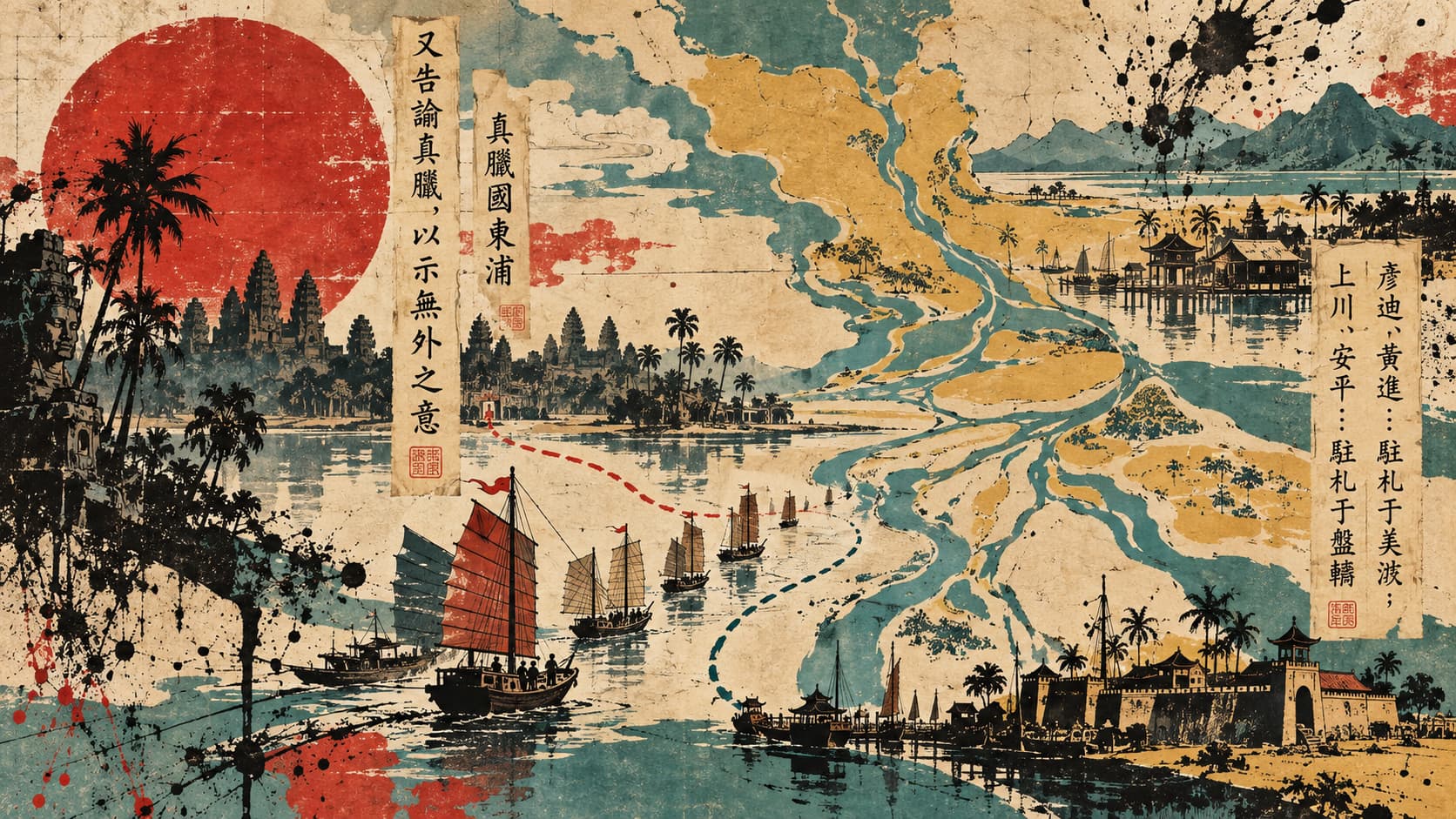
In the previous post, I talked about how LLMs can do a better job of translating than humans can, and I gave an example of a factual mistake that ChatGPT found in a passage from the Vietnamese translation of the Đại Nam thực lục.
There were other issues that ChatGPT pointed out with that short passage, including another factual error, not translating certain terms, etc. However, there was one translation issue that it pointed out that I found particularly important.
The passage that I had ChatGPT look at is about an event that occurred in 1679. In that year, some Ming loyalists arrived in the area of what is now Đà Nẵng. There was a discussion at the court of the Nguyễn lord about what to do with these men, which the Đại Nam thực lục describes as follows:
時議以彼異俗殊音,猝難任使;而窮逼來歸,不忍拒絕。眞臘國東浦(嘉定古別名)地方沃野千里,朝廷未暇經理,不如因彼之力,使闢地以居,一舉而三得也。
“At the time, the court discussed the matter. Because these men had different customs and a different speech, it would be hard to put them to use at short notice; yet they had come in desperate straits, and it was unbearable to turn them away. The region of Đông Phố (an old name for Gia Định) in the kingdom of Chân Lạp had fertile land stretching a thousand leagues, and the court had no leisure to administer it. It would be better to rely on their strength and have them open up land and settle there, so that one move would bring three gains.”
Here, Chân Lạp 眞臘 refers to “Cambodia,” and Đông Phố 東浦 in the context of this passage is a reference to a region centered around what is now Saigon.
The Nguyễn lord agreed, and thereupon,
彥迪、黃進兵船駛往雷巤(今屬嘉定)海口,駐札于美湫(今屬定祥);上川、安平兵船駛往芹蒢海口,駐札于盤轔(今屬邊和)。
“The warships of [Dương] Ngạn Địch [Yang Yandi] and Hoàng Tiến [Huang Jin] sailed to the Lôi Lạp sea mouth (now part of Gia Định) and were stationed at Mỹ Tho (now part of Định Tường). The warships of [Trần] Thượng Xuyên [Chen Shangchuan] and [Trần] An Bình [Chen Anping] sailed to the Cần Giờ sea mouth and were stationed at Bàn Lân (now part of Biên Hòa).”
The Nguyễn lord also notified Chân Lạp that he was sending these Ming loyalists to settle in its territory. This is how the translation of the Đại Nam thực lục records this matter:
Lại cáo dụ nước Chân Lạp rằng như thế là có ý không để nước Chân Lạp ra ngoài.
“He also proclaimed to Chân Lạp that this had the meaning of not letting Chân Lạp be outside.”
That does not make sense, and ChatGPT pointed that out right away, saying, “Very literal and potentially misleading. 無外 means something closer to ‘to demonstrate the intention of treating [them] as not outsiders’ / ‘showing no distinction between inner and outer.’ It does not straightforwardly mean ‘not allowing Cambodia to remain outside.’”
The Chinese text for this is 又告諭眞臘,以示無外之意, and it literally means “Also proclaimed to Chân Lạp to demonstrate the no-outside [vô ngoại 無外] intent.”
The key term here is “vô ngoại” 無外, literally meaning “no outside.” It is a very important term. However, the translators of this passage don’t demonstrate that they understood it.
And that’s a problem, because the issue of historical Vietnamese-Cambodian relations is a very sensitive topic, and it is one that is often discussed using modern concepts (i.e., “the nation”).
Vô ngoại, however, is a premodern concept, and to understand the relations between the Nguyễn lords and Chân Lạp in this early period, we need to appreciate what such a term meant.
So, since ChatGPT pointed out that the translation was unclear, I asked it what it “knows” about the concept of vô ngoại.
How did you know about 無外?
I recognized 無外 from Classical Chinese political vocabulary, especially the conventional phrase 王者無外—literally, “for the true king, there is no ‘outside.’” In that idiom, the point is that the ruler conceptually treats the realm as an inclusive whole rather than recognizing a sharp inside/outside distinction.
That is why, when I saw 又告諭眞臘,以示無外之意, I did not take 無外 (no outside) literally as “not letting Chân Lạp be outside.” I read it as something like:
“He also issued an explanation to Chân Lạp, in order to demonstrate his intention of making no distinction between inner and outer.”
or more idiomatically:
“…to show that Cambodia was not being treated as an outsider.”
That reading is supported by standard dictionary explanations. 漢典 gives 無外 as, among other things, “沒有區別,視同一體” (“making no distinction, treating as one”) and “帝王以天下為一家” (“the ruler regards All-under-Heaven as one family”). It cites the old formula 王者無外 (for the true king, there is no “outside”) from the Gongyang zhuan.
There is also a particularly useful historical example from the Wei shu [History of the Wei]. In diplomatic correspondence, one side deliberately removes language like “your territory” versus “this [our territory]” because it wants to express 無外之意—precisely “the idea of not distinguishing an outside [from an inside].”
So my interpretation came first from recognizing the classical idiom, not from seeing a translation of this particular Đại Nam thực lục passage elsewhere. The context reinforces it: Nguyễn authorities are telling Chân Lạp about the decision to settle these newcomers in Đông Phố, and 以示無外之意 describes the political posture they wished the communication to convey.
I would now translate that clause fairly conservatively as:
“They also notified Chân Lạp, thereby demonstrating their intention to make no distinction between inner and outer.”
If you want the political implication made explicit in English:
“They also notified Chân Lạp, thereby showing that they did not regard it as an outsider.”
Because I knew what this term meant, I could see that ChatGPT was close, but still wasn’t getting to the core sense of the concept, so I asked it to go a bit deeper.
What exactly does 無外 mean here in this context?
Here 無外 is a piece of classical political language. The sentence is:
又告諭眞臘,以示無外之意。 “He also informed/instructed Chân Lạp, in order to demonstrate the intention of 無外.”
The key is that just before this, Đông Phố is explicitly called territory of Chân Lạp: 眞臘國東浦…… “Đông Phố of the kingdom of Chân Lạp…”
The Nguyễn lord has decided to send the Ming refugees there to clear land and settle. Because this involves Chân Lạp, he 告諭 (proclaimed to) Chân Lạp—language that itself has a somewhat hierarchical flavor, “to notify/instruct by proclamation”—and this is said to demonstrate 無外 (no outside).
What is it saying politically?
In this particular context, I think the force is approximately: The Nguyễn lord did not treat Chân Lạp as lying wholly outside the political order over which his authority and concern extended.
The logic of the passage is:
Đông Phố belongs to Chân Lạp → the Nguyễn lord decides to settle the Ming refugees there → he informs/instructs the Cambodian ruler of the decision → by doing so he displays the rulerly principle of 無外 (no outside).
This is hierarchical language. The Nguyễn lord is not depicted as negotiating with an equal foreign sovereign for permission to settle people on Cambodian territory. He makes the decision and then 告諭 (proclaims to) the Cambodian ruler. Calling this 無外 (no outside) places Chân Lạp within an encompassing Nguyễn-centered political order.
At the same time, I would not translate it as “to show that Cambodia was part of his territory.” That would import a modern concept of territorial sovereignty that the phrase does not itself assert. 無外 (no outside) is deliberately more elastic: Cambodia can remain a distinct kingdom while simultaneously being represented as not wholly “outside” the ruler’s encompassing sphere.
So, for a fairly literal scholarly translation, I would use:
“He also notified Chân Lạp, thereby demonstrating his intention to make no distinction between inner and outer.”
But with a note I would explain that 無外 (no outside) invokes the classical ideal 王者無外 (for the true king, there is no “outside”), according to which a ruler’s political and moral sphere encompasses those beyond his immediate domain.
For a translation that communicates the actual political sense rather than preserving the idiom, perhaps:
“He also issued instructions to Chân Lạp, thereby demonstrating that he did not regard it as lying outside his political sphere.”
The crucial point is political encompassment, not simply inclusiveness or friendliness.
BINGO!!! ChatGPT can get kind of wordy, and I actually deleted some of what it wrote. However, it got to the bottom of this issue. It took a little bit of prodding, but it got it right.
And how did it do that? By researching the topic!!
I later asked it if there were any scholars who had written about this concept of “no outside” in any language. Five minutes later it came back with its answer: “Yes, it’s mentioned in the scholarship of Liam C. Kelley (2023), Yoshikawa Kazuki 吉川和希 (2018), Taga Yoshihiro 多賀良寛 (2026), and Chiung Wi-vun 蔣為文 (2018), but only Kelley has actually discussed and explained what it meant.” [Great observation, ChatGPT!!! 😊]
It then “realized” that there was more to this concept of “no outside” than the one example we had been looking at and noted that it constituted a kind of “discourse.”
I then asked it if any Vietnamese scholars had written about this concept, and it couldn’t find any.
Why would the above scholars mention it while Vietnamese scholars have not? Because the above scholars all work with the original classical Chinese versions of texts, while most Vietnamese scholars do not, and when you work with translations like that of the Đại Nam thực lục, it’s impossible to see this concept.
Or, it “used to be” impossible. Now with LLMs, even people who cannot read classical Chinese can free themselves from the limitations of the Vietnamese translation and see what is actually written in the Đại Nam thực lục.
This in turn, I would argue, raises the bar for all scholarship. At the moment, a lot of journals in the sciences and social sciences are getting inundated with papers written by AI, and the sense is that the papers must be lousy because they were not written by humans. And perhaps many or most of them are.
However, looking at the small field of premodern Vietnamese history, I think LLMs will now demand that scholarship be better than it has been.
Previously, people had it easy. They could just rely on what was written in a translation, like that of the Đại Nam thực lục.
Now one can’t do that anymore, because anyone can easily check what one says against what the text actually records. Further, when scholars (even those who can’t read the original classical Chinese sources) ask an LLM to check what a text actually says, they will find new concepts and information that force them to dig deeper and figure out what they mean.
For instance, I just downloaded a paper on Nguyễn dynasty relations with different peoples within its realm that was freely available online and asked ChatGPT to evaluate it in light of the above discussion. It found many faults with the paper, starting with:
“Given our discussion of 無外 (no outside), I think this paper has several significant problems—not necessarily because its individual factual examples are all wrong, but because its conceptual framework tends to flatten the Nguyễn sources into modern categories and thereby obscures precisely the kind of political vocabulary we have been discussing.”
So, that establishes a new bar. It is no longer acceptable to flatten the Nguyễn sources into modern categories that obscure historical political vocabulary because LLMs can easily detect and explain the problems with such an approach. Were this person to write about this topic again, they would have to produce a more sophisticated argument.
And there is only one way to do that. You have to learn what the sources actually record and what that information means. Yes, it is possible to get an LLM to do a lot of that work, but at the very least, doing so still requires prodding and investigation, and I’m confident that somewhere in the process, the scholar will actually gain new insights about the past, and the result will be better than what they produced before LLMs reached the point they are at now.
Finally, I’ve written about ChatGPT here, but I had Claude compare the Vietnamese translation of this same passage against the original in classical Chinese, and it found the same errors, and made the same observation about 無外 (no outside).
My conclusion: LLMs are raising the bar, not lowering it.
It will take time for people to realize this. Meanwhile, the LLMs will keep improving. . .