

Zhou Qufei’s 周去非 1178 work, Lingwai daida 嶺外代答 [Representative Responses about the Region Beyond the Passes], is a very important Chinese source for information about maritime Southeast Asia at that time.
For some reason, this work has never been translated. However, it should have been, and it should have been translated a long, long time ago.
I see that there apparently is an English translation that was published in Italy in 2020, but I don’t have access to that, so I sat down today with ChatGPT and made a translation in an afternoon. Or I guess I should say, ChatGPT made a translation and I spent the afternoon going over it.
I’m pasting what I have below. This is information from the book that relates to maritime Southeast Asia. This is a rough draft. And I stopped checking the translation closely when I got to Dashi, so the stuff at the end has been double-checked the least.
However, I think this should still be very helpful for anyone interested.
There are long sections on Annan and the Li people on Hainan that I did not include (yet).
Enjoy!!

《外國門上,海外諸蕃國》
諸蕃國大抵海為界限,各為方隅而立國。國有物宜,各從都會以阜通。正南諸國,三佛齊其都會也。東南諸國,闍婆其都會也。西南諸國,浩乎不可窮,近則占城、真臘為窊里諸國之都會,遠則大秦為西天竺諸國之都會,又其遠則麻離拔國為大食諸國之都會,又其外則木蘭皮國為極西諸國之都會。三佛齊之南,南大洋海也。海中有嶼萬餘,人奠居之。愈南不可通矣。闍婆之東,東大洋海也,水勢漸低,女人國在焉。愈東則尾閭之所泄,非復人世。稍東北向,則高麗、百濟耳。
The Various Foreign Kingdoms across the Seas
The various foreign kingdoms are, for the most part, bounded by the sea, each establishing its kingdom within a defined corner of the world. Each kingdom has its own natural products, which it brings to central hubs for trade and prosperity.
For the kingdoms directly to the south, Sanfoqi 三佛齊 serves as the central hub. For the kingdoms to the southeast, Shepo 闍婆 serves as the central hub. As for the kingdoms to the southwest, the region is vast and seemingly boundless. The nearer parts include Champa 占城 and Zhenla 真臘, which serve as the central hub for Wali 窊里 and other kingdoms. Further away lies Daqin 大秦, the central hub for the various kingdoms of Western India [Xi Tianzhu 西天竺]. Still further is the kingdom of Maliba 麻離拔, which is the central hub for the various kingdoms of Dashi 大食. Beyond even that lies the kingdom of Mulanpi 木蘭皮, the central hub of the farthest western countries.
South of Sanfoqi is the Southern Great Ocean. In that sea are over ten thousand islands, where people live in settlements. But further south it is no longer passable.
East of Shepo lies the Eastern Great Ocean. The water level gradually drops, and it is there that the [mythical] Country of Women is said to be found. Farther east is where the waters of the world drain away [weilu 尾閭; see the Zhuangzi], a place no longer part of the human realm. Slightly to the northeast are Goryeo 高麗 and Baekje 百濟.
《占城國》
占城,漢林邑也。境上有馬援銅柱。在唐曰環王,王所居曰占城,以名其國。地產名香、犀、象。土皆白砂,可耕之地絕少,無羊豕蔬茹,人採香為生。國無市肆,地廣人少,多買奴婢,舶舟以人為貨。北抵交址,南抵真臘,臣事交址,而日與真臘為仇。乾道癸巳,閩人有以西班到選,得官吉陽軍都監者,泛海之官,飄至占城,見其國與真臘乘象以戰,無大勝負,乃說王以騎戰之利,教之弓弩騎射。占城王大悅,具舟送至吉陽,厚齎。隨以買馬,得數十匹,以戰則克。次年復來,人徒甚盛。吉陽軍因卻以無馬,乃轉之瓊管,瓊管不受,遂怒而歸,後不復至也。異時諸國舶舟,類為其所虜,蓋其俗本好剽掠。其屬有賓胴朧國、賓陁陵國。目連舍基在賓陁陵,或云即王舍城。建隆二年曾貢方物,三年八月又來貢。哲宗元祐元年十二月又進貢,有詔賜錢二千六百緡,其慕化抑可嘉也。
The Kingdom of Champa
Champa [Zhancheng 占城] was known in Han times as Linyi 林邑. Along its border stands the bronze pillars of Ma Yuan. During the Tang dynasty, it was called Huanwang 環王, and the royal seat was called Champa [lit. Zhan Citadel], from which the kingdom takes its name.
The land produces fine incense, rhinoceros horn, and elephants. The soil consists mostly of white sand, with very little arable land. There are no sheep, pigs, or vegetables; the people make a living by gathering incense. The kingdom has no markets or shops. Its territory is vast, but its population is sparse. People frequently buy slaves, and ships trade in human cargo.
To the north it borders Jiaozhi 交址, and to the south, Zhenla 真臘. It serves as a vassal of Jiaozhi, but is constantly in a rivalry with Zhenla.
In the guisi year of the Qiandao era (乾道癸巳, 1173), a man from Fujian was selected from among the military officials to serve as Commandant of Jiyang Garrison [on Hainan]. As he was traveling by sea to take up his post, his ship was blown off course to Champa. There, he witnessed a battle between Champa and Zhenla, in which both sides fought on elephants, and there was no decisive outcome. He then advised the king on the advantages of cavalry warfare and taught them mounted archery and crossbow tactics.
The king of Champa was delighted and sent him by ship to Jiyang, bearing generous gifts. He soon returned to buy horses and obtained several dozen, with which they later won a battle.
The following year, he came again, this time with many people in his retinue. The Jiyang command refused him on the grounds that they had no more horses, so he turned to the Qiong administration [also on Hainan], which also refused. Enraged, he returned home, and they came no more.
In earlier times, ships from various kingdoms were often captured [by Champa], probably because raiding and plundering are part of its customs.
Its dependencies include the kingdoms of Bintonglong 賓胴朧 and Bintuoling 賓陁陵. The reliquary [? sheji 舍基] of Maudgalyāyana [Mulian 目連] is located in Bintoling; some say it is the same as Rajgir (Wangshe cheng 王舍城).
In the second year of the Jianlong era (建隆二年, 961), [Champa] sent tribute goods, and again in the eighth lunar month of the third year (962). In the twelfth lunar month of the first year of the Yuanyou era of Emperor Zhezong’s reign (哲宗元祐元年十二月, 1086/7), they once more presented tribute, and an imperial edict granted them 2,600 strings of cash. Their admiration for moral transformation is commendable.
真臘國
真臘國遠於占城,而近於諸蕃。其旁有窊裏國、西棚國、三泊國、麻蘭國、登流眉國、第辣撻國,真臘為之都會。北抵占城。最產名香,登流眉所產為絕奇,諸蕃國香所不及也。其國僧道咒法靈甚。僧之黃衣者,有室家;紅衣者寺居,戒律精嚴。道士以木葉為衣。國中望天一隅,常有少痕。其人云,昔女媧所不至也。本朝徽宗宣和二年曾遣使人貢。
The Kingdom of Zhenla
The kingdom of Zhenla 真臘 lies farther from Champa but is closer to the various foreign lands.
Adjacent to it are the kingdoms of Wali 窊裏, Xipeng 西棚, Sanbo 三泊, Malan 麻蘭, Dengliumei 登流眉, and Dilata 第辣撻, for which Zhenla serves as the central hub. To the north, it borders Champa.
Zhenla is renowned for producing fine incense, and that which is produced in Dengliumei is particularly extraordinary. None of the incense in all the other foreign countries can compare.
The Buddhist monks and Daoist priests in this kingdom are highly effective in their rituals and spells. Among the monks, those who wear yellow robes are married and live at home, while those in red robes reside in temples and follow strict monastic discipline. The Daoists wear garments made from tree leaves.
In one corner of the sky as seen from this country, there is always a faint mark. The people say it is where the goddess Nüwa 女媧 never reached.
During the second year of the Xuanhe era of Emperor Huizong of our dynasty (徽宗宣和二年, 1120 CE), the court sent envoys there to receive tribute.
蒲甘國
蒲甘國,自大理國五程至其國,自窊裏國六十程至之。隔黑水、淤泥河,則西天諸國不可通矣。蒲甘國王、官員,皆戴金冠,狀如犀角。有馬不鞍而騎。王居以錫為瓦,以金銀裹飾屋壁。有寺數十所,僧皆黃。國王早朝,其官僚各持花獻王,僧作梵語祝壽,以花戴王首,餘花歸寺供佛。徽宗崇寧五年二月曾入貢。
The Kingdom of Pugan
The kingdom of Pugan lies five stages’ journey from the kingdom of Dali 大理, and sixty stages from the country of Wali. It is cut off by the Black River [Hei shui 黑水] and the Muddy River [Yuni he 淤泥河], so the kingdoms of Western India cannot be accessed.
The king and officials of Pugan all wear golden crowns shaped like rhinoceros horns. They ride horses without saddles. The king’s residence is roofed with tin tiles, and the walls are decorated with gold and silver.
There are dozens of temples, and all monks wear yellow robes. When the king holds court in the morning, each official presents him with flowers. Monks chant blessings in the Fan language [=Indic language] to wish the king long life, placing flowers on his head. The remaining flowers are returned to the temples as offerings to the Buddha.
In the second lunar month of the fifth year of the Chongning era of Emperor Huizong’s reign (崇寧五年二月, 1106), tribute was offered.
三佛齊國
三佛齊國,在南海之中,諸蕃水道之要衝也。東自闍婆諸國,西自大食、故臨諸國,無不由其境而入中國者。國無所產,而人習戰攻,服藥在身,刃不能傷。陸攻水戰,奮擊無前,以故鄰國咸服焉。蕃舶過境,有不入其國者,必出師盡殺之,以故其國富犀象、珠璣、香藥。其俗縛排浮水而居。其屬有佛羅安國,國主自三佛齊選差。地亦產香,氣味腥烈,較之下岸諸國,此為差勝。有聖佛,三佛齊國王再歲一往燒香。藝祖開基,建隆元年九月,三佛齊王悉利大霞里壇,按宋史悉利下有胡字。遣使來貢方物。二年五月復遣使進貢。三年三月又來貢,十二月又貢方物。至神宗元豐二年七月,遣詹卑國使來貢。哲宗元祐三年閏十二月又遣使入貢,五年復來貢。慕義來庭,與他國不侔矣。
The Kingdom of Sanfoqi
The kingdom of Sanfoqi 三佛齊 lies in the midst of the Southern Sea and is the key strategic point along the maritime routes of the various foreign lands. From the east, Shepo and the various other kingdoms, and from the west, Dashi 大食, Gulin 故臨 and the various other kingdoms, all must pass through its territory in order to reach the Middle Kingdom.
The kingdom produces no goods of its own, but its people are skilled in warfare and attack. They apply medicinal substances to their bodies, such that blades cannot injure them. Whether in land battles or naval engagements, they fight with great force and are unrivaled. As a result, neighboring kingdoms all submit.
When foreign ships pass through its territory, any that do not enter the kingdom are attacked by military force and all on board are killed. Because of this, the country is rich in rhinoceros horn, elephant tusks, pearls, and incense. Their custom is to bind rafts, float them on the water and live there.
Among its vassals is the kingdom of Foluo’an 佛羅安, whose king is selected by and dispatched from Sanfoqi. This land also produces incense, though their scent is overly pungent [腥烈, hard to translate]. Compared to the other kingdoms on the lower coast, it is somewhat superior. There is a sacred Buddha there, and the king of Sanfoqi goes once every two years to offer incense.
When Emperor [Song Taizu] established the dynasty, in the ninth month of the first year of the Jianlong era (建隆元年, 960), the king of Sanfoqi, Xili Daxialitan 悉利大霞里壇 (note: the History of the Song adds the character 胡 after Xili), sent envoys to offer tribute goods. In the fifth lunar month of the second year, he again sent envoys to present tribute. In the third lunar month of the third year, they again came to offer tribute, and in the twelfth lunar month again presented tribute goods.
In the reign of Emperor Shenzong, in the second year of the Yuanfeng era [元豐二年, 1079], envoys from the Zhanpi 詹卑 kingdom were sent to come and offer tribute. During the reign of Emperor Zhezong, in the intercalary twelfth lunar month of the third year of the Yuanyou era [元祐三年閏十二月, 1088], envoys were again sent to present tribute, and in the fifth year [1090], they came again. Their admiration for righteousness and willingness to approach the court was unmatched by other kingdoms.
闍婆國
闍婆國,又名莆家龍,在海東南,勢下,故曰下岸。廣州自十一月十二月發舶,順風連昏旦,一月可到。國王撮髻腦後。人民剃頭留短髮,好以花樣縵布繳身。以椰子并撻樹漿為酒。蔗糖其色紅白,味極甘美。以銷銀鍮錫雜鑄為錢,其錢以六十個,準為一兩金,用三十二錢為半兩金。土產胡椒、檀香、丁香、白豆蔻、肉豆蔻、沉香。國人尚氣好鬥戰,王及官豪有死者,左右承奉人皆願隨死,焚則躍入火中;棄骨於水,亦踣水溺死,不悔。
The Kingdom of Shepo
The kingdom of Shepo 闍婆, also known as Pujialong 莆家龍, lies to the southeast across the sea. It is in a low position, hence it is referred to as the “lower coast” [xia’an 下岸].
From Guangzhou, ships depart in the eleventh or twelfth lunar month, and with favorable winds blowing day and night, it can be reached in about one month.
The king ties his hair into a knot at the back of his head. The people shave their heads, leaving short hair, and enjoy wrapping themselves in patterned cotton cloth.
They make wine from coconuts and the sap of the toddy palm. Their cane sugar is red and white in color, with an extremely sweet taste. They cast coins by alloying melted silver with tin; sixty coins are considered equal to one tael of gold, and thirty-two coins to half a tael.
Local products include black pepper, sandalwood, cloves, white cardamom, nutmeg, and aloeswood [or agarwood].
The people of the country value courage and are fond of combat. When the king or prominent officials die, their attendants and retainers willingly follow them in death. Some leap into the fire during cremation, others throw themselves into the water and drown along with the bones, all without regret.
故臨國
故臨國與大食國相邇,廣舶四十日到藍里住冬,次年再發舶,約一月始達。其國人黑色,身纏白布,鬚髮伸直,露頭撮髻,穿紅皮履,如畫羅漢腳踏者。好事弓箭,遇鬥戰敵時。以彩纈纏髻。國王身纏布,出入以布作軟兜,或乘象。國人好奉事佛。其國有大食國蕃客,寄居甚多。每洗浴畢,用鬱金塗身,欲象佛之金身也。監篦國遞年販象、牛,大食販馬,前來此國貨賣。國王事天尊牛,殺之償死。中國舶商欲往大食,必自故臨易小舟而往,雖以一月南風至之,然往返經二年矣。
The Kingdom of Gulin
The Kingdom of Gulin lies near the kingdom of Dashi 大食. From Guang[zhou], ships take forty days to reach Lamuri [Lanli 藍里], where they spend the winter. The following year, they set sail again, and it takes about one month to reach Gulin.
The people of that country have dark skin. They wrap their bodies in white cloth, their beards and hair are straight, and they go bareheaded with hair tied in topknots. They wear red leather shoes, like those seen on the feet of the arhats [luohan 羅漢] in paintings. They are fond of archery and use bows and arrows when fighting enemies. They wrap colorful printed cloth around their topknots.
The king wraps himself in cloth and, when going out, cloth is used to make a soft hammock [?] or he rides an elephant.
The people are devoted Buddhists. Many Dashi foreign merchants reside there. After bathing, they rub turmeric [yujin 鬱金] on their bodies, seeking to imitate the golden body of the Buddha.
The kingdom of Jianbi 監篦 comes every other year to trade elephants and buffaloes, while Dashi trades horses.
The king of Gulin worships a sacred ox; killing it is punishable by death.
When Chinese merchants wish to go to Dashi, they must switch to smaller ships in Gulin and then proceed further. Then with a month of southern winds it can be reached. However, the round-trip journey takes two years.
注輦國
注輦國是西天南印度也。欲往其國,當自故臨國易舟而行,或云蒲甘國亦可往。其國王冠有明珠異寶。多與西天諸國戰爭。國有戰象六萬,皆高七八尺。戰時象背立屋載勇士,遠則用箭,近則用槊。戰勝者,象亦賜號以旌其功,至有賜錦帳金槽者。每日象亦朝王。國王及官民皆撮髻,繞白布。以金銀為錢。出指環腦子,蓋貓兒睛之類也,真珠、象牙、雜色琥珀、色絲布。妓女近萬家,每日輪妓三千入朝祗役。國人尚氣輕生,有不相伏者,日數十對在王前用短刀格鬥,死而無悔。父子兄弟不同釜而爨,不共器而食,然甚重義。真宗大中祥符八年,注輦國王遣使貢真珠等。譯者道其言曰:「願以表遠人慕化之心。」至神宗熙寧十年六月,此國亦貢方物。上遣內侍勞問之,乃此國也。
The Kingdom of Zhunian
The kingdom of Zhunian 注輦 is India [Yindu 印度] to the south of Western India [Xitian 西天] [not sure how to translate this]. To reach this country, one must change boats at the kingdom of Gulin; some say it can also be reached from the kingdom of Bagan.
The king of this country wears a crown adorned with luminous pearls and other rare treasures. The kingdom frequently engages in warfare with the kingdoms of Western India.
The country has sixty thousand war elephants, each standing seven to eight chi tall [approximately 2.3–2.7 meters]. In battle, houses are constructed on the elephants’ backs to carry warriors. At long range, they use bows and arrows; at close range, they fight with lances. When an elephant performs with distinction in battle, it is awarded a title in recognition of its merit. Some are even granted brocade tents and golden troughs. Every day, elephants also attend court to pay respect to the king.
The king and all officials and commoners tie their hair in topknots and wrap their heads with white cloth. The currency consists of gold and silver. Exports include jeweled rings, “naozi” 腦子 (likely cat’s eye gemstones), pearls, ivory, multi-colored amber, and colored silk cloth.
There are nearly ten thousand courtesan households. Each day, three thousand of them enter the court in rotation to serve.
The people value courage and do not fear death. If two people are at odds, they may engage in blade combat before the king, sometimes dozens of such duels occur in a day. The loser dies without regret.
Fathers, sons, and brothers do not cook in the same pot or eat from the same utensils, yet they deeply value loyalty and honor.
In the eighth year of the Dazhong Xiangfu era of Emperor Zhenzong’s reign (大中祥符八年, 1015), the king of Zhunian sent envoys to offer tribute, including pearls and other items. The translator conveyed the envoy’s words: “We come from afar to demonstrate our intent to recieve moral transformation.”
In the tenth year of the Xining era under Emperor Shenzong (熙寧十年六月, 1077), this kingdom again offered tribute goods. The emperor dispatched an imperial attendant to offer greetings and hospitality—this was that very kingdom.
《外國門下,大食諸國》
大食者,諸國之總名也。有國千餘,所知名者,特數國耳。
有麻離拔國。廣州自中冬以後,發船乘北風行,約四十日到地名藍里,博買蘇木、白錫、長白藤。住至次冬,再乘東北風六十日順風方到。此國產乳香、龍涎、真珠、琉璃、犀角、象牙、珊瑚、木香、沒藥、血竭、阿魏、蘇合油、沒石子、薔薇水等貨,皆大食諸國至此博易。國王官民皆事天,官豪皆以金線挑花帛纏頭搭項,以白越諾金字布為衣,或衣諸色錦。以紅皮為履,居五層樓,食麵餅肉酪,貧者乃食魚蔬。地少稻米,所產果實,甜而不酸。以蒲桃為酒,以糖煮香藥為思穌酒,以蜜和香藥作眉思打華酒,暖補有益。以金銀為錢。巨舶富商皆聚焉。哲宗元祐三年十一月,大食麻羅拔國遣人入貢,即此麻離拔也。
有麻嘉國。自麻離拔國西去,陸行八十餘程乃到。此是佛麻霞勿出世之處,有佛所居方丈,以五色玉結甃成墻屋。每歲遇佛忌辰,大食諸國王,皆遣人持寶貝金銀施舍,以錦綺蓋其方丈。每年諸國前來就方丈禮拜,並他國官豪,不拘萬里,皆至瞻禮。方丈後有佛墓,日夜常見霞光,人近不得,往往皆合眼走過。若人臨命終時,取墓上土塗胸,即乘佛力超生云。
有白達國,係大食諸國之京師也。其國王則佛麻霞勿之子孫也。大食諸國用兵相侵,不敢犯其境,以故其國富盛。王出,張皂蓋,金柄,其頂有玉獅子,背負一大金月,耀人目如星,遠可見也。城市衢陌居民,豪侈多寶物珍段,皆食餅肉穌酪,少魚菜米。產金銀、碾花上等琉璃、白越諾布、蘇合油。國人皆相尚以好雪布纏頭。所謂軟琉璃者,國所產也。
有吉慈尼國,皆大山圍繞。鑿山為城,方二百里,環以大水。其國有禮拜堂百餘所,內一所方十里。國人七日一赴堂禮拜,謂之除或作廚幭。其國產金銀、越諾布、金絲錦、五色駝毛段、碾花琉璃、蘇合油、無名異、摩娑石。人食餅肉乳酪,少魚米。民多豪富,居樓閣有五七層者。多畜牧駝馬。地極寒,自秋至春,雪不消,寢近西北故也。
有眉路骨惇國。居七重之城,自上古用黑光大石疊就,每城相去千步。有蕃塔三百餘,內一塔高八十丈,內有三百六十房。人皆纏頭搭項,寒即以色毛段為衣,以肉面為食,以金銀為錢。所謂鮫綃、薔薇水、梔子花、摩娑石、硼砂,皆其所產也。
有勿斯離國。其地多名山。秋露既降,日出照之,凝如糖霜,採而食之,清涼甘腴,此真甘露也。山有天生樹,一歲生粟,次歲生沒石子。地產火浣布、珊瑚。
The Kingdom of Dashi
Dashi 大食 is a general term for various kingdoms. There are over a thousand kingdoms, but only a few are known by name.
There is the kingdom of Maliba 麻離拔. From Guang[zhou], ships depart after mid-winter, riding the north wind. After about forty days, they arrive Lanli 藍里 [Lamuri], where they purchase sappanwood, white tin, and long white rattan. They stay there until the following winter, then sail again using the northeast wind for sixty days to reach Maliba.
This kingdom produces frankincense, ambergris, pearls, glassware, rhinoceros horn, ivory, coral, aloeswood, myrrh, dragon’s blood resin, asafoetida, storax oil, natron (soda ash), and rosewater. These goods are bartered here by merchants from all over the Dashi world.
The king and officials worship Heaven. Officials and nobles wear headwraps made of embroidered silk with gold thread, and robes of white yuenuo 越諾 cloth inscribed with golden characters, or robes of multicolored brocade. They wear red leather shoes, live in five-storey towers, and consume flatbread, meat, and milk. The poor eat fish and vegetables. The land produces little rice, but its fruits are sweet and not sour.
They make wine from grapes, and other wines by boiling sugar and fragrant herbs: one is called sisu wine [sisu jiu 思穌酒], and another, made with honey and herbs, is called meisidahua wine [meisidahua jiu 眉思打華], and is warming and restorative.
They use gold and silver as currency. Great ships and wealthy merchants gather here.
In the eleventh lunar month of the third years of the Yuanyou era (哲宗元祐三年, 1088), the kingdom of Malaba 麻羅拔 sent tribute. This is the same country as Maliba.
There is the kingdom of Majia 麻嘉. Travelling west from Maliba by land for over 80 stages, one arrives at Majia. This is the birthplace of Fo Maxiawu 佛麻霞勿 [lit., Buddha Maxiawu]. There is a residence of the Buddha, a square hall constructed of walls and roofs made from five-colored jade.
Each year, on the Buddha’s memorial day [jichen 忌辰], the kings of the various Dashi kingdoms all send people bearing treasures, gold, and silver as offerings, and cover his square pavilion [fangzhang 方丈] with brocade and fine silk. Every year, people from these countries come to the pavilion to worship; officials and nobles from other lands, regardless of being ten thousand leagues away, all come to pay their respects.”
Behind the square pavilion is the Buddha’s tomb, from which rosy light is seen day and night. People cannot approach it; when passing nearby, they often close their eyes and hurry past. It is said that when a person is near death, if one takes soil from atop the tomb and applies it to the chest, they can rely on the Buddha’s power to attain rebirth in a higher realm.
There is the kingdom of Baida 白達. This is the capital of all Dashi kingdoms, and its king is a descendant of Fo Maxiawu. The various Dashi (Arab) countries wage war against one another, but none dares to invade this land, and thus the country is wealthy and prosperous.
When the king goes out, a black canopy with a golden handle is unfurled. At its top is a jade lion carrying a large golden crescent on its back, which dazzles the eyes like a star and is visible from afar.
In the cities, on the streets and avenues, the residents live in luxury, possessing many precious goods and fine fabrics. They all eat flatbread, meat, and milk; fish, vegetables, and rice are seldom eaten.
The country produces gold and silver, high-grade pressed glass, white yuenuo cloth, and storax oil. The people all value fine snow-white cloth for wrapping their heads. What is referred to as “soft glass” [ruan liuli 軟琉璃] is also produced in this country.
There is the kingdom of Jicini 吉慈尼, which is entirely surrounded by great mountains. The mountains have been hollowed out to form a city, which spans 200 leagues across, and is encircled by a large body of water.
Within the kingdom, there are over a hundred places of worship, one of which alone is ten leagues wide. The people of the country gather there for worship once every seven days; this is called chu 除 or chumie 廚幭.
This kingdom produces gold, silver, yuenuo cloth, brocade with gold thread, five-colour camel-hair textiles, pressed floral glass, storax oil [suhe you 蘇合油], a mysterious substance with no name [wuming yi 無名異], and mosuo stone [mosuo shi 摩娑石].
The people eat flatbread, meat, and milk, and consume little fish or rice. The population is mostly wealthy; some live in towers five to seven storeys high. Many raise camels and horses.
The land is extremely cold; from autumn to spring, the snow does not melt — as it lies close to the northwest.
There is the Kingdom of Meilugudun 眉路骨惇. It dwells within seven concentric city walls, constructed since ancient times from large blocks of black, glossy stone. Each city wall is separated from the next by a distance of one thousand paces.
There are more than 300 foreign stupas, among which one tower rises to 80 zhang in height, containing 360 chambers inside.
The people all wrap cloth around their heads and necks. In cold weather, they wear garments made from colored woolen fabric. They eat meat and flatbread, and use gold and silver as currency.
What are called shark silk, rosewater, gardenia flowers, muosuo stone, and borax are all products of this country.
There is the Kingdom of Wusili 勿斯離. Its land is filled with famous mountains. When autumn dew descends and the sun rises upon it, it congeals like candied frost. It is gathered and eaten — cool, sweet, and rich — this is truly divine nectar.
There are naturally occurring trees in the mountains that one year produce millet, and the next year produce natron.
The land produces fire-resistant cloth and coral.
《航海外夷》
今天下沿海州郡,自東北而西南,其行至欽州止矣。沿海州郡,類有市舶。國家綏懷外夷,於泉、廣二州置提舉市舶司,故凡蕃商急難之欲赴愬者,必提舉司也。歲十月,提舉司大設蕃商而遣之。其來也,當夏至之後,提舉司徵其商而覆護焉。諾蕃國之富盛多寶貨者,莫如大食國,其次闍婆國,其次三佛齊國,其次乃諸國耳。三佛齊者,諸國海道往來之要衝也。三佛齊之來也,正北行,舟歷上下竺與交洋,乃至中國之境。其欲至廣者,入自屯門。欲至泉州者,人自甲子門。闍婆之來也,稍西北行,舟過十二子石而與三佛齊海道合於竺嶼之下。大食國之來也,以小舟運而南行,至故臨國易大舟而東行,至三佛齊國乃復如三佛齊之入中國。其他占城、真臘之屬,皆近在交址洋之南,遠不及三佛齊國、闍婆之半,而三佛齊、闍婆又不及大食國之半也。諸蕃國之入中國,一歲可以往返,唯大食必二年而後可。大抵蕃舶風便而行,一日千里,一遇朔風,為禍不測。幸泊於吾境,猶有保甲之法,茍泊外國,則人貨俱沒。若夫默伽國、勿斯里等國,其遠也,不知其幾萬里矣。
The Voyaging Foreign Barbarians
At present, the coastal commanderies and prefectures of the empire stretch from the northeast to the southwest, reaching as far as Qinzhou. Many coastal regions have Maritime Trade Offices [Shibo 市舶]. To soothe and manage the foreign barbarians, the government established Supervisory Maritime Trade Offices [Tiju shibo si 提舉市舶司] in Quanzhou and Guangzhou. Therefore, whenever foreign merchants face emergencies or have urgent matters to report, they must go to the Supervisory Office.
In the tenth lunar month of each year, the Supervisory Office makes grand arrangements for the departure of foreign merchants. As for their arrival, it occurs after the summer solstice. At that time, the office summons the merchants and provides protection.
Among all the foreign kingdoms, none is richer or possesses more valuable goods than the kingdom of Dashi; next comes Shepo, then Sanfoqi, followed by the remaining countries.
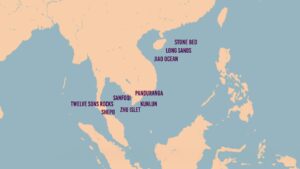
Sanfoqi is the central hub along the sea routes of the various kingdoms. Ships coming from Sanfoqi travel due north, passing through Upper and Lower Zhu [Shang Xia zhu 上下竺] and the Jiao Ocean [Jiaoyang 交洋] before reaching the Chinese coast. Ships destined for Guangzhou enter via Tunmen 屯門; those going to Quanzhou enter through Jiazi Gate 甲子門.
Ships from Shepo travel a bit northwest, passing the Twelve Sons Rocks [Shi’erzi shi 十二子石], and merge with the Sanfoqi route below Zhu Islet [Zhuyu 竺嶼].
Ships from the Dashi kingdom begin by traveling south in small boats. Upon reaching the kingdom of Gulin, they transfer to large vessels and sail east to Sanfoqi. From there, they follow the same route into the Middle Kingdom as ships from Sanfoqi.
As for other kingdoms such as Champa and Zhenla, they are located just south of the Jiaozhi Sea [Jiaozhi yang 交址洋], and are less than half as far away as Sanfoqi and Shepo. Yet Sanfoqi and Shepo themselves are less than half the distance to the Dashi kingdom.
Among the foreign kingdoms that enter China, most can make the round trip within a year. Only Dashi requires two full years to complete the journey.
In general, foreign ships travel quickly with favorable winds, covering a thousand leagues a day. But if they encounter northerly winds, the outcome is unpredictable and dangerous. If they are fortunate enough to land in our territory, there is a security system in place. But if they land in a foreign country, both people and cargo may be lost.
As for extremely distant lands such as the Kingdom of Mojia [written above as Majia 麻嘉] and Wusili, they are so far away that one cannot even estimate how many tens of thousands of leagues lie between.
《香門》
沉水香
沉香來自諸蕃國者,真臘為上,占城次之。真臘種類固多,以登流眉(案範成大桂海虞衡志作丁流眉,宋史作登流眉。) 所產香,氣味馨鬱,勝於諸蕃。若三佛齊等國所產,則為下岸香矣,以婆羅蠻香為差勝。下岸香味皆腥烈,不甚貴重。沉水者,但可入藥餌。交址與占城鄰境,凡交址沉香至欽,皆占城也。海南黎母山峒中,亦名土沉香,少大塊,有如繭栗角,如附子,如芝菌,如茅竹葉者,皆佳。至輕薄如紙者,入水亦沉。萬安軍在島正東,鐘朝陽之氣,香尤醞藉清遠。如蓮花、梅英之類,焚一銖許,氛翳彌室,翻之四面悉香,至煤燼,氣不焦,此海南香之辨也。海南自難得,省民以一牛於黎峒博香一擔,歸自差擇,得沉水十不一二。頃時香價與白金等,故客不販,而宦遊者亦不能多買。中州但用廣州舶上蕃香耳。唯登流眉者,可相頡頏。山谷『香方』率用海南沉香,蓋識之耳。若夫千百年之枯株中,如石如杵,如拳如肘,如奇禽龜蛇,如雲氣人物,焚之一銖,香滿半里,不在此類矣。
Sinking Aloeswood
Among the foreign kingdoms that produce aloeswood, Zhenla has the finest, with Champa next in quality. Zhenla produces many varieties, particularly from Dengliumei 登流眉 (note: Fan Chengda’s Guihai Yuheng zhi has Dingliumei 丁流眉 and in the History of the Song has Dengliumei.) The fragrance of aloeswood from there is rich and mellow, surpassing all other foreign kinds.
The aloeswood produced by Sanfoqi and other kingdoms a lower coast incense [xia’an xiang 下岸香]. Of those, Poluoman 婆羅蠻 produces a slightly superior variety. However, lower coast incense is overly pungent, and are not highly valued. The sinking aloeswood variety is used only for medicinal preparations.
Jiaozhi 交址 shares a border with Champa, so all aloeswood that arrives in Qin[zhou] from Jiaozhi is in fact from Champa.
In the Li people’s mountain settlements [dong 峒] around Mount Limu 黎母山 on Hainan, a local aloeswood known as “native sinking wood” [tu chenxiang 土沉香] is also found. Large pieces are rare. The best are shaped like silkworm cocoons, water chestnuts, aconite roots, mushrooms, or bamboo leaves. Even pieces as light and thin as paper can sink in water and are thus valuable.
At Wan’an Garrison on the east of the island, where it absorbs the essence of the rising sun, the incense is particularly subtle, mellow, and far-reaching. It resembles lotus or plum blossoms in scent. Burning just a little over one zhu 銖 fills the entire room with fragrance; no matter where the smoke is directed, all corners are perfumed. Even when burned to ashes, it does not smell scorched. This is the distinguishing feature of Hainan incense.
Because Hainan incense is difficult to obtain, provincial people trade a single ox with the Li settlements to acquire one load of incense. Upon returning, they sort through it and may only find one or two pieces of true sinking-grade wood out of ten. Recently, incense has become as valuable as silver bullion, so merchants do not trade it, and even traveling officials cannot afford to buy much.
In the central provinces, people only use foreign incense from the Guangzhou trade ships. Only Dengliumei incense can compare with Hainan’s.
Shangu’s 山谷 [i.e., Huang Tingjian 黃庭堅], in his “Incense Prescriptions” [Xiangfang 香方], uses Hainan sinking incense, showing that he recognized it.
As for ancient resinous heartwood, aged for centuries, resembling stone, pestles, fists, elbows, or shaped like strange birds, turtles, snakes, or clouds, vapors, and human figures—burning just a tenth of a zhu fills half a league with fragrance. This kind of incense belongs to an entirely different category altogether.
《志異門 、聖佛》
南海諸蕃國皆敬聖佛。相傳聖佛出世,在真臘國之占里婆城。聖佛,女子也,有夫。渡海而舟為龍王所蕩,乃謂龍玉曰;「使我登岸,當歲生一子以奉龍王。」既,海神送其舟于占里婆城,乃顯神異。人有慢輕,必降禍焉;人有祈求,必赴感焉;人有自欺於前,必報驗焉。南蕃皆敬事之。凡相爭者,必相要質于聖佛前,曲者不敢往也。南蕃所居皆茅廬,唯聖佛廟貌甚整,黃金飾像,四軀為四殿。蓋一佛而三夫也。女巫數輩,謂之夷婆。廟多鼓舞,血食無虛日。每歲正月十三日,設廬于廟前,積禾于中,請聖像出廟,而焚禾以祭。十四日聖佛歸廟,二十日聖佛生子,乃忽有一圓石出其身。二十日夜,舉國人民不寢,以聽佛之生子。明日國人皆奉珍寶、犀象獻佛。其所生子,舟載而投諸海以奉龍王云。六合之外,妖祥怪誕愈多如此!
The Sacred Buddha
All the various southern maritime kingdoms of the South Seas revere the Sacred Buddha [Sheng Fo 聖佛].
According to local legend, the Holy Buddha was born in the city [cheng 城] of Zhanlibo 占里婆 in the kingdom of Zhenla. The Sacred Buddha was a woman, who had a husband. When she crossed the sea by boat, her vessel was struck and tossed about by the Dragon King. She said to the dragon spirit: “If you allow me to come ashore, I will give birth to a child each year to offer in your honor.”
Thereafter, the sea deity delivered her boat safely to the city of Zhanlibo, where divine signs appeared. Those who slighted or disrespected her were met with misfortune; those who prayed or petitioned her were always answered; those who tried to deceive her were quickly exposed. Thus, all the southern barbarians revere and serve her.
Whenever there are disputes between people, they must go before the Sacred Buddha to swear oaths. The guilty dare not come forward.
Though the southern peoples live in humble thatched huts, the temple of the Sacred Buddha is particularly well-built and adorned: its statue is gilded with gold, and it contains four statues housed in four separate halls. It is said to represent one Buddha with three husbands.
Several women shamans serve the temple; they are called yipo 夷婆. The temple is filled with constant drumming, dancing, and blood sacrifices—there is no day without offerings.
Each year on the 13th day of the first lunar month, a temporary hut is erected in front of the temple and piled with grain. The image of the Sacred Buddha is brought out of the temple and the grain is burned as a sacrificial offering. On the 14th, the image returns to the temple. On the 20th, the Sacred Buddha gives birth: a round stone suddenly emerges from her body.
On the night of the 20th, the entire population stays awake to witness the Buddha giving birth. On the morning of the 21st, the people of the country present her with treasures, rhinoceros horn, and elephants as offerings. The child that is ‘born’ is placed in a boat and cast into the sea as an offering to the Dragon King.
Beyond the bounds of the universe, such strange and marvelous tales grow ever more excessive!

Good evening 😉 Excellent translation doctor. It is generally agreed upon that Shangxiazhu is the Aur island north of Singapore. With Sanfoqi being now in Cambodia, what could it be referring to? 😋
I was expecting someone to bring this up, but boy, that was fast!! 🙂
Yes, there are two places that sound similar.
I need to check all of the variations for Pulau Aur, but what I remember coming across in I think the Shunfeng songxiang was “East West Bamboo” (Dong Xi zhu). This one here is Shang Xia zhu (with no meaning for “zhu”).
Roderich Ptak has an article in which he mentions that there are historical sources that place in in the Cham region, but the doesn’t follow up on that. Instead, he looks at later sources. The article is “Pulau Aur and Some Nearby Islands in Chinese
Nautical Sources of the Ming Period” and it is open access.
In that article I think he mentions that he has another article on earlier sources, but I don’t have access to it.
In any case, I’ll probably write about this later, but it is easy to place this Upper/Lower Zhu at the end of the Indochinese Peninsula, where it would be dividing the Upper Coast from the Lower Coast (a concept mentioned in the Lingwai daida that I haven’t seen people talk about before).
If I were to guess (open up Google Earth and zoom in close), it’s a reference to the two islands at the end of the Indochinese Peninsula: Hòn Khoai and Hòn Chuối.
The point that I think many scholars don’t realize is that in the Song period most sailing was still done along the coasts. These islands would have marked where to turn. If you were coming down from China and passing the Upper Coast of Champa and Zhenla, you would then reach Hòn Khoai (the Upper Zhu) and that was your marker to turn west along the coast. Then you would pass by Hòn Chuối (the Lower Zhu) and reach the Southern Coast polity of Sanfoqi. To reach Shepo, ships would sail further to the west and then cross over to what is now Koh Samui: that was the landmark on the other side of the Lower Coast, and then you reached Shepo around the Lake Songkhla region. Look in this translation at the explanation of how you get from Shepo to China, it mentions Twelve Sons Rocks [Shi’erzi shi 十二子石]. Variations of that same name appear in various texts, and its pointing to that landmark of Koh Samui.
In my working paper I talk about the region at the end of the Indochinese Peninsula. Historically this was an incredibly important region. This was seen as the dividing line between two worlds.
Later, during the Ming, for instance, ships could finally sail directly south from the end of the Indochinese Peninsula. That’s when places like Pulau Aur became important. Before that point, most ships sailed along the coast, and the end of the Indochinese Peninsula was a critical landmark.
There is a complete German translation of the Lingwai daida by A. Netolitzky from 19771 and the more recent translation into English by V. Almonte published in 2020 you mentioned above. I had no problems downloading it from the publisher Aracne editrice website.
Thanks for letting me know.
I personally don’t like translations (always best to go to the text itself), but I want this text to be available for people who can’t read Chinese.
As for the recent English translation, on the publisher’s site I see a download that costs 15 Euros: https://www.aracne-editrice.it/index.php/pubblicazione.html?item=9788825528947
But then I found a poor quality scan of it uploaded here (the print blurs when I try to make it big enough to read): https://dspace.unitus.it/handle/2067/46906
As I expected, she’s following the “orthodox” view.
In the translation ChatGPT and I made, I intentionally did not explain most of the placenames to avoid imprinting ideas in people’s minds. I want people to think and try to figure things out for themselves. Instead of being told first.
The profession values annotated translations. However, when people annotate them wrong, it screws things up for. . . generations, centuries?
Alongside annotated translations, I think we also need, “pure” translations. What ChatGPT and I did isn’t quite that, but it was done in that spirit.
I did not claim they were ‘good’ translations. Almonte follows Hirth and Rockhill, for instance. Perhaps, if you set your vpn to Germany, you can download her work for free. When I tried from Brunei they wanted to charge me 1200€!
This is excellent Sir! However, I do wonder if you have translations for the parts that mentioned this:
《044 东南海上诸杂国》
东南海上有沙华公国。其人多出大海劫夺,得人缚而卖之闍婆。又东南有近佛国,多野岛,蛮贼居之,号麻罗奴。商舶飘至其国,擒人以巨竹夹而烧食之。贼首钻齿,陷以黄金。以人头为食器。其岛愈深,其贼愈甚。又东南有女人国,水常东流,数年水一泛涨,或流出莲肉长尺馀,桃核长二尺,人得之则以献于女王。昔尝有舶舟飘落其国,群女携以归,数日无不死。有一智者,夜盗船亡命得去,遂传其事。其国女人,遇南风盛发,裸而感风,咸生女也。
Cuz Shao Yun Yang’s translation and annotation of the Zhu Fan Zhi suggested some toponyms there, such as ‘Shahuagong’ and ‘The Maluonu’ , to have been polities in the present-day southern Philippines. The Zhu Fan Zhi descriptions for these two countries were said to have been derived from the earlier Ling Wai Daida account. He said : ‘Note: This section is based entirely on information from the Lingwai daida.’ for ‘Shahuagong’ and ‘Note: This section, too, is from the Lingwai daida.’ for ‘The Maluonu’.
Cheers.
Sorry, this note went into the spam folder. I just saw it.
I just used Grok to translate it (below). I think it’s impossible to know where these places are. What’s clear, is that they were places which Chinese mariners did not want to visit, as they were considered dangerous. So, they were not regular trading sites. Instead, they were perceived to be dangerous places which one reached if one went off course. And in the case of the Kingdom of Women, that is probably lore/myth.
Further, what Grok has translated as “various” (za 雜), has a negative connotation. It’s the various “random/disorderly” kingdoms, not the good places.
東南海上諸雜國 Various Kingdoms of the Southeastern Sea
東南海上有沙華公國。其人多出大海劫奪,得人縛而賣之闍婆。又東南有近佛國,多野島,蠻賊居之,號麻羅奴。商舶飄至其國,擒人以巨竹夾而燒食之。賊首鑽齒,陷以黃金。以人頭為食器。其島愈深,其賊愈甚。又東南有女人國,水常東流,數年水一泛漲,或流出蓮肉長尺餘,桃核長二尺,人得之則以獻於女王。昔嘗有舶舟飄落其國,群女攜以歸,數日無不死。有一智者,夜盜船亡命得去,遂傳其事。其國女人,遇南風盛發,裸而感風,咸生女也。
In the southeastern sea, there is the Shahuagong Kingdom. Its people frequently venture into the great sea to plunder, capturing people, binding them, and selling them to Shepo.
Further southeast lies the Jinfo Kingdom, with many wild islands inhabited by barbarian thieves known as Maluonu. When merchant ships drift to their land, these thieves seize people, bind them with large bamboo, and burn and eat them. The chieftains of these thieves drill their teeth and inlay them with gold, using human skulls as eating vessels. The deeper one goes into these islands, the more ferocious the thieves become.
Further southeast, there is the Kingdom of Women, where the water always flows eastward. Every few years, the water surges and overflows, sometimes carrying out lotus seeds over a foot long or peach pits two feet long, which the people obtain and offer to the queen. In the past, a merchant ship once drifted to this kingdom, and a group of women took the crew back with them. Within a few days, all the men died. However, one wise man stole a boat under the cover of night and escaped, thus spreading word of this affair. In this kingdom of women, when strong southern winds blow, the women expose themselves to the wind and all give birth to daughters.
Thank you so much good sir! I wasn’t notified when you replied, but thanks for taking the time answering my questions. Cheers!