

Zhenlifu 真里富 (Chen-li-fu) is the name of a small kingdom in central Cambodia that briefly interacted with the Song dynasty at the beginning of the thirteenth century.
If you search for “Zhenlifu” or “Chen-li-fu” (an older style of Romanization), you will find a Wikipedia page, but it doesn’t go by either of these names.
Instead, it is a Wikipedia page for the “Suvarnapura Kingdom.”
Have you heard of that kingdom before?
My guess is that your answer will be “No, I haven’t.”
And to set things straight, I’m guessing that not because I think you’re dumb. To the contrary, I’m certain that your brain is working just fine.
I know that you have not heard of it because there is no historical record of any such kingdom.
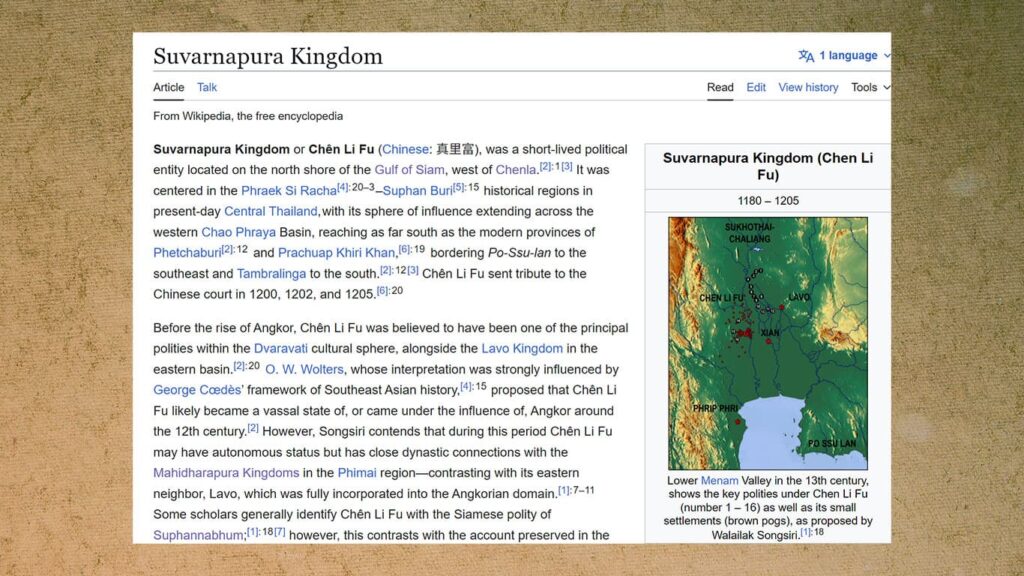
This Wikipedia page was created by a contributor who goes by the name Thomson Walt. I was alerted to a page created by him recently, and then discovered that he has created many pages, over 500 (although a large percentage are on beauty pageants), and has made well over 50,000 edits in the past 10 years.
At first, I thought Thomson Walt might be some group of people with a political agenda, but now I’m more inclined to think that it is someone with plenty of time on his hands and a sincere interest in putting information on Wikipedia that he believes relates to the early history of Thailand.
And that is where the problems start, because there is a ton of unresolved issues concerning, and plenty of substandard scholarship about, early Southeast Asia, and as such, it is possible to take say an article that O. W. Wolters wrote 65 years ago where he claimed that Zhenlifu “lay to the west of Cambodia and had access to the Gulf of Siam” and which no one since has followed up with anything solid and claim that Zhenlifu was in the Chao Phraya River valley, or to take a chapter by Tatsuo Hoshino which scholars have politely questioned but never “rigorously rejected,” and find information in that work to place a Cambodian polity (Wendan) in the area of Thailand, when in fact the sources that the flawed/outdated scholarship of Wolters and Hosino et al. based their writings on doesn’t actually support what they wrote.
This is happening right now BIG TIME.
See the posts, “The Thai-ification of Tang-era Chinese Placenames” and “Zhenlifu (Chen-li-fu) was NOT in Thailand!”
But in the case of Zhenlifu, it is not just Thomson Walt.
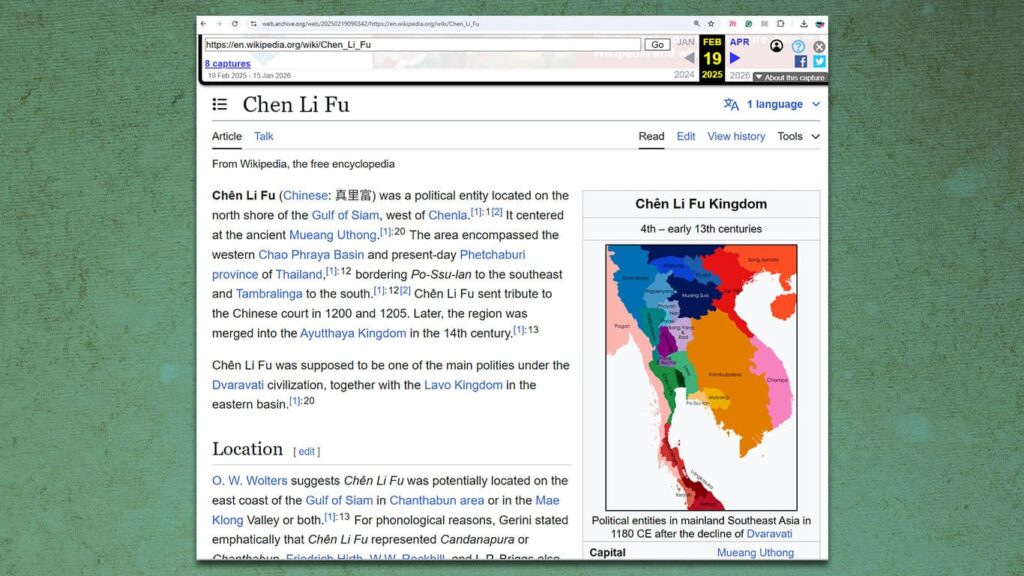
Actually, Thomson Walt originally created a Wikipedia page on “Chen Li Fu” and only later changed it to the “Suvarnapura Kingdom.”
In his original page, he followed Wolters and claimed that “Chen Li Fu was a political entity located on the north shore of the Gulf of Siam, west of Chenla,” but then added additional details, saying “It centered at the ancient Mueang Uthong. The area encompassed the western Chap Phraya Base and present-day Petchaburi province of Thailand. . .”
Hmmmm. . . While Zhenlifu was not where Thompson Walt (following O. W. Wolters) thinks it was, there is no information that can be added to what is in the historical records about it to add details like this (I present and discuss the historical information about Zhenlifu here).
At some point after Thomson Walt started creating the Wikipedia page on “Chen Li Fu,” he discovered some recent work by archaeologist Walailak Songsiri, and some other scholars whom she references. It was at that point that Thomson Walt changed the “Chen Li Fu” Wikipedia page to the “Suvarnapura Kingdom” page.
As far as I know, Walailak Songsiri is a respected archaeologist. Unfortunately, she is now using “Zhenlifu” as it is described in Wolters’ flawed and outdated 1960 article to serve as a kind of framework for discussing what we know about the archaeology, art, and inscriptions of the Chao Phraya River valley in the twelfth and thirteenth centuries.
Further, Walailak Songsiri is very active. She is not a typical academic who just writes obscure articles that no one reads. Instead, she is active online and has conducted Facetime interviews about Zhenlifu that have then gotten uploaded onto YouTube. She posts shorts of the videos, etc.
And all of this has culminated in a 2025 book entitled In the Land of Zhenlifu: The City-State Not Under the Political Authority of King Jayavarman VII, to the Historical Problems That Cannot Find a Way Out in Thai Society ในดินแดนแห่งเจนลีฟู นครรัฐที่ไม่ได้อยู่ในอำนาจทางการเมืองของพระเจ้าชัยวรมันที่ ๗ สู่ปัญหาทางประวัตศาสตร์ที่หาทางออกไม่เจอของสังคมไทย
While that title has somewhat of a nationalist feel to it, from what I have been able to figure out, that is not the point. From my understanding, many Thai academics tend to be “progressive,” and I think that what Walailak Songsiri is trying to do is to deconstruct various (and sometimes nationalist) narratives to create a story about the past that is more about local agency.
While all of that is fine. . . There is no way on earth that Zhenlifu was in Thailand!! So please don’t use it as the framework for such a project!!
On the one hand, I really wish that people would realize that it’s rarely a good idea to try to build on scholarship that was produced 65 years ago, particularly the writings of O. W. Wolters. We put warnings on cigarette packages. . . I really wish that we could do the same for Wolters’ publications.
“Warning! The scholarly community has determined that this article can be dangerous for your scholarship!”
However, Walailak Songsiri is by no means the first person to follow Wolters’ erroneous ideas. . .
So, on the other hand, this is where we are. We have “lost” Zhenlifu. It’s “Thai” now. Not only has it become the “Suvarnapura Kingdom,” but Thompson Walt has many other pages linked to that page as over the past year or more he has created a large and growing network of interlinked Wikipedia pages that are all building a “Thai-centric” body of knowledge from the flawed/outdated scholarship of scholars like Wolters and Hoshino.
Indeed, early Southeast Asian history on Wikipedia is being seriously Thai-ified. Given the extent of what has already happened, and given how active Thomson Walt is, and given how inactive the world of scholarship on early Southeast Asia is, and given the absence of scholars who can really deal with the sources, regardless of the language, I do not see how that Thai-ificiation process can ever be reversed.
Thomson Walt is on track to go down in history as the most influential historian of early Southeast Asia of all times, and I’m assuming, although I’m not an expert here, the greatest documenter of beauty pageants that the world has ever known as well.

In trying to understand what is going on, I looked into the work on “Zhenlifu” by Walailak Songsiri. I am pasting below a summary of an article she wrote and two long videos she made. The summary was made by NotebookLM.
Originally, I was going to go through this and add my comments about how Wolters was wrong in various places, but since I can now clearly see that Zhenlifu was in Cambodia. . . it’s not worth the time and effort.
That said, I think it’s interesting to see the kind of argument that Walailak Songsiri builds, as well as the role that the 1960 paper by O. W. Wolters plays in that argument.
Finally, while Zhenlifu was not in Thailand, the archaeological, inscriptional, and artistic information that Walailak Songsiri references all were. So, there IS a story that can be told.
It’s just not the story of “Zhenlifu.”
Here is NotebookLM’s summary:
Based on the sources, Walailak Songsiri (วลัยลักษณ์ ทรงศิริ) and Professor Srisakra Vallibhotama (อาจารย์ศรีศักร วัลลิโภดม), whom she interviewed, describe Chen Li Fu (เจนลีฟู) as a significant ancient independent city-state or federation of states located in the upper Chao Phraya River basin during the 18th Buddhist Century (approximately the early 13th Century AD).
Drawing on the research of the late Professor O.W. Wolters, as well as the archaeological surveys of Srisakra Vallibhotama and the artifact databases of Manus Oubakul, here is a summary of their findings regarding Chen Li Fu:
1. Historical Context and Chinese Records
• Embassies to China: Chen Li Fu is famously documented in the Chinese Song Dynasty records (Sung hui-yao). It sent official embassies and tribute to the Chinese imperial court three times within a five-year period (1200–1205 AD / B.E. 1743–1748).
• Rare Status: This was remarkable because, during that era, the Song court had largely requested other major states like Cambodia (Angkor), Tambralinga, and Lavo to cease sending regular tribute. Chen Li Fu was the only overseas state in the south allowed to continue these missions at that specific time.
• Independent from Angkor: A key point emphasized by Walailak and Srisakra is that Chen Li Fu was not under the political power of King Jayavarman VII of the Khmer Empire. While it shared some cultural or “kinship” ties, it operated as a distinct sovereign entity.
2. Geographic Location
• Inland Riverine State: While early scholars debated its location, O.W. Wolters used Chinese records to determine that Chen Li Fu was not a coastal city. He noted it took five days to travel by boat from the city to reach the Gulf of Siam (specifically near the mouth of the Chao Phraya or Maeklong rivers).
• Hypothesis – Sankhaburi: Srisakra Vallibhotama proposes that the center of Chen Li Fu was located in the area of Sankhaburi (จังหวัดชัยนาท), specifically at the ancient sites of Dong Khor (ดงคอ) and later Phraek Sri Racha (แพรกศรีราชา).
• Riverine Network: The state flourished within a “riverine” network of marshes and canals connecting the Noi River (แม่น้ำน้อย) and the Suphan Buri River (แม่น้ำสุพรรณบุรี).
3. Political Structure and Society
• A Federation of 60 Communities: Chinese records state that the Chen Li Fu federation consisted of more than 60 small towns or settlements, each with its own local leader.
• Titles and Kingship: The rulers used the title “Kamrateng” (กมรเตง), a high-ranking title common in the Khmer-influenced region at the time. One recorded king’s name was Sri Mahidharavarman.
• Ethnic Diversity: While Wolters initially suspected the population was primarily Mon, Srisakra suggests a mixture of ethnicities, including Mon-Khmer speakers and early Tai groups, who used the Tai language as a lingua franca for trade.
4. Economy and Culture
• Lead Currency: Unlike earlier or later periods that used cowrie shells, the people of Chen Li Fu used lead ingots (ตะกั่ว) as a primary medium of exchange in their markets.
• Trade with China: There was a high demand for Chinese ceramics (particularly Qingbai ware from the Southern Song Dynasty). In return, Chen Li Fu exported forest products such as ivory, rhinoceros horns, aromatic woods, and beeswax.
• Buddhism: Chen Li Fu was a Buddhist state. Its legal and social systems were deeply tied to religious faith; for example, disputes were often settled through oaths taken in front of Buddha images, involving the drinking of sacred water.
• Pala Influence: The art and religious artifacts from this period show significant influence from the Pala style of eastern India (often transmitted through the Pagan Empire in Myanmar), rather than strictly following the Hindu-centric traditions of Angkor.
5. Transition to Later States
Walailak writes that after the mid-13th century, the federation of Chen Li Fu likely evolved into or was replaced by the emerging Tai-centric states of Suphannaphum (สุพรรณภูมิ) and Siam (เสียน/เสียม). In the sources, the scholars clarify that the name “Chen Li Fu” likely disappeared from Chinese records as these new political entities consolidated power and merged into what would eventually become the Ayutthaya Kingdom.
This is the article and two YouTube videos.
6 March 2025
ในดินแดนแห่งเจนลีฟู นครรัฐทีไม่ได้อยู ่ในอํานาจทางการเมืองของพระเจ้าชัยวรมันที ๗ สู ่ปญหาทางประวัติศาสตร์ทีหาทางออกไม่เจอของสังคมไทย
“In the land of Zhenlifu, a city-state that was not under the political authority of King Jayavarman VII, lies a historical problem for Thai society for which no solution has yet been found.”
https://ia800900.us.archive.org/35/items/in-the-land-of-genlifu-a-city-state-that-was-not-under-the-political-power-of-ki/In%20the%20land%20of%20Genlifu%2C%20a%20city-state%20that%20was%20not%20under%20the%20political%20power%20of%20King%20Jayavarman%20VII%2C%20to%20the%20historical%20problems%20that%20cannot%20be%20solved%20for%20Thai%20society..pdf
12 January 2024
ครั้งที่ ๘๓ สาระสนทนาฯ เรื่อง เจนลีฟู คือรัฐใดในกลุ่มเมืองโบราณภาคกลาง ?
“The 83rd Session of the Sarasontanā Series: ‘Which State Was Zhenlifu among the Ancient City-States of Central Thailand?’”
https://youtu.be/2_oQshdGHR0?si=uTPB2gDNc0MzL3pM
30 November 2024
ครั้งที่ ๑๒๓ สาระสนทนาฯ เรื่อง เจนลีฟู และสมมติฐานอยู่ที่แพรกศรีราชาในเขตลุ่มแม่น้ำน้อย
“The 123rd Session of the Sarasontanā Series: Zhenlifu and the Hypothesis That It Was Located at Phraek Si Racha in the Noi River Basin.”
https://www.youtube.com/watch?v=IQ00N_TSD4o