
I like to use X/Twitter as a means to gain a sense of how people view a certain issue. This is because as polarized as most media is today, there is still enough diversity on X/Twitter for one to get a sense of the different views on a topic, particularly when certain topics go viral.
A couple of days ago, there has been a lot of discussion on X about AI in higher education, and from that discussion, I can clearly sense a shift in views from say a year ago.
First, I saw a tweet that was posted on Bluesky and then shared on X by Kyle Siler, someone who self identifies as “Academician. Friend of puppies,” but a quick Google search reveals that he has a PhD in Sociology from Cornell University.
In the tweet, Siler shared his recent article, “The Diffusion of Large Language Models in Published Academic Articles,” which is behind a paywall, and perhaps partly as a result, this tweet did not gain much traction.
In any case, Siler wrote on X that “We all know that ChatGPT loves to delve, bolster, leverage, encompass, showcase, underscore, et cetera. I analyzed full text of 7.3 million journal articles published 2020-2025, hunting for 228 words that spiked after ChatGPT launched in late 2022.”
People who have worked with ChatGPT will recognize that what Siler did here was to identify certain words that appeared frequently in its (previously) generated writing (I don’t see it as much anymore in ChatGPT 5.5), such as the verb “to delve,” and then to trace their appearance in academic publications over time.
What he found is that:
In 2023, about 12% of papers showed signs of LLM influence. By 2025, an estimated 57%. Importantly, this 57% involves a great deal of heterogenity; ranging from scholars who don’t use AI, but recycle text from other AI-influenced articles, to articles mostly generated by AI.
The article also examines who is most likely to use LLMs in their published work: Adoption was highest:
– In regions where English is a second language
– At lower-ranked and unranked institutions
– At high-volume for-profit publishers like MDPI and Frontiers
– In fields like computer science, business, and law, while math, philosophy, and history lagged furthest behind
Then, a New York Times article about the University of California system’s contract with Open AI, a deal that gives ChatGPT access to all students and staff, was shared, “What It’s Like to Be a Student at the First A.I.-Powered University.”
Then someone by the name of Sarah Osment shared that the University of Chicago has signed a similar deal with Anthropic.
Then Tyler Austin Harper, who writes on higher education for The Atlantic asked, “Genuinely, can someone give me the steel man version of the rationale behind the new ‘give everyone AI’ university strategy? What is the theory of the case here? Do universities think it’s sustainable to ask students to pay over $90k per year to cheat their way through college?”
On a different, but related topic, philosophy professor Jennifer Frey posted the comment that “Every academic press and journal needs a clear ban on AI writing.”
Finally, a gentleman by the name of Mushtaq Bilal, PhD posted a thread of tweets that began with this: “Claude Code just gave me a complete research paper with a single prompt. The paper has a strong argument and even beats AI-detection app, Pangram. With a little editing, it can pass for 100% human, and can be easily submitted for peer review. Here’s the workflow I used:”
Writing Papers with LLMs
Dr. Bilal’s tweets have been showing up in my feed for a while, and it is clear that he is trying to make some money, such as by holding paid seminars where he teaches people how to do things like create papers with Claude.
Further, he can also be provocative in his tweets (like saying that his paper “even beats AI-detection app, Pangram”), which I suspect is his attempt to draw attention, but that also probably leads many to quickly dismiss him. However, I would argue that doing so is a mistake.
Bilal identifies himself on his Academia.edu page as a postdoctoral researcher at the University of Southern Denmark’s Hans Christian Andersen Centre who holds a PhD in comparative literature from Binghamton University.
If one reads beyond the provocative opening tweet about writing a paper in Claude Code with one prompt, one will see that Bilal describes the same process that I just did in the post “Curating Knowledge in the Age of AI Scholarship,” comes to the same conclusion, and uses the same verb, “to curate”:
It seems like writing will no longer be an important part of the research process. It can easily be outsourced to AI.
What’s going to matter is the way researchers curate their materials.
Claude Code was able to do a good job partially because I already had a well-curated list of materials, and I knew the direction of the argument.
That said, researchers will still need to learn writing because it helps you think through problems.
Initially, I wanted to do what Bilal did, which is to try to write an academic paper using Claude Code or Claude Cowork as they can engage in more complex tasks than a chatbot, but I wasn’t sure if attempting to do so would max out the tokens that come with a subscription, and as Bilal’s experiment shows, asking it to write a paper and using all of the highest settings did max out the tokens and he had to spend a bit more to complete the task.
However, as my experiment indicated to me, one can just as easily write a paper with a chatbot by “curating” the sources for it to work with and giving it the right series of instructions.
The Changing View
I realize this now, and in looking at the comments to the above tweets on X, it is obvious that many other people realize this (or something close to it) now too. That is the change that I detect. Previously I have not seen so much acceptance of using LLMs to help with the writing of academic papers. Now, however, that is clearly evident.
Given the findings of Siler’s paper, this makes sense. Obviously, many people are now using LLMs in writing academic papers, and. . . they like it!!
With one clear exception. . . certain scholars in the humanities. For the most part, the people on X who are opposed to using LLMs in scholarship are in the humanities.
In his trademark snarky style, I just saw Bilal point out the contrast as follows:
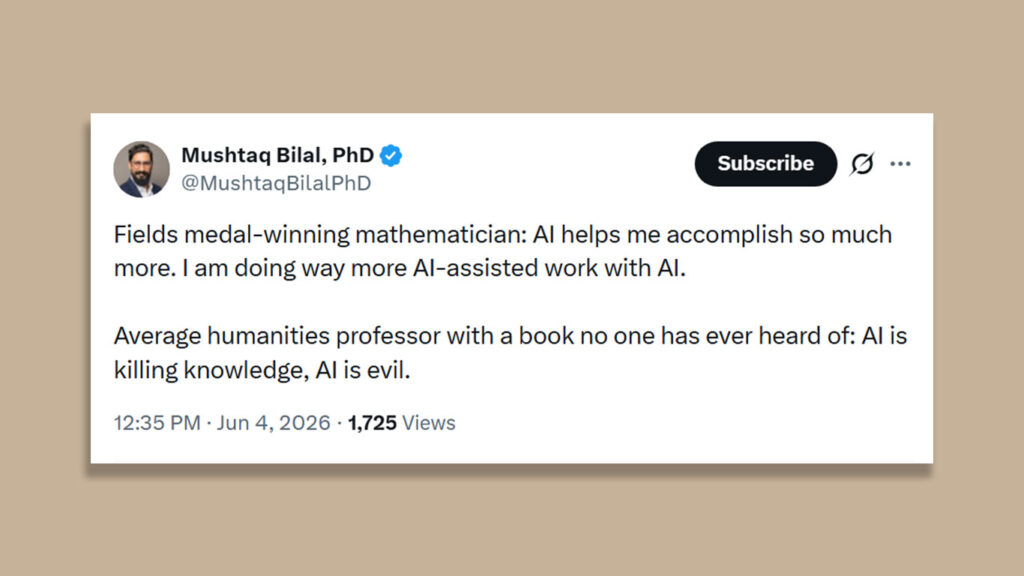
This contrast is extremely clear on X. Further, what’s striking about this is that scholars in the humanities are making the same comments today that they have been making since the time ChatGPT emerged in late 2022 (such as that they hallucinate sources – sorry, folks, not anymore. Get off the free tier and see for yourself), whereas the people opposed to them are saying things in support of LLMs that are new.
For instance, when Frey said that publishers should ban AI, she had people respond with comments like these:
“Rather than banning AI, they should require that you try to see if AI can rewrite to improve any part of your article.”
“Why is it bad to use a resource that helps us communicate our ideas more clearly? Should we ban using a copy-editor also?”
“i thought the purpose of peer-review was to verify whether the material is valid advances understanding and where necessary whether the claims are replicable. if it is why does ai writing matter???”
“I usually write the other part myself, feed them to AI and interrogate them until they give me a satisfactory intro/conclusion. Most of these part are unnecessary word salad required by the banal ‘academic standard’ anyway”
“…why? Academic writing is where human touch and expression matter the least. If AI writing can increase the clarity and technical accuracy of a paper (it can, scientists are famously terrible at writing clearly) then why hate it?”
“AI is a great blessing for co-authored paper. Different writing styles, spellings, choice of terms , … especially when international co-author involved. Ask AI to homogenize … A research paper is just a communication, the paper itself is not the research.”
“Clearly a English native speaker perspective. Think outside of your bubble to see how AI benefits people who need to express their thought in a foriegn language.”
“Two questions: how? And, why?”
A year ago, I don’t think such a post would have garnered so many responses like these (the majority of responses were in opposition to her statement). These responses show that people are clearly familiar and comfortable with using LLMs in academic writing.
I’m not going to go through the responses to the other tweets, but one can find similar ideas there as well. Meanwhile, I don’t come away with a sense that the humanities scholars are making a strong case, and that is a sense that is clearly shared by many others.
As one person commented on the Bilal tweet, “Reactions to this have been angry misfires.. It is clear that the project is trying to explore the frontier of research in relation to AI. Reactions tend to be adolescent outrage, rather than reflective ‘critical thinking’, the quality people keep telling me is the hallmark of academe…”
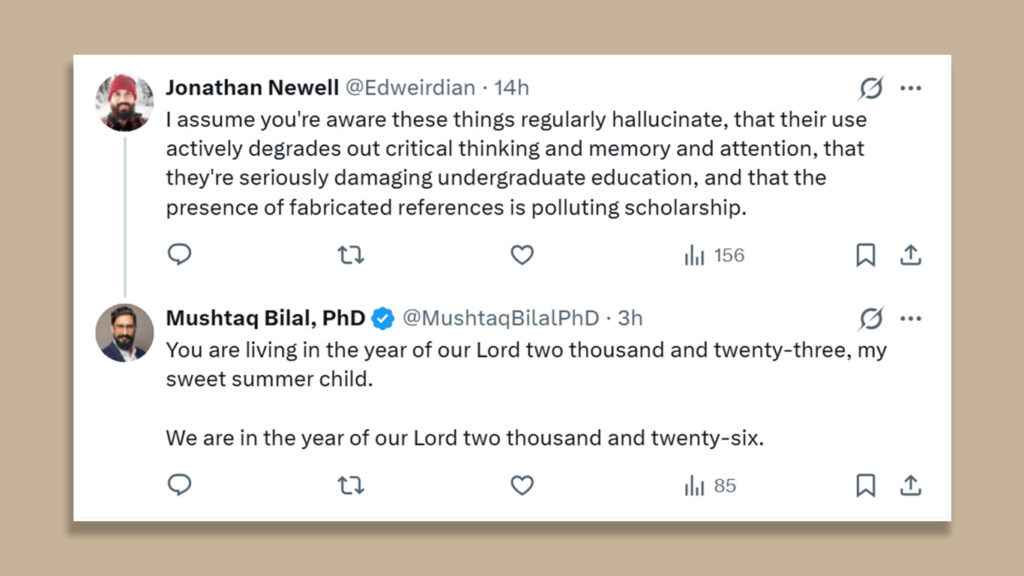
Indeed, when you look at the comments made in opposition to Bilal’s string of tweets, it’s obvious that some people who objected did not even read and understand what he wrote. He clearly shows that he selected the sources for Claude to work with, and then people object by making comments like “How do you know it’s accurate and the citations are real?”
Or this:
LLMs as Massive Human Collaboration
As I was doom-scrolling through these comments yesterday on X, I also spent some time doom-scrolling on YouTube and came across a recent interview with computer scientists and futurist Jaron Lanier entitled “Father of VR: The Best AI Future Nobody is Talking About.”
Lanier has spoken a lot in recent years about the problems with the way social media algorithms work. I was familiar with that, but I had not heard his take on AI. In a nutshell, he sees AI as an “ideology” when LLMs in fact, he argues, are a “software,” and he thinks that this software works better when we realize what it is, namely, a massive “human collaboration,” as it is built on the works that human beings have created across the globe and throughout history.
I found that conceptualization helpful. It is totally obvious to me that virtually all knowledge is soon going to be produced with that “human collaboration,” and that therefore, we should be focusing on trying to figure out how to do that, and how a world where that is the new norm would function.
Humanities Knowledge as the New 8-Legged Essay
Here, I am reminded, as I have been so many times before in observing the rise of the Internet and the ways in which it transformed how we obtain, consume, and share knowledge, of the early twentieth century in Vietnam when the traditional civil service examination was abolished and the entire world of premodern knowledge was replaced by modern (Western) knowledge.
For centuries prior to that point, the Vietnamese elite had believed that the most important knowledge that a human being could possess was recorded in ancient texts written in classical Chinese, and that the way to test and validate someone’s knowledge was by having him (that’s right, him not her) sit through an exam that required that he write essays about those texts according to strict rules (the 8-legged essay), to composed poetry based on ideas in those texts, etc.
Then in the early twentieth century, that body of knowledge was pushed aside and replaced by new knowledge, based on new sources of authority, and communicated in new languages.
And what happened? Did Vietnamese society collapse?
No. I think pretty much everyone would agree that it benefited from the change.
Indeed, it turns out that one could develop one’s intellect without being able to write an 8-legged essay in classical Chinese.
Hmmm, could it now be possible that one can also develop one’s intellect without being able to write an XXX-word essay in 12-point Times Roman font following the Chicago Manual of Style?
I think we are at a comparable moment in history. Historians and humanities scholars today are like the Confucian scholars of the early twentieth century. They have mastered a specialized way of producing knowledge that they believe is indispensable for society, however, just as occurred with classical knowledge a century ago, it is being pushed aside by a new way of producing knowledge.
And just as happened a century ago, life will go on.
Whereas “modern” knowledge expanded the input to the production of knowledge far beyond the corpus of classical texts that Confucian scholars studied, the “human collaboration” of billions of people that takes place when we use LLMs is again expanding the input to knowledge production far beyond what people considered when they produced knowledge over the past century.
If Our Scholarship is Weak, Why Don’t We Use LLMs to Strengthen It?
This leads to what I now see as a disconnect in the outlook that historians and other humanities scholars have.
There is arguably nothing that gets academics more animated than talking about the weaknesses in the work of other academics or seeing the work of other academics get critiqued.
This is, in part, what the graduate seminar teaches. Further, when academics meet up at conferences, the conversations in hallways or restaurants or bars inevitably turn to the juicy topic of, “Have you read ABC’s recent book on. . . ??!!” “Did you read XYZ’s review of ABC?” etc.
So, academics repeatedly identify and talk about the flaws in other’s work, but then they find it inconceivable that the work of their field could possibly be done better with the collaboration of billions of people across the globe/history/languages (that is, with an LLM).
I have, of course, done plenty of critiquing of scholarship, particularly on this blog. Recently I fed the information on some such past posts to an LLM (i.e., what an author stated, as well as the information in the primary sources that it was based on), and the LLM had absolutely no difficulty in pointing out that the statements were not supported by the sources.
I have also fed it my own published work and seen that it can easily identify ways that my work could have been better.
Therefore, if historians worked with LLMs and tested what they wrote, they could identify weakness in their work, and, I would argue, produce stronger scholarship.
Why would we not want that to happen?
Why would we not want scholars to use LLMs to make their work stronger? We are totally aware of the weaknesses in each other’s scholarship and LLMs are totally capable of identifying those weaknesses as well.
So, again, why would we not want to work with LLMs to improve our scholarship?
I totally want that, and in fact, I would love it if every scholar (myself included) would go back and re-write everything they have written with the assistance of an LLM. I can guarantee you that every one of us would be able to improve our past scholarship.
Imagining a New Normal
A sentiment I see expressed a lot is that those of us who became established before LLMs were created have an advantage because we know how to produce knowledge and verify it in the “traditional” way, but upcoming people will not know that, and the implied idea is that they will be led astray by supposed hallucinating LLMS.
The first thing I would point out is that in fields like mine, history, there are very few “upcoming” people anymore. So, we are talking about a tiny group of people in a declining field. Nonetheless, let’s assume that fields like history survive into the AI age.
A couple of weeks ago, I did a kind of test/interview with an AI avatar that ran me through a series of questions, with each question building on, or digging deeper into, topics that I discussed.
It was a fascinating experience, and I really enjoyed it. It was recorded on video so “the other side” could verify that I was not looking at notes or at another screen, etc. Basically, I had to look at the camera and talk, and to think fast on my feet.
It reminded me of a comprehensive exam oral defense, except that it was much more intense, because I was interviewed by “someone” who asked sharper and more precise questions than my human examiners ever did. It definitely got my adrenaline flowing.
This made me think about what graduate education could look like in the AI age. If writing is done in collaboration with LLMs, then “expertise” has to be demonstrated in some other way, and I think intense AI-run comprehensive oral exams could be a possibility.
I can also imagine “reading” seminars to be re-invented so that they combined “LLM reading” with “human reading.”
I’ve heard older people say, “When I was a graduate student, I had to read 3 books a week for each seminar” etc. That’s BS. No one can read three books in a week. This means that people “spot read” 3 books.
Well, guess what folks, LLMs can do a hell of better job at “spot reading” than humans can. In fact, there are probably a lot of innovative ways to “read” with LLMs by prompting them to get works to “speak to” or interpret each other, etc. Indeed, I just saw someone make the following comment on X:
“I’m not an academic, but my conversation with Claude about the Aeneid is over 70000 words. Very useful for taking notes and bouncing ideas while reading. There are limitations, but most people would get a lot more out of the books they read if they discussed them with a chatbot.”
As such, I can imagine a future in which “reading” becomes something that takes more forms than it does today, but one in which the result of all of that reading would be tested in a more rigorous way than it is today as well.
Finally, I don’t see why or how such a world would necessarily produce people who are intellectually inferior to people today. To the contrary, the potential is there to train people who have superior knowledge and intellectual capabilities than we do today.
Undergraduate Education
I, therefore, apparently like plenty of other people now, have a positive view of the role that LLMs can play in scholarly knowledge production. However, when it comes to undergraduate education, the enterprise that financially supports the knowledge production that takes place at universities. . . I see no good way forward.
Here is the problem: If a university student uses an LLM to write a report for a business class, that can be considered “cheating.” However, if the same person gets a job after university and writes a report for a company using an LLM, that can be called “work.”
The university sees the use of an LLM as “cutting corners” while the company sees its usage as “enhancing work.”
In fact, LLMs can do both. If you are lazy, it can help you get something done with minimal effort. If you are driven, it can enable you to achieve more than you can do on your own.
When I was an undergraduate student in the late 1980s, I would say that a definite majority of students at my university wanted to get by with minimal effort. By all accounts, that is even more so the case today.
I remember my sophomore year, I met a roommate’s father who said, “Everything I know, I learned in graduate school. So, have fun, kid!” In my case, this turned out to be true too. I can only remember what I learned in graduate school.
So, we live in this world where kids might work hard in high school to get into a university, and if they go to graduate school, they might work hard again, but in between is this period which they just have to get through somehow.
LLMs are much more likely to be used in unproductive ways in such a setting.
I have no idea how to solve that problem, but the problem of the unimportance of undergraduate education to so many students is, I would argue, the real problem regarding AI/LLMs and universities.
Once people get past that point and need to do well at a job or in a graduate program that they have finally decided they want to pursue, then AI/LLMs can enhance what they do, but when you are an undergraduate who just needs to get something done to get it done. . .
Human Stupidity and AI Slop
On a related but different note, I still often hear or read people saying that some piece of writing “looks like it was written by AI” or that it is “AI slop.” While something that we could call “AI writing” did exist in say 2023, today when I see someone say or write that something “looks like it was written by AI,” then I know that human ignorance is involved in one of the following ways:
1) The person is actually looking at lousy human writing (remember that?), doesn’t know how easy it is today to produce good writing with an LLM, and because the writing is bad, assumes that it must have been created by AI;
2) The person who produced the text did something stupid like one of the following:
A) Used the free version of an LLM;
B) Gave the LLM a single prompt like “write an essay on ABC,” rather than go through a series of prompts to build up knowledge and expectations before executing the main task;
C) Cut and pasted what the LLM wrote without checking it first and continuing to engage in iterative edits/rewrites;
D) Didn’t ask the LLM to write in a certain style (such as one’s own writings), etc.
In other words, the only way to end up with “AI slop” at this point is if a human being does something stupid.
This is good news for smart people, because what it shows is that AI/LLMs have not eliminated distinctions in human intelligence (at least not yet).
Conclusion
These are some thoughts that came to my mind in a couple of days of doom-scrolling on X and YouTube. Again, I was somewhat surprised to see what I perceive as a discernible shift in favor of using LLMs in writing academic papers, but I was also not surprised, as I have recently come to see that as inevitable as well.
Finally, while I have long seen people on X criticize the humanities regarding things like identity politics, there was something different in the criticisms this time around as well. Nothing was mentioned about identity politics or “Wokeness,” etc. Instead, people expressed surprise at how out-of-touch the comments of critics were.
Critics were still talking about things like hallucinated sources and respondents kept asking, “Are you using the paid/pro version of ChatGPT/Claude?” “Do you have it set to ‘thinking’ mode rather than ‘instant’”?
In other words, the comments that critics were making were simply no longer part of the reality for so many people, so they did not lead to discussion.
Notre Dame professor Alexander Kustov, who had some essays on AI in higher education go viral earlier this year, offered the following reflection on the disconnect between humanists and non-humanists that revealed itself in the comments to the above tweets:
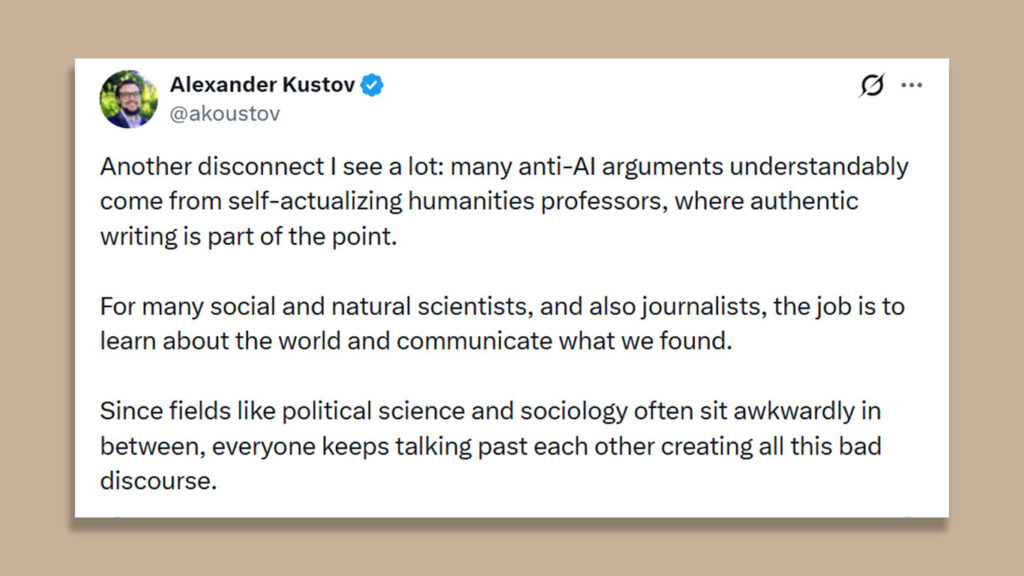
In fact, I don’t think the divide is that stark.
One of the hallmarks of a humanities monograph is a long acknowledgement section where the author thanks people for reading and commenting on their work.
In other words, authors thank their colleagues for “human collaboration.”
I agree with Lanier that this is precisely what LLMs are. However, the LLM collaboration goes far beyond the community of colleagues of any given humanities scholar. And not surprisingly, LLMs can often do as good or better of a job than individual humans can in evaluating and commenting on a piece of scholarship.
Final Thought
At this point, as I think should be obvious, I’m totally ok with the idea of writing with LLMs.
I think one misconception that people have is that they imagine that this means that all you have to do is the equivalent of “pressing a button” and you will have a paper.
No. If you just “press a button,” you will get AI slop. That’s what stupid people (will) do.
To “write with an LLM” means curating the sources, working with an LLM to analyze those sources, engaging in a lot of back and forth discussion, and then going through a similarly iterative writing process, all of which involves lots of reading and re-reading and editing and checking back with the sources, etc.
That said, I also don’t think that everything in the future will need to be written together with LLMs. It will be fine to not do that, although I do think that every author should check with an LLM to see how their manuscript could be strengthened. I see absolutely no logic for not doing that. (If privacy is your concern, there are easy ways to protect it.)
Finally, while my views might be “radical” for the humanities at the moment, from my reading of comments over the past couple of days on X, I can see that they are shared by more and more people in other disciplines, such that the type of “ban AI!!” position that we find coming from some humanists is clearly and quickly becoming an outlier view in the larger world of knowledge production.
On that point, let me now finally conclude with the comment that I liked the most in my doom-scrolling:
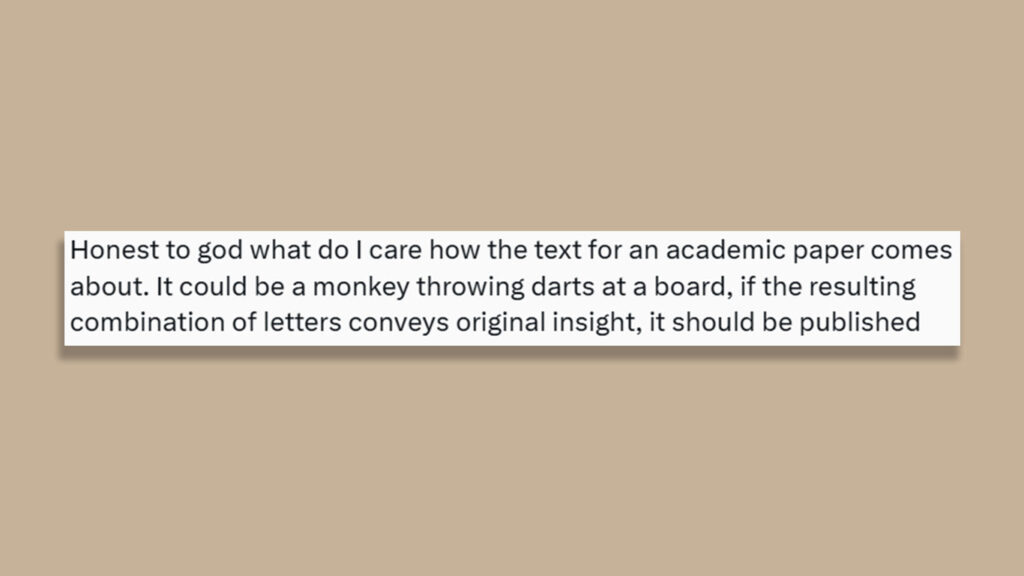
Yes!! Knowledge production by monkeys with darts!! Sign me up!!!



AI will be the death of us all 🫢 it wastes water 💦 and resources 🌴 and threatens human creativity. The Vietnamese mandarins 🍊 saw the world in a new way but civilisation ending it was not. Today it’s like watching Rome 🍝 burn after the sack of the Visigoths. The city itself survived, but it was the tragic end of an era 👑
“That’s what stupid people (will) do.” — unfortunately that’s exactly how the undergrads I encounter use AI. They don’t know or don’t care to know what a well-organized, well-communicated argument looks like.
A chief minister of a federal state in Germany was found to have AI write a paper about the misuse/abuse of AI among school children. The quite well-known paper he submitted his/its text to rejected it after an examination. So much for “stupid people” and AI.