
I have recently written a long 2-part article that demonstrates that there was never a kingdom called “Srivijaya.” The first part will be published in a few days.
Much of the information that was used to create the history of that supposed kingdom came from Chinese sources, and I have been able to demonstrate that this information was not about a place on the island of Sumatra. Instead, it was about a place on the Southeast Asian mainland – Kambuja, that is, Angkor.
What does the history of Southeast Asia then look like when we view the information that was previously used to write about “Srivijaya” from that perspective? I haven’t had time to fully research and write this yet, so what follows is a “draft” outline of what I now know/think.
1) There was never a major kingdom on Sumatra like the imagined “Srivijaya,” but of course, there were small kingdoms there, such as one at Jambi and another at Palembang. It was probably the ruler of one of these places who created the Kota Kapur Inscription in 686 which mentions “His Majesty Vijaya” (Sri Vijaya).
2) Angkor was much more “international” than historians have realized. I think the best way to think of this is to recall what places like Ayutthaya were like.
The Thai/Siamese were, for the most part, not a sea-faring people, and as a result, much of the trade at Ayutthaya was carried out by foreigners, and there were sections of the city where they resided. Some of those foreigners also became very powerful and got involved in politics.
A closer examination of the Chinese sources (that people previously believed were about “Srivijaya”) will reveal the same thing about Angkor. The Khmer are not a sea-faring people, and therefore, much of Angkor’s trade was conducted by foreigners, and there are tantalizing indications that they may have gotten involved in politics (see below).
I wrote a blog post about this a couple of years ago:
https://leminhkhai.blog/abus-sris-and-yang-po-kus-arabs-in-10th-and-11th-century-cambodia/
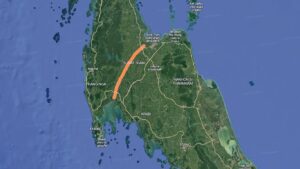
3) Prior to the fourteenth century, the trading world of Southeast Asia was divided between two “powers” – Angkor and a place on the Malay Peninsula around what is now Songkla. Angkor controlled a sea route to India and the Middle East that went down the eastern coast of the Malay Peninsula and then up through the Straits of Melaka.
The other polity (known in Chinese sources as Shepo/Dupo), controlled trans-peninsular trade at the Kra Isthmus. I wrote about this earlier here:
https://leminhkhai.blog/the-singora-angkor-rivalry-the-greatest-story-of-premodern-southeast-asian-history-youve-never-heard/
This makes perfect sense. While archaeologists have found plenty of artifacts on the Kra Isthmus, that region has not played a major role in the written history of premodern Southeast Asia, but in looking at the evidence from this new perspective, it will become clear that the Kra Isthmus was an extremely important place for international trade.
4) The fourteenth century was a major turning point in Southeast Asian history, as the above two “powers” were replaced by two new powers: Majapahit and Ayutthaya.
There is a text from the mid-fourteenth century, the Nagarakretagama, which describes the extent of the empire of Majapahit. It shows that it claimed control over various places in island Southeast Asia, including Jambi and Palembang.
However, Chinese sources (when we understand that they are recording information about Angkor rather than “Srivijaya”) as well as Siamese and Khmer sources, demonstrate that in the second half of the fourteenth century (i.e., after the Nagarakretagama was compiled), Majapahit attacked Angkor and ended up controlling a part of the Lower Mekong Region.
In other words, Majapahit was way more powerful than I think historians have ever realized.
At the same time, the newly-established kingdom of Ayutthaya also attacked Angkor, and in addition, it extended its control to the south into the area of the Kra Isthmus.
The expansion of these two new empires brought to an end the power and influence of Angkor and the polity that had controlled the trade across the Kra Isthmus, as these two powers basically divided Southeast Asia into their spheres of control and influence.
5) In between the spheres of influence of Majapahit and Ayutthaya was the area where Melaka emerged in the early fifteenth century.
The rise of Melaka has to be linked to this major power transformation. My guess would be that the traders from India and the Middle East who had previously sailed to the western side of the Kra Isthmus relocated down the western coast of the Malay Peninsula to Melaka.
6) Were some Cambodian rulers foreigners? While inscriptions in Sanskrit and Old Khmer were created in Cambodia as early as the fifth and seventh centuries, respectively, the extent Cambodian written chronicles contain information that only begins in the fourteenth century.
The late historian Michael Vickery was perplexed by the names of the earliest Cambodian rulers in the chronicles, as they did not seem “Khmer,” and they were different from the names that one found in the earlier inscriptions.
The second part of the article that I have written will show that some of those people interacted with, and gained support from the people who had occupied part of the lower Mekong region. These people may have been from Majapahit. Could it be that the earliest recorded Cambodian rulers had some foreign connection (which thus made it easy for them to interact with other foreigners)?
Again, the history of Ayutthaya would indicate that such a development should not surprise us. However, this is a topic that I’m still wondering about (just as Vickery wondered about the “strange” names of the early Cambodian rulers in the Chronicles). I haven’t found evidence that can persuasively make this point, but perhaps there are details in inscriptions that would help resolve this issue one way or the other.
In any case, I know that there will be people who will not like hearing that “Srivijaya” never existed, however, the story that emerges when we gain a more accurate understanding of the historical sources is absolutely AMAZING!!!


Hi
I have visited what is called Sri Vijaya on Sumatra and have seen all the archaeological evidence.
If not Sri Vijaya then what was it?
Thanks for the comment.
There were various kingdoms on the island of Sumatra. There was one at Jambi, another at Palembang, for instance. The Nagarakretagama makes reference to these. However, none of them were called “Srivijaya,” and the information in Chinese sources that people from the time of George Coedes onward have used to create a history for an imagined “Srivijaya” (and most of the information comes from these sources) are about Angkor. That’s what I have documented in the article which will be out in a few days.
I was reading some historical accounts about Sanfotsi and some of the accounts stood out to me, particularly the following:
from the chu fan chi
“A large proportion of the people are surnamed P’u. The people either live scattered about outside the city, or on the water on rafts of boards covered over with reeds, and these are exempt from taxation.”
If you know the khmer language P’u means uncle in khmer or it is used to refer to males that are older than you.
from the Ling-wai-tai-ta
“When they are about to fight, they cover their bodies with a medicine which prevents swords wounding them. In fighting on land or on water none surpass them in impetuosity of attack; even the Ku-lin people come after them. If some foreign ship, passing this place, should not enter here, an armed party would certainly come out and kill them to the last.”
In khmer culture there are medicinal herbs and magic spells/tattoos that are said to make khmer warriors impervious to swords wounds and to fire. it’s called “kap mean mut, dot mean cheah”. the only way to kill these warriors is through their orifices, that is what khmer mythology states. these spells were used during the vietnam war when lon nol soldiers tried to expel the viet cong from eastern cambodia.
very interesting
Thanks for the comment!!
The comment about people being surnamed “Pu” comes from Song Dynasty period sources. When those sources were used to try to write the history of “Srivijaya,” that information was interpreted to mean something like “Abu,” a Muslim name. There are other passages where the term “Haji” seems to be used as well. So, this is why I said that I think the history of Angkor is much more “international” than people have previously realized.
My guess is that the comment about the people being surnamed “Pu” is not a comment about the actual people in the country. I don’t think any Chinese merchant or diplomat went around the country asking people what their name was. Instead, it’s the name of the people whom the Chinese were in contact with – the international merchants who did things like deliver tribute from Angkor to China. I wrote about this a couple of years ago here:
https://leminhkhai.blog/abus-sris-and-yang-po-kus-arabs-in-10th-and-11th-century-cambodia/
As for the part about the medicinal herbs and magic spells/tattoos, thanks for pointing that out!! I had assumed that this was something pretty universal in the region, and therefore isn’t information that can specifically tie it to say Cambodia, rather than say Sumatra. However, I have assumed that. I don’t know for sure. So, I’ll try to look into that to see if anyone ever mentioned something similar for other places. If not, then yes, this is good information that can link it to that area. Thanks!!
you can read about the magical tattoos here they are called sak yant
https://www.scmp.com/magazines/post-magazine/article/1825503/magical-tattoo-artists-cambodia
the article doesn’t mention magic herbs or medicines but it is well known among cambodians that we also have magic potions and herbs that can give you supernatural powers. cambodian kick boxers used to drink these potions before each bout back in the 1800s
and here is another more in depth article
https://www.minnpost.com/global-post/2009/09/art-armor-cambodian-soldiers-believe-certain-tattoos-can-protect-them-bullets-an/
Hi
Some ,including myself, have a hypothesis that Krakatoa erupted around 535 a.d causing a displacement of peoples from south to mid Sumatra and some of them went Borneo. What do you think ?
If Sri Vijaya is interpreted as a maritime empire stationed on the sea silk road that had existed for more than 600 years, it should have been well remembered in local Sumatra, Malaya, as well as neighboring places or atleast known by early European sailors.
Thanks for the comment!
Yes, what you are asking is the kind of logical, common-sense question that historians should have asked themselves, and which should have led them to go back and look closely at the sources that have been used to create the “Srivijaya myth.”
In finding that much of the information that was used to write about “Srivijaya” was actually about Angkor, while some is about the Songkhla area, similar questions came to my mind:
!) If Angkor had one of the biggest populations of any place in the world during its peak, why is there supposedly much more information about a supposed maritime empire called “Srivijaya” which did not leave behind a clear archaeological record like Angkor did?
2) If the Kra Isthmus is the narrowest strip of land on the Malay Peninsula, and given that shipping was coastal for much of the past and archaeologists have found plenty of evidence of human habitation and activity around places like Songkla, then why doesn’t that area appear much in historical records?
So, in other words, we supposedly don’t have much historical information for places that logically one would think should be places that would have been noticed and information recorded about. Meanwhile, we supposedly do have information for a place that no one in the region ever mentioned but then suddenly got “discovered” in 1918 by George Coedes. . .
Where is the logic and common sense there?
I asked my wife and I was wrong. The site I saw was Jambi and not Sri Vijaya.
Yea, there is no problem with seeing Jambi as an early kingdom. There is archaeological evidence. It’s mentioned in Chinese sources (as Moluoyu in modern Mandarin pronunciation). I wouldn’t be surprised if the “His Majesty Vijaya” in the Kota Kapur inscription was from there.
Also, there is another Chinese term, Shilifoshi, that people have argued refers to “Srivijaya.” My sense is that it referred to a Buddhist community rather than a place, as it seems to appear in two different locations at two different times, but one of those places was Jambi.
So, yea, there is plenty of evidence for Jambi being an early kingdom.
I have read the early Portuguese accounts and can’t remember them mentioning Sri Vijaya. Maybe it’s because Sri Vijaya was drilled into my mind by Codes…
There is none. The record of Srivijaya/Sriwijaya (this exact name) after the 7th-century inscriptions is virtually nothing until it was “discovered” by Coedes in Le royaume de Çrīvijaya (1918). The Portuguese on the other hand recorded the name “Palembang”. The polity that has a conflict with the Hindu Mataram kingdom was Malayu, which is a name of a kingdom in Sumatra, not yet a name of an ethnic group. Modern historians just identified Malayu as Srivijaya, or at least identify Malayu as a part of Srivijaya (subject/vassal).
As far as I remember, virtually any type of Javanese historical record never mentioned Srivijaya as a polity. Srivijaya is also unknown in classical Malay text such as Hikayat Raja-Raja Pasai, Hikayat Melayu, and Hikayat Hang Tuah. Makes you wonder why a supposedly great maritime empire is not known or at least left some significant legacy.
It all makes sense now. it was the chams, khmers and javanese all competing for control of the malacca strait hence why in cham records there was a seafaring people from the south that raided and invaded their cites. the same thing happened to the khmers. the main powers in south east asia were khmer, cham and javanese which is why all the archaeological sites can be found in these areas. It also explains why there is linguistic and genetic influence of the chams in sumatra
sorry i think i may be chinese records that described what happened to the chams. they were invaded by a people from the south that were described as dark skinned and very skinny
I have always understood that the reason for the southward migration of the Chams and Khmers was to
secure the landing sites so the Chinese merchants could repair their sails. The sails were made of palm leaves
and needed frequent mending. The Javanese, in order to protect their interests, fought for similar sites along
the peninsula. I didn’t know there were any Chams in lower Sumatra. If they were lighter-skinned than the Sumatrans then the spread of Buddhism would have prevailed from the Chams. Just my hypothesis.
Look up Chamic languages they are languages that are related to cham and are spoken in aceh.
Responding to aseanhistory’s comment “It all makes sense now. it was the chams, khmers and javanese all competing for control of the malacca strait.” – I think this is close, but I’ve come to develop a different interpretation.
Up until Ayutthaya extended its control down the Malay Peninsula in the late 14th century, there were two main trade routes: one overland around Songkhla and the other through the Straits of Melaka. I tried to write about that here:
https://leminhkhai.blog/the-singora-angkor-rivalry-the-greatest-story-of-premodern-southeast-asian-history-youve-never-heard/
Why is Aceh a Chamic language? I think it is because Chamic peoples were controlling a trading route that went from Aceh up to the western coast of the Malay Peninsula, then overland to the Songkhla area, and then what is now the Vietnam coast and on to China (where there was also a Chamic community on the island of Hainan), and I have a way of documenting this which I will write about soon.
This would have been around 1,000 AD. As such, what we should be talking about during that time period is the importance of the “Chamic world.”
I don’t know when this world/network first emerged, but it looks to me like Angkor eventually tried to bypass this network by creating its own network of ports down the eastern coast of the Malay Peninsula and up through the Straits of Melaka, leading to a rivalry between Angkor and the place around Songkla that was the key link in the Chamic trade network.
Then both of these networks were disrupted in the late fourteenth century when Ayutthaya expanded southward, cutting off the overland trade route, and eastward, conquering Angkor. The Javanese meanwhile went northward at that time, attacked Angkor from the east, and occupied areas of what is now coastal southern Vietnam (the Mekong Delta region). This roughly a century later, the Vietnamese attacked the main Cham kingdom (1471).
This left a space in between these two expanding empires, and that is where Melaka emerged, which in turn led to the creation of the “Malay World.”
The more I go down the “there was no Srivijaya” road the clearer the historical sources become. There are so many things which people have struggled to understand (like why Acehnese is Chamic) that become completely clear when we stop using the information about “Sanfoqi” to try to write about an imagined “Srivijaya.” It’s like people have been looking at a picture upside down, and when you realize that Sanfoqi was Kambuja, then it is like turning the picture rightside up. Everything becomes clear and falls into place.
Wow fascinating stuff Liam!!! in the past people have always attributed the presence of chamic in aceh and hainan china as being from cham refugees fleeing champa after its fall to the vietnamese. can’t wait for you to write a paper about the “chamic world”. that would be awesome
And that is really weird, right? If you are a Cham refugee, why would you go all the way to Aceh?!!
Well, if there are centuries of contact and interaction prior to the point when you become a refugee, then yes, that makes complete sense.
Hi Sir. I wonder how Philippine polities were impacted or contributed to all of these shenanigans. I just wanna see the overall picture. The Philippine polities were basically at the periphery of the maritime silk road and the known world then, but that didnt stop my ancestors to become key players of the geopolitics in the region, as exemplified by Butuan Kingdom during the Song Dynasty, the deeper penetration into the Philippine markets during Yuan, and the rise of Lusong (During the Portugues arrival, Lusong aka Lucoes had merchant colonies in Melaka and her traders were everywhere, including in Timor Island) and Sulu during the Ming Dynasty.
I’m most especially curious about Butuan and how it was impacted by the rivalry between Angkor/Sanfoqi and Songkla/Jaba. Roderich Ptak [I can’t remember where I read it] noted that Butuan, along with Angkor (Sanfoqi), was one of the few polities at that time to have sent Moluccan spices to the Song court, suggesting a degree of control just south of Mindanao. I wonder how the ‘trade game’ was like if we consider other players like Champa Kingdom.
Exactly, – I don’t see a contradiction here either. People will naturally tend to take refuge in places they already know and where they can reasonably expect to find support based on prior contacts or ethnic/religious solidarity.
>The late historian Michael Vickery was perplexed by the names of the earliest Cambodian rulers in the chronicles, as they did not seem “Khmer,” and they were different from the names that one found in the earlier inscriptions.
____
He had a perfectly satisfactory explanations for it. He believed that the Khmer chonicle writers in the 18th-19th century copied straight from the Siamese chronicles. Some of the passages are words for words. Cambodia was under the rule of Siam and Annam at the time, and many Khmer elites was educated in Ayuthaya. Even the kings spoke more in Thai, and the names are Thai names. In post-Angkorian eras the real names “and histories” of the previous Khmer kings (jayavarman et al) were forgotten. Ponhea Yat, being a significant figure is one of the few that are remembers at all sources. His other name, Suryavarman III (according to Coedes) was not remembered.
Actually, I was just thinking about this, and mentioned it at the end of this long post: https://leminhkhaiblog.com/the-history-of-cambodia-you-never-knew-about/
Hi sir. I wonder as well how Singhasari [the forerunner for Majapahit ruled by the same Rajasa Dynasty] was faring during the rivalry of Angkor and Jaba/Shepo. Cuz it was said that prior to Majapahit, Singhasari also had military and naval campaigns to extend its influence. It even had a ‘Pamalayu’ expedition/campaign. Wonder how that fits with Angkor vs Jaba/Shepo.
The short answer is that I have no idea. 🙂
What I am arguing is that Chinese sources do not tell us anything (other than some tidbits) about Java until we get to the time when the Mongols attack. Obviously a lot must have happened before that time, and obviously the people there must have been active beyond the island of Java, but in Chinese sources (and that’s what I’m looking at), this is not recorded. So, we have to turn elsewhere to try to learn that.
Just want to ask you this again, sir. thanks
Hi Sir. I wonder how Philippine polities were impacted or contributed to all of these shenanigans. I just wanna see the overall picture. The Philippine polities were basically at the periphery of the maritime silk road and the known world then, but that didnt stop my ancestors to become key players of the geopolitics in the region, as exemplified by Butuan Kingdom during the Song Dynasty, the deeper penetration into the Philippine markets during Yuan, and the rise of Lusong (During the Portugues arrival, Lusong aka Lucoes had merchant colonies in Melaka and her traders were everywhere, including in Timor Island) and Sulu during the Ming Dynasty.
I’m most especially curious about Butuan and how it was impacted by the rivalry between Angkor/Sanfoqi and Songkla/Jaba. Roderich Ptak [I can’t remember where I read it] noted that Butuan, along with Angkor (Sanfoqi), was one of the few polities at that time to have sent Moluccan spices to the Song court, suggesting a degree of control just south of Mindanao. I wonder how the ‘trade game’ was like if we consider other players like Champa Kingdom..