
After a break for a few months, it’s difficult to get into the mood to write a new blog post. I have plenty of ideas, but when I think of the time and mental effort that it would take to organize those inchoate ideas into coherent posts, I hesitate. . . or procrastinate.
So, I turned to ChatGPT and wrote: “I run Le Minh Khai’s Southeast Asian history blog. What should I write about next: https://leminhkhaiblog.com/”
The response I got began, “Your recent output has moved through two concentrated phases: first the demolition of the conventional Srivijaya narrative, then a series of reflections on AI, historians, and scholarly production. Five of the seven posts visible from May–June 2026 concern AI. I would now return to the kind of compact historical puzzle at which the blog is strongest.”
Ok, well thanks for the encouraging assessment of my writings on Srivijaya and AI. . .
Instead of those topics, ChatGPT said that I should talk about a 1274 passage from the Đại Việt sử ký toàn thư that I had asked it to translate a couple of days ago, and I asked it a couple of questions about it too.
So, besides checking this blog, ChatGPT also “remembered” what I have been doing recently, and saw something there as having potential for a blog post.
It told me why it was a good topic, showed me the argument to develop, laid out a workable structure, and explained to me why a blog post on this topic should come next.
It then gave me some other options, again linked to things I had asked ChatGPT about in recent weeks, but it concluded by saying that the 1274 passage from the Đại Việt sử ký toàn thư was the best.
So, I asked ChatGPT to write it. I paste it here below. This is just the first iteration. I didn’t ask it for citations or to elaborate anything.
Historians!! If you read this post, please recognize that it is far beyond foolish at this point to claim that “Oh! AI can never do what we do!!”
That is RUBBISH!!! Utter and complete and unmitigated RUBBISH!!!
And don’t give me the “Oh, but we look at materials in archives. . .” As recent news has pointed out, just give Anthropic a little bit more time and it will gobble up all of that material as well.
While I can perhaps tweak ChatGPT’s findings, it did a much better job than I could in identifying the various ideas that are out there about this passage and in thinking through how to deal with them. What is more, it produced a blog post in 5 minutes and 28 seconds.
At most, there is perhaps 1-3% left that could be added (although leaving it as is would also be totally fine).
We are in a new world. It’s time to stop saying that “Oh, AI will never be able to do what I do,” because it already does it better than you, me, and everyone else can do.
It’s time to start thinking about WHAT DO WE DO NOW?!!
Here is the post ChatGPT created:
Who Were the Hồi Kê?: Song Refugees, Central Asian Merchants, and a Strange Market in Thirteenth-Century Đại Việt
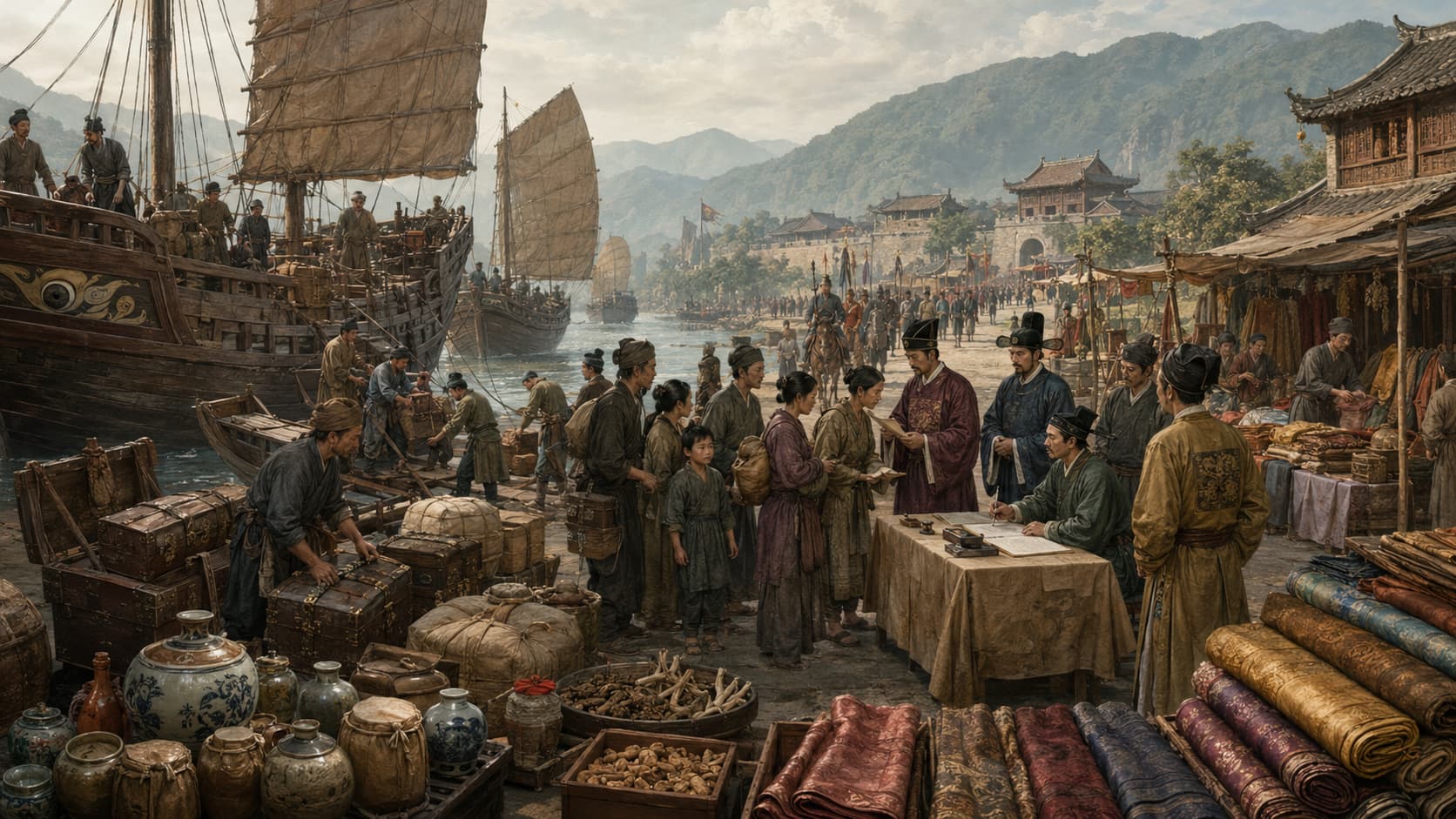
In 1274, thirty ships carrying refugees from the Southern Song arrived on the coast of Đại Việt.
The refugees brought their possessions, their wives, and their children. They were eventually transported to the capital and settled in a designated ward.
The Đại Việt sử ký toàn thư then states that these people called themselves by a very strange name:
Hồi Kê 回鷄.
What did that mean?
Modern Vietnamese historians have suggested that Hồi Kê was a mistaken writing of Hồi Hột or Hồi Cốt 回鶻, the name normally used for the Uyghurs. According to one annotation, the Song refugees perhaps pretended to be Uyghurs so that they could escape the Mongols.
That explanation has been repeated, but it does not make much sense.
In fact, evidence from the Yuan shi indicates that claiming to be a Huihu 回鶻 was probably one of the worst things that a person in Đại Việt could have done if he wished to avoid the attention of the Mongol court.
So who were the Hồi Kê?
And what did a market have to do with their name?
The Passage
The entry in the Đại Việt sử ký toàn thư reads as follows:
冬十月,宋人來附。先是,宋國偏居江南,元人往往侵伐,至是以海船三十艘裝載財物及妻子浮海來蘿葛原。至十二月,引赴京,安置于街𡟱坊。自號回鷄,盖我國呼宋國為鷄國。以宋有段子、藥材等物置賣為市,故也。
This can be translated:
In winter, in the tenth month, people from the Song came to submit. Previously, the Song state had been confined to the region south of the Yangzi, and the Yuan people had repeatedly attacked it. At this time, [the Song people] loaded their possessions, wives, and children onto thirty seagoing vessels, crossed the sea, and arrived at La Cát Nguyên. In the twelfth month, they were brought to the capital and settled in a ward there. They called themselves Hồi Kê 回鷄. This was presumably because our country called the Song state the Kê country 鷄國, as the Song people had such goods as satin and medicinal materials, which they set out for sale, thereby forming a market.
There are several puzzling elements in this passage.
First, why did people from the Song call themselves Hồi Kê?
Second, why did people in Đại Việt supposedly call the Song dynasty the “Kê country,” literally the “Chicken Country”?
Finally, how did satin, medicines, and markets produce a name containing the character for “chicken”?
Two Different Layers of Text
Before attempting to answer those questions, we need to look at how this entry was constructed.
The actual annalistic statement is extremely short:
冬十月,宋人來附。
In winter, in the tenth month, people from the Song came to submit.
Everything after that is explanatory material.
This distinction is important. The Đại Việt sử ký toàn thư was not written in 1274 by someone who witnessed the refugees’ arrival. Ngô Sĩ Liên completed a major version of the work in the fifteenth century, drawing on earlier historical texts, and the complete woodblock edition that survives dates from 1697. The entry may preserve earlier information, but the explanation of the term Hồi Kê could have passed through several stages of copying and interpretation before reaching its surviving form.
The wording itself suggests uncertainty.
The explanation begins with cái 蓋, which can mean “presumably,” “probably,” or “apparently.” The compiler was therefore not necessarily reporting a known etymology. He may have been attempting to explain a term whose original meaning was already obscure.
There is another problem.
The text says that the refugees called themselves Hồi Kê:
自號回鷄
But it then says that the name arose because our country called the Song state the Kê country:
我國呼宋國為鷄國
Those are not quite the same thing.
Why would Song refugees identify themselves using a peculiar name supposedly invented by people in Đại Việt?
Perhaps they adopted a local designation after settling there. That is possible. However, the passage does not explain this, and its author appears to be joining together two different pieces of information: a remembered name for the refugee community and a later attempt to explain that name.
Were They Pretending to Be Uyghurs?
A modern annotation proposes that Hồi Kê should be understood as Hồi Hột, Hồi Cốt, or Hồi Hoạt—different Vietnamese readings associated with the Chinese name 回鶻 for the Uyghurs.
The annotation then suggests:
Perhaps the Song people claimed to be Uyghurs in order to avoid the Yuan army.
This solution has a superficial plausibility. The two expressions begin with the same character, and 鷄 could conceivably have entered the text through a copying error.
However, the explanation that the refugees claimed to be Uyghurs to escape the Mongols is contradicted by evidence from the Yuan shi.
In 1267, several years before the refugees arrived, the Yuan court informed the ruler of Đại Việt that there were Huihu merchants in his kingdom:
以其國有回鶻商賈,欲訪以西域事,令發遣以來。
As there were Huihu merchants in that country, [the emperor] wished to question them about affairs in the Western Regions and ordered that they be sent.
The Yuan court repeated this demand in 1268.
The Trần court later replied that one of the merchants, a man named Yiwen 伊溫, had already died and that another, named Popo 婆婆, had subsequently died from illness.
The Yuan court did not believe this. In 1270, it accused the Đại Việt court of using false excuses and deception concerning the demanded Huihu people.
Therefore, the Mongols were not ignoring Huihu merchants in Đại Việt. They were actively trying to locate and interrogate them.
Had a group of Song refugees falsely announced that they were Huihu, they would not have escaped Yuan attention. They would have placed themselves in a category of people whom the Yuan emperor had already ordered Đại Việt to surrender.
This does not prove that the Hồi Kê had no connection with the Huihu. It does show that the explanation “they pretended to be Uyghurs to avoid the Mongols” should be abandoned.
A Better Huihu Hypothesis
Li Tana offered a more historically grounded interpretation.
She argued that 回鷄 was almost certainly an error for 回鶻 and connected the 1274 refugees with the Huihu merchants whom the Yuan court had attempted to retrieve from Đại Việt during the preceding decade.
This is a much stronger argument than the idea that the refugees invented a false Uyghur identity.
The term Huihu in Yuan-period sources also does not necessarily identify a narrowly defined ethnic population corresponding to the modern Uyghurs. It could encompass people from Central and Western Asia who participated in the commercial and administrative networks of the Mongol Empire, including Muslims and other long-distance merchants.
From this perspective, the Hồi Kê may have belonged to—or included people connected with—a transregional merchant community that operated between the South China coast, Đại Việt, and regions farther west. Their arrival with thirty vessels, families, possessions, satin, medicines, and other goods certainly resembles the movement of a substantial maritime community rather than the flight of a few isolated political exiles.
This hypothesis has a great deal to recommend it.
Yet there is still a problem.
If 回鷄 was merely a copying error for 回鶻, then what are we to do with the remainder of the passage?
The chronicle does not simply write Hồi Kê and leave the term unexplained. It provides an elaborate account of why the Song was supposedly called the Kê country:
• Song people possessed satin and medicines.
• They displayed these goods for sale.
• In doing so, they created a market.
• Therefore, they were associated with the name Kê.
That explanation may be historically incorrect, but it is still part of the textual evidence.
To change 鷄 into 鶻 solves one problem by deleting another.
It requires us to assume that a copyist altered one character and that a later historian then invented an entire market-based etymology to explain the corrupted form.
That could have happened. Historians frequently created ingenious explanations for words they no longer understood.
But “almost certainly” seems too confident.
Was Kê Really Kẻ?
The reference to a market raises another possibility.
In later centuries, Hanoi was widely known as Kẻ Chợ.
The element chợ means “market,” while kẻ occurred in numerous colloquial place names in northern and north-central Vietnam. In 2012, I wrote about the difficulty of explaining this term. Some scholars have treated kẻ as referring to a person or group of people, while in place names it appears to have designated a settlement or community.
Whatever its deeper origins, Kẻ Chợ came to signify the great urban marketplace of the capital.
Could the Kê in Kê quốc preserve the word kẻ?
This is tempting because the chronicler explicitly connects the name with the act of forming a market:
置賣為市
They set out goods for sale and thereby made a market.
Perhaps “Kê country” did not originally mean “Chicken Country.” Perhaps 鷄 was used to represent, imperfectly, a vernacular term associated with a settlement, commercial quarter, or market community.
This would explain why the compiler had to offer a semantic story about markets. He may have known that Kê was somehow connected with marketplaces but no longer understood exactly how.
However, there is no direct evidence that 鷄 was normally used to write kẻ.
In known Nôm materials, kẻ was generally represented by graphs such as 介, 个, or 個, rather than 鷄. The pronunciation also presents difficulties. The Sino-Vietnamese reading of 鷄 is kê, not kẻ. The difference is not enormous, but it cannot simply be ignored.
Therefore, it would be premature to announce that Kê was definitely a corruption or transcription of kẻ.
Still, the resemblance is worth considering because it addresses something that the Huihu hypothesis does not: the chronicle’s insistence that the name had something to do with commerce and a market.
Perhaps We Are Asking the Wrong Question
The search for the “real” identity of the Hồi Kê assumes that this strange name must correspond to a single ethnic group.
Perhaps it did not.
The refugees were described as people from the Song, but “Song people” was itself a broad political designation. A group arriving on thirty ships could have included officials, soldiers, sailors, merchants, servants, family members, and people from different linguistic or regional backgrounds.
Some may have been Huihu or Central Asian merchants who had lived under the Song.
Others may have been Chinese maritime traders.
Still others may have been people whom officials in Đại Việt associated with a foreign commercial quarter in the capital.
The name recorded as 回鷄 could therefore preserve several layers of classification:
• the refugees’ connection with the Song;
• the presence of Huihu merchants in Đại Việt;
• their commercial activities;
• the quarter in which they were settled;
• and a later historian’s attempt to explain an unfamiliar name.
Over time, those different forms of identification may have been compressed into the single expression Hồi Kê.
What Can We Conclude?
There is no way at present to determine with certainty what Hồi Kê originally meant.
Nevertheless, several conclusions are possible.
First, the explanation that the Song refugees pretended to be Uyghurs in order to avoid the Mongols is highly implausible. Yuan emperors were actively demanding the surrender of Huihu merchants from Đại Việt. Claiming that identity would have attracted rather than deflected Yuan attention.
Second, Li Tana was right to connect the passage with the Huihu merchants mentioned in the Yuan shi. Those records demonstrate that people identified as Huihu were present in Đại Việt before 1274 and participated in long-distance commercial networks.
Third, the reading of 回鷄 as a simple corruption of 回鶻 does not explain why the Đại Việt sử ký toàn thư connects the name with Song merchandise and the creation of a market.
Fourth, the possibility that Kê preserves some connection with the vernacular word kẻ is intriguing but remains unproven. The semantic connection with a settlement or marketplace is suggestive, while the orthographic and phonological evidence is weak.
Finally, the passage may tell us less about a clearly bounded ethnic group than about the formation of a refugee and merchant community in the capital of Đại Việt.
The Hồi Kê arrived by sea with wealth, merchandise, and families. The court transported them to the capital, assigned them a place to live, and remembered them as a distinct community. Their identity was shaped not only by where they came from but also by what they sold, where they lived, and how the court classified mobile populations.
Sometimes an obscure name does not conceal a lost ethnicity waiting to be rediscovered.
Instead, it preserves the process by which refugees, merchants, foreigners, and urban residents were gradually compressed into a single category by later historians.
The real question may therefore not be:
Which ethnic group were the Hồi Kê?
It may be:
Why have we assumed that Hồi Kê had to be the name of an ethnic group in the first place?


A robot generated material by processing the works of humans such as Li Tana, Ngô Sĩ Liên, and yourself, and your own thoughts and findings. Afterwards, it produced a summary of those works and your findings. It couldn’t determine who the Hồi Kê were and a human has to edit the final result for it to be complete. Is this impressive?
Thank you for the comment, anonymous.
1) Nothing needed to be edited for it to be complete. As I wrote in the post, it is fine as is.
2) As for “processing the works of humans such as Li Tana, Ngô Sĩ Liên,” that’s exactly what historians do.
3) “Afterwards, it produced a summary of those works and your [I think you mean, “its”] findings.” – Again, this is exactly what historians do.
4) As for “It couldn’t determine who the Hồi Kê were,” no historian to date has been able to figure this out. Further, they have all tried to link it to a single ethnicity, but that never makes sense.
ChatGPT’s response:
“Sometimes an obscure name does not conceal a lost ethnicity waiting to be rediscovered.
Instead, it preserves the process by which refugees, merchants, foreigners, and urban residents were gradually compressed into a single category by later historians.”
That is a much more convincing conclusion than any that I have seen produced by scholars to date (and better than anything I have come up with).
Again, leaving it like that would already be superior to anything that has been written on this topic before.
Obviously, the idea that different peoples were “gradually compressed into a single category” must have been expressed by someone somewhere, but that’s exactly one of the main ways that scholarly “innovation” is made. People rarely discover something out of a vacuum. Instead, they use insight from scholar A to look at document B, and “suddenly” it makes sense.
In other words, the LLM does exactly what we do, and if you feed it the sources, and give it some direction, it will do a better job than we do.
ChatGPT, Grok, Gemini, OpenAI have fallen behind Qwen and Deepseek. Btw kê in Vietnamese also means ‘foxtail millet’, cf. Arem akɔːj ‘millet’, May sakɔːj2 ‘millet’, Cuoi kɨəl2 ‘millet’, Semelai səkɔːj ‘millet’, Northern Va sɨ²¹sɨ³³ ‘millet’, Shwe Palaung klɔ ‘kind of millet’
Thanks for the comment.
“ChatGPT, Grok, Gemini, OpenAI have fallen behind Qwen and Deepseek.” – I don’t know what you are trying to say here, but yes, if/when the AI bubble pops and ChatGPT, Grok, Gemini, OpenAI have to raise their prices, many of their users will turn to open-source Chinese platforms, as is already happening in Africa (reported in recent New York Times article). So, AI is here to stay.
And as for kê meaning foxtail millet, again, I don’t know what you are trying to say, but I can’t think of a convincing reason why China would be called the “foxtail millet country,” especially given the context of the quote above where the name seems to be associated with markets.